Loading cart…
No products in the cart.

Original price was: $518.00.$259.00Current price is: $259.00.
A hand-painted study by Henry Bacon of the Parthenon frieze attributed to Phidias, translating carved marble into a museum quality oil on canvas.
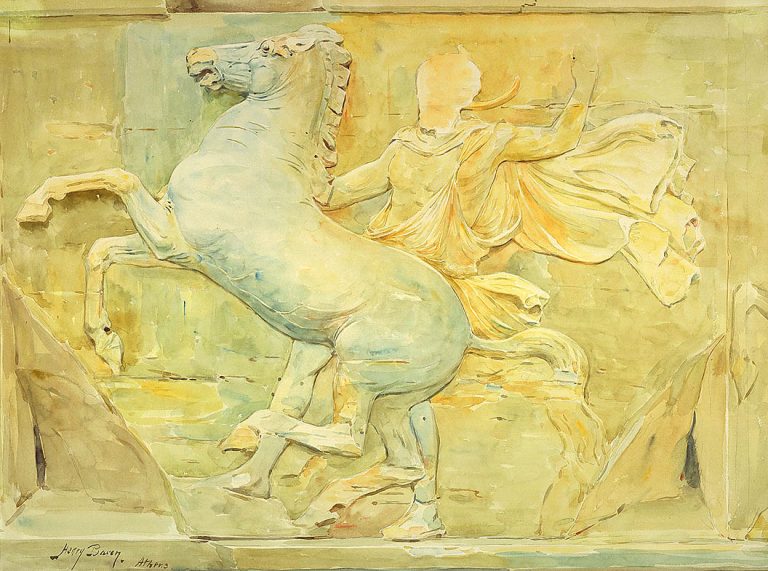
Look closely at the brushwork here and you can see how carefully the paint was built up to answer stone. The palette stays close to the tones of weathered marble, warm greys and pale ochres, with edges softened where the paint imitates the worn contour of ancient carving rather than the crisp line of drawing. Out of this handling the subject comes forward: a single metope from the Parthenon frieze, the sculptural program long attributed to Phidias and his workshop, rendered not as a diagram but as a living surface of light and shadow.
Bacon approached the relief the way a painter studies a model, not the way an archaeologist catalogues a fragment. The composition holds tightly to the carved panel itself, letting the viewer feel the compressed drama of figures caught mid-motion within the stone. Drapery folds and tensed musculature are rendered with a sculptural weight, the paint thickened in places to suggest the raised planes of the original carving and thinned elsewhere to let shadow pool in the deeper cuts. This is the record of an American painter abroad in the great tradition of artists who travelled to Greece and Rome to look hard at the ancient world and bring something of it home in their own medium.
What emerges is an unusual double subject, sculpture studied through the eye and hand of a painter, and it belongs to a moment when direct engagement with classical remains still shaped serious artistic training. The play of light across the carved surface, the way it catches an elbow or falls into a fold of cloth, becomes as much the subject as the mythological scene the frieze once told.
Our reproduction is a genuine oil painting reproduction, made by hand rather than printed, so the texture that carries so much of the meaning here survives intact. A trained artist works in oil on artist-grade canvas, matching the palette Bacon chose and preserving the visible brushwork and surface texture that give the panel its sculptural presence. The result is a museum quality reproduction meant to be seen up close, the way the original study rewards a long look rather than a glance.
What has kept this small, quiet painting worth returning to is exactly that tension between two mediums, stone and oil, each translating the other. Owning a hand-painted version of it means living with that translation on your own wall, a painted record of something carved more than two thousand years ago and still capable of holding a room.
Empty walls flatten a room. A classical artwork restores structure and visual hierarchy. One painting defines the space, anchors furniture, and establishes identity.
Worldwide shipping included. Each painting is produced to order and safely packed for international transport.
All payments are encrypted and processed through trusted payment providers.
Real brushwork, layered oil paint, and durable pigments on museum-quality canvas.
If the result does not meet expectations, return it for a full refund.


Your artwork is painted on premium cotton canvas, then shipped safely rolled in a rigid tube with extra blank canvas border — ready for stretching or framing locally.
Select a handcrafted frame and we’ll deliver your painting fully assembled, protected, and ready to hang.
For safe shipping, framing is available up to a maximum size. Larger sizes will automatically disable the frame option.


Choose “Stretched” to receive your canvas mounted on wooden stretcher bars — perfect if you’ll frame it later or display it as-is.
Gallery Wrap is a deeper, 1.5" style stretcher. The canvas wraps around the sides and is stapled on the back for a clean, modern, frameless look.
We ship with UPS, FedEx, or DHL straight to your door. You’ll receive a tracking number as soon as your order leaves our studio. Typical delivery is 5 to 7 days after dispatch; large, framed, or stretched pieces may take longer depending on the safest shipping route.


Unframed canvases are protected with a film, carefully rolled, and secured inside a rigid shipping tube.

Stretched, Gallery Wrapped, and Framed paintings are wrapped, cushioned with foam protection, and boxed for safe transit.