Loading cart…
No products in the cart.

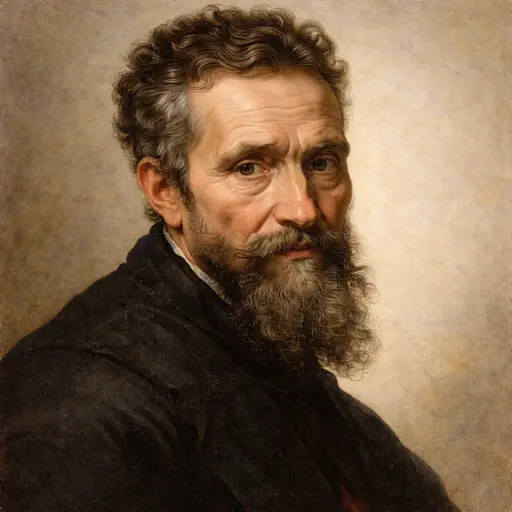
Italian painter · Renaissance
1475 – 1564
Michelangelo (1475 to 1564) painted the Sistine Chapel ceiling and The Last Judgment, though he always called himself a sculptor. Explore his famous paintings and order any of them hand-painted in oil.
Renaissance
Michelangelo
Renaissance
Michelangelo
Renaissance
Michelangelo
Michelangelo Buonarroti was born in 1475 in Caprese, in Tuscany, trained in Domenico Ghirlandaio’s workshop in Florence and grew up in the household of Lorenzo de’ Medici. He thought of himself as a sculptor first: by 30 he had carved the Pietà and the David. Yet the works that made him the most famous painter in Europe were frescoes he never wanted to paint. Pope Julius II ordered him onto the scaffolding of the Sistine Chapel in 1508; twenty-five years later Pope Paul III sent him back for the altar wall. He spent his last decades designing the dome of St Peter’s, and died in Rome in 1564, at 88.
More than 300 figures across a vault forty metres long: the Creation, the Fall and the Flood down the centre, prophets and sibyls around the edges. He painted it standing on a scaffold he designed himself, not lying on his back. Sistine Chapel, Vatican. Read the story.
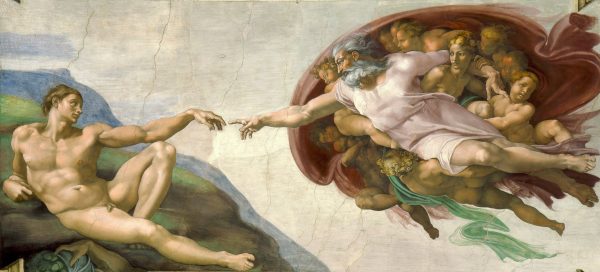
God reaches out from a cloud of angels and Adam lifts a heavy hand to meet him, the two fingers not quite touching. Perhaps the most reproduced image in the history of painting. Sistine Chapel, Vatican. Read the story.
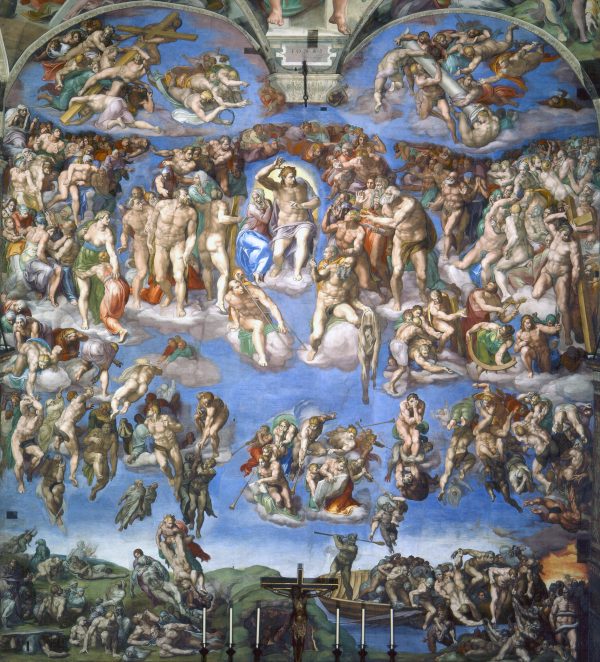
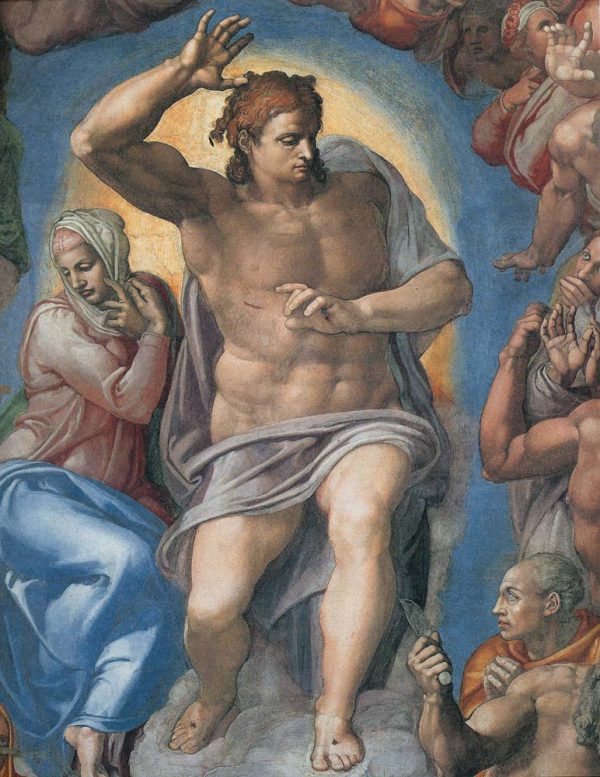
Christ raises his arm and the whole wall turns: the saved rise on the left, the damned fall on the right. The nudes caused such a scandal that another painter was later hired to add draperies. Michelangelo hid his own face in the flayed skin held by Saint Bartholomew. Sistine Chapel, Vatican. Read the story.
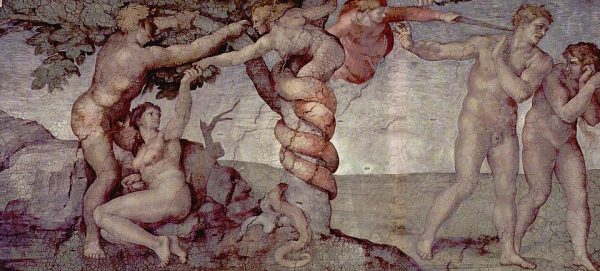
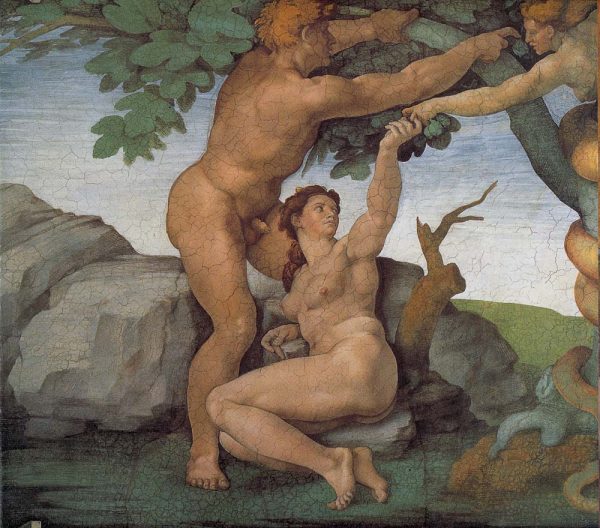
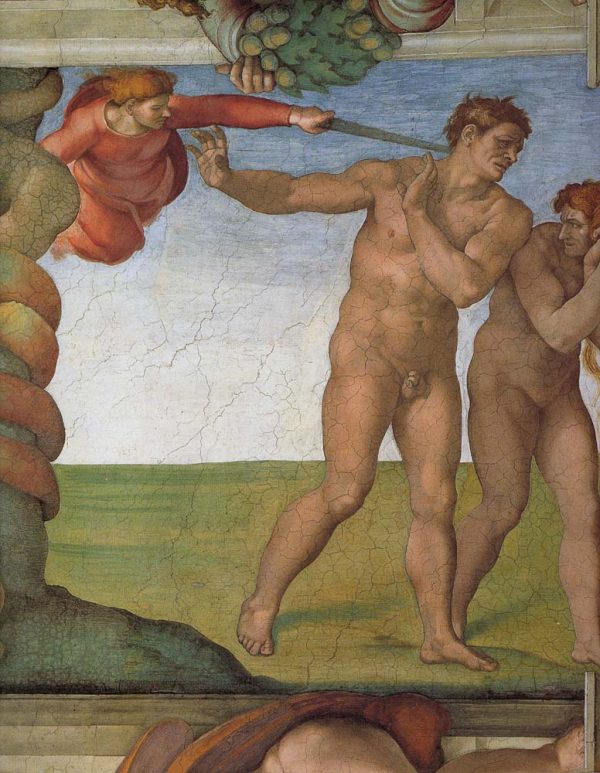
Two scenes in one panel: Eve takes the fruit from a serpent with a woman’s body, and an angel drives the couple out of the garden, suddenly old and ashamed. Sistine Chapel, Vatican. Read the story.
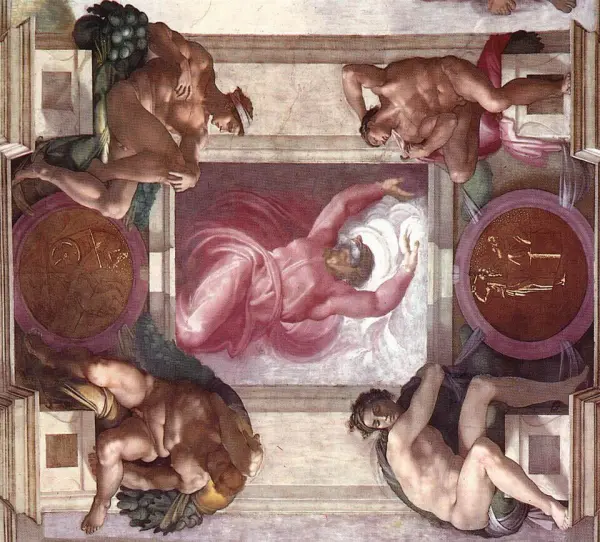
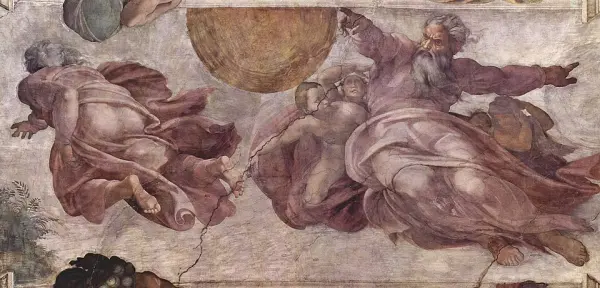
God twists through the void, pushing light and dark apart. The first day of Creation in the story, and one of the last panels Michelangelo painted, directly above the altar. Sistine Chapel, Vatican. Read the story.
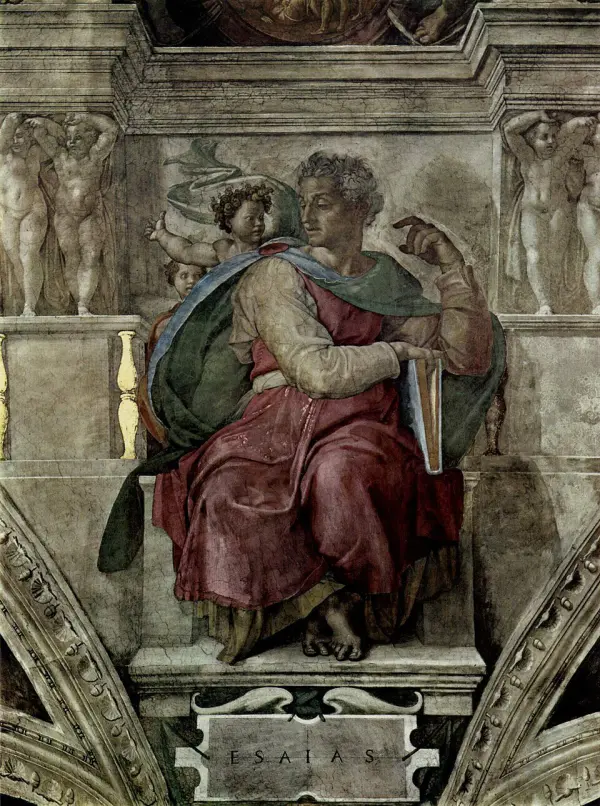
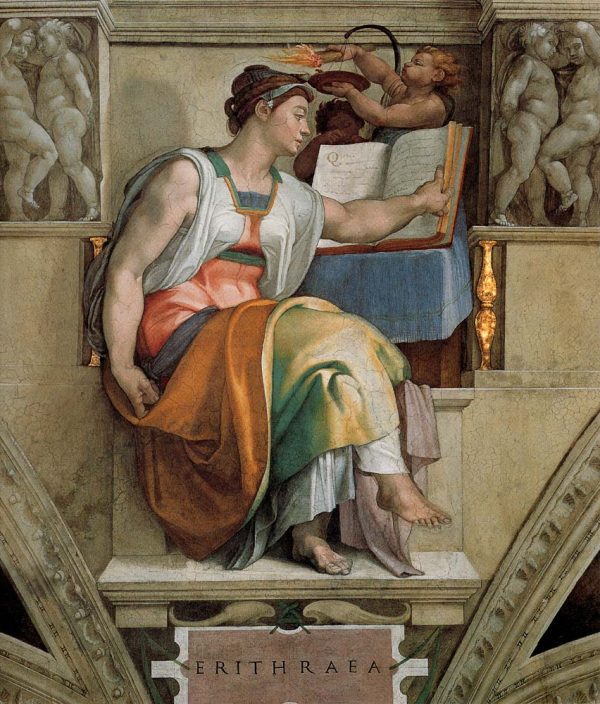
The prophet turns from his book as a child angel calls him, one of the seven prophets who sit around the ceiling. Sistine Chapel, Vatican. Read the story.
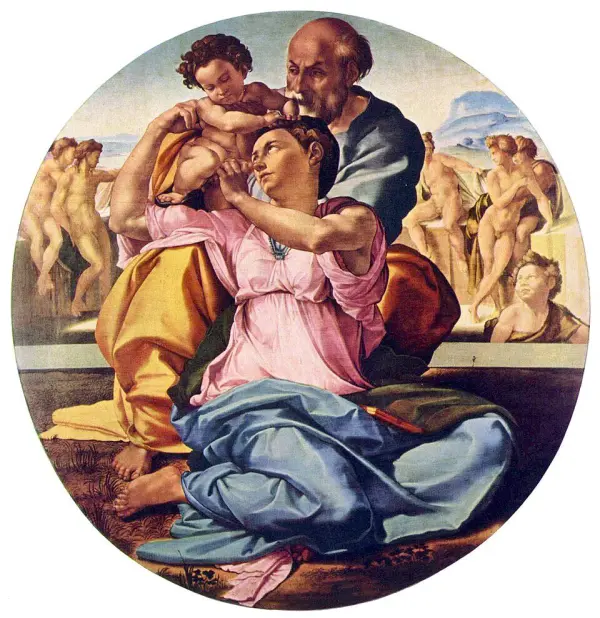
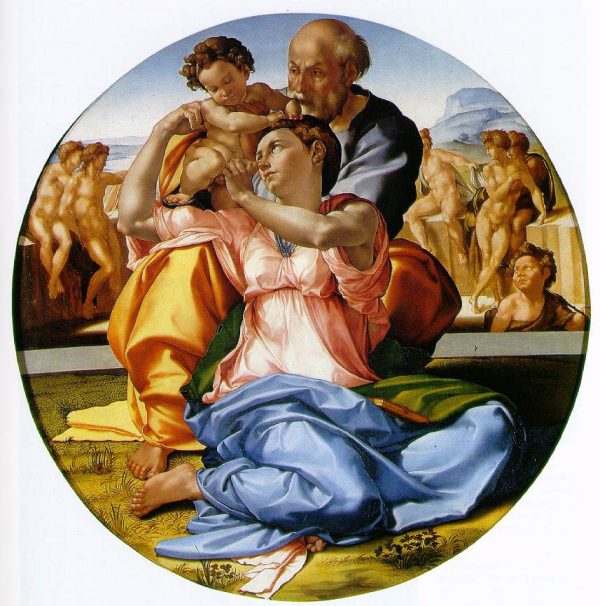
The Holy Family twisting together in a circle, with nude youths behind them. The only finished panel painting that is certainly by Michelangelo, still in its original carved frame. Uffizi, Florence. Read the story.
Saul is thrown to the ground by a blinding light from heaven while his escort scatters. One of the two frescoes of his old age in the Pope’s private chapel. Pauline Chapel, Vatican. Read the story.
Peter, crucified upside down, twists to stare straight at the viewer. Michelangelo’s last fresco, painted in his seventies. Pauline Chapel, Vatican. Read the story.
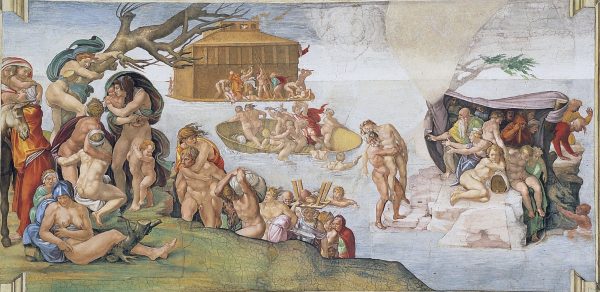
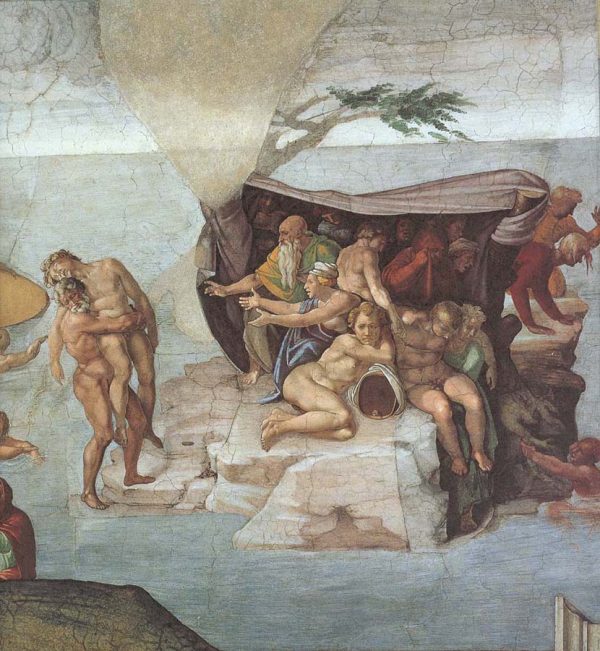
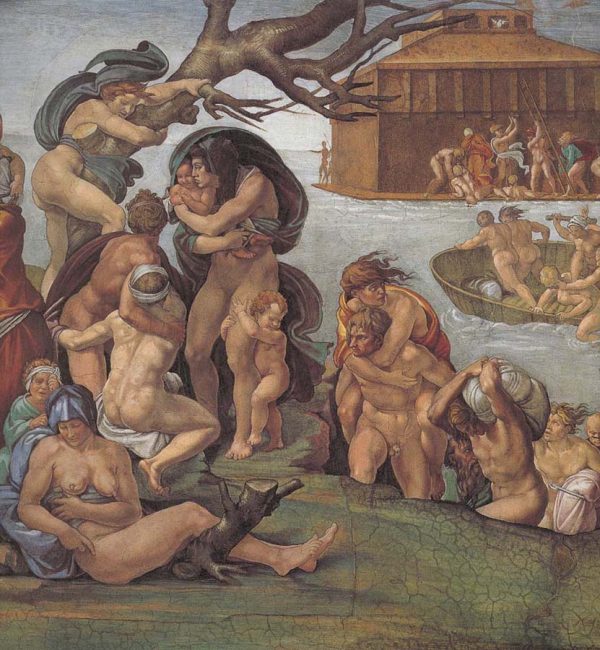
Families climb onto rocks and drag their belongings away from the rising water while the ark floats out of reach. The first of the big ceiling scenes he painted. Sistine Chapel, Vatican. Read the story.
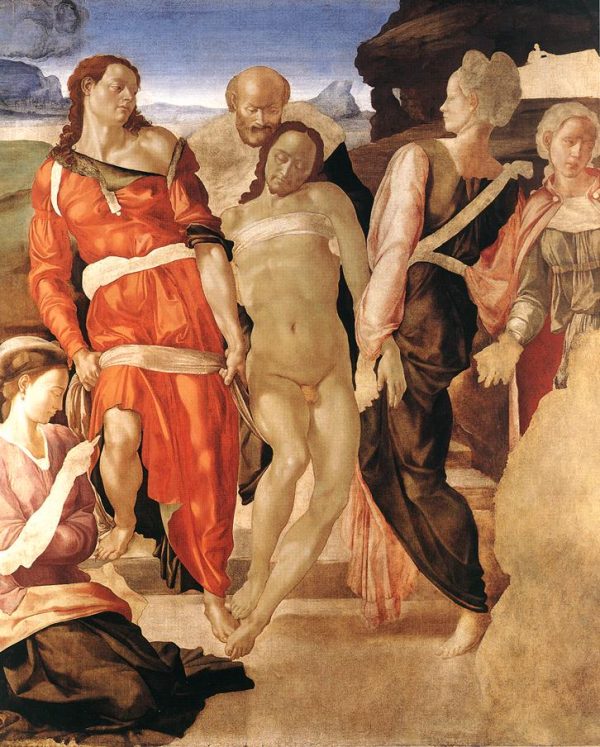
Christ’s body carried to the tomb, left unfinished when Michelangelo went back to Florence to carve the David. National Gallery, London.
Michelangelo painted like a sculptor. His figures are heavy, muscular and twisted in space, as if carved and then coloured, and he cared about the human body above everything else, landscape and setting almost not at all. On the Sistine ceiling he worked in true fresco, painting into fresh plaster one day’s patch at a time, and the cleaning finished in the 1990s revealed how bright his original colours were.
Michelangelo died in 1564, so his paintings are in the public domain. Every painting on this page can be ordered as a hand-painted oil reproduction on canvas, in the size you choose. For more of the stories, read our guide to Michelangelo’s famous paintings.
Michelangelo thought of himself as a sculptor, yet his Sistine Chapel frescoes are among the most famous paintings ever made. Our reproductions turn those ceiling and wall scenes into paintings you can hang at home.
The Creation of Adam is the most requested, followed by The Last Judgement and The Separation of Light from Darkness.
The Doni Tondo is the only finished panel painting generally accepted as his. It is round, so it makes a striking centrepiece.
The originals are painted on walls and ceilings, many metres wide. A reproduction is a scaled canvas, so choose a size that suits your wall rather than the original.
Quick answers for anyone choosing a Michelangelo reproduction.
The Sistine Chapel ceiling (1508-1512), with The Creation of Adam at its heart, and The Last Judgment (1536-1541) on the altar wall. Read the story of The Creation of Adam.
Our guide to Michelangelo's paintings and Leonardo vs Michelangelo are good places to start.
Yes. His works are centuries out of copyright, so anyone may paint copies of them.
No. A trained painter rebuilds the image with oil paint on artist canvas, preserving visible brushwork, layered colour and surface variation.
Yes. Choose a listed dimension or contact ByMuseum when your wall requires a custom size that keeps the painting’s original proportions.
Browse curated painting collections, compare art movements, or visit the complete painting shop.

Man Writing a Letter
Gabriel Metsu, c. 1664
The gallery list
Every painting is already 50% off. Join the list and we will send you an extra $15 code, plus first access to new collections.
No spam. Unsubscribe anytime. · Privacy Policy
Welcome
Your $15 code is on its way. Explore the gallery while you wait.