Loading cart…
No products in the cart.

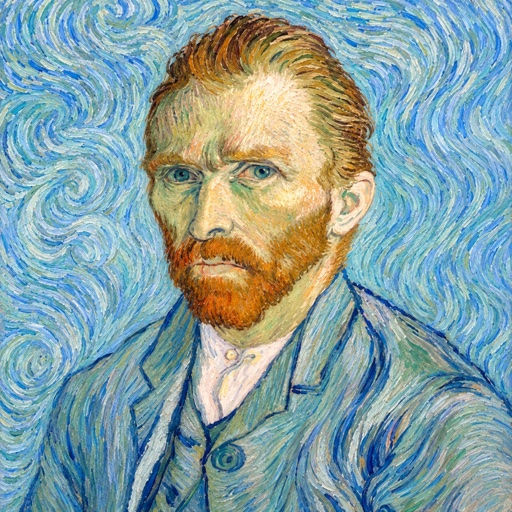
Dutch painter · Post-Impressionism
1853–1890
Vincent van Gogh (1853 to 1890) painted The Starry Night, Sunflowers and the cafés of Arles in a single decade. Explore his most famous paintings and order any of them hand-painted in oil.
Vincent van Gogh was born in 1853 in Zundert, in the south of the Netherlands. He worked for an art dealer, then as a teacher and a lay preacher, and only began to paint at 27. In the ten years that followed he made around 850 paintings, most of them in the last two and a half years of his life in the south of France. He moved to Paris in 1886, to Arles in 1888, spent a year in the asylum at Saint-Rémy, and died in Auvers-sur-Oise in July 1890, at 37. His brother Theo, an art dealer, paid for almost everything, and the hundreds of letters Vincent wrote him are the reason we know so much about how these paintings were made.
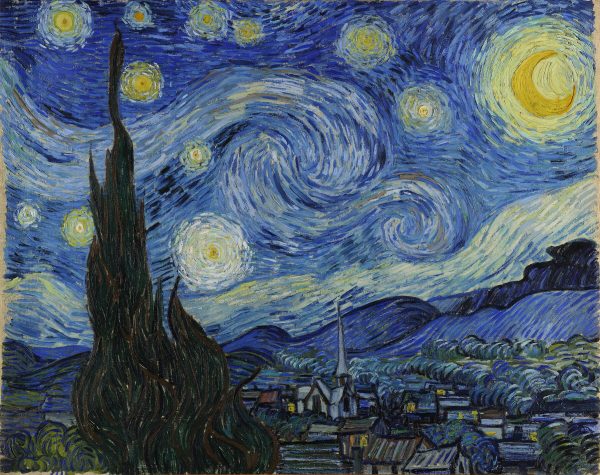
Painted in the asylum at Saint-Rémy from the view out of his window, with a sky of swirling light and a village he added from memory. Museum of Modern Art, New York. Read the story.
Painted in Arles to decorate the room he had ready for Paul Gauguin: yellow flowers, on a yellow table, against a yellow wall. National Gallery, London. Read the story.
His first starry sky, over a lit café on the Place du Forum in Arles, painted outdoors at night without a touch of black. Kröller-Müller Museum, Otterlo. Read the story.
His room in the Yellow House, painted in flat, bright colours that he said should suggest rest. He liked it so much that he painted it three times. Van Gogh Museum, Amsterdam. Read the story.
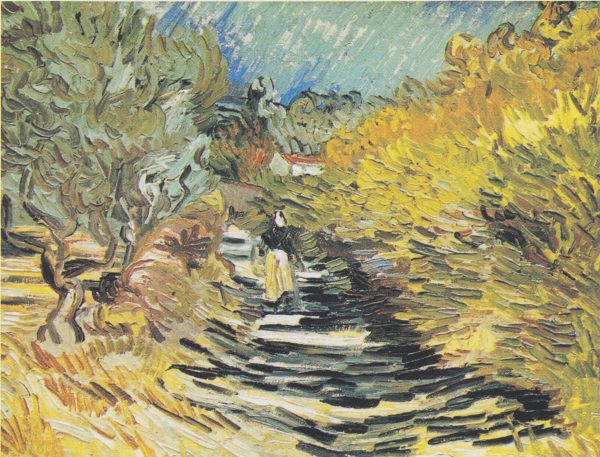
One of the first paintings he made in the asylum garden, a week after arriving. In 1987 it sold for $53.9 million, then the highest price ever paid for a painting. J. Paul Getty Museum, Los Angeles. Read the story.
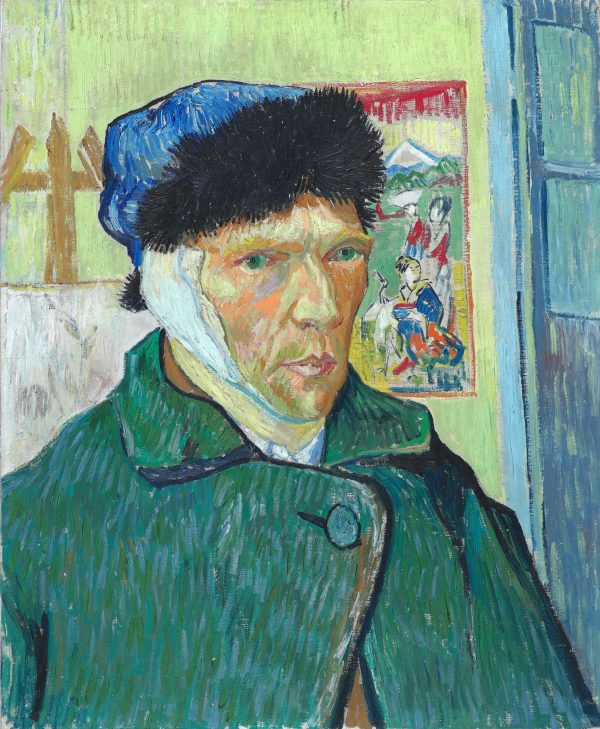
Painted a few weeks after he cut off part of his ear in December 1888, in a winter coat and fur cap, with a Japanese print behind him. The Courtauld, London. Read the story.
The inside of an all-night café in Arles, in blood red and green, where he said a man could ruin himself or go mad. Yale University Art Gallery, New Haven. Read the story.
A stormy sky, black birds and a path that ends in the wheat, painted in July 1890, weeks before he died. Van Gogh Museum, Amsterdam. Read the story.
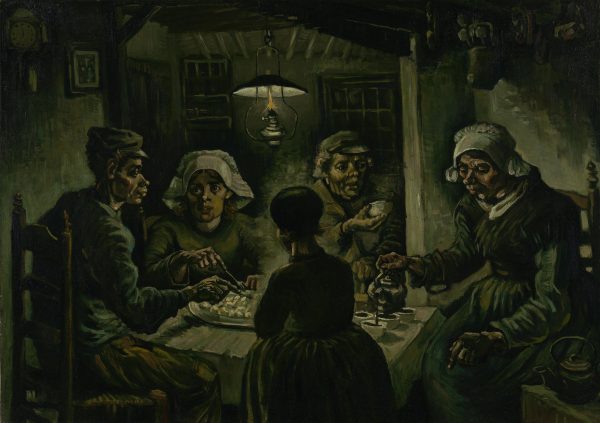
A peasant family eating by lamplight, in the dark browns of his Dutch years. He saw it as his first major work. Van Gogh Museum, Amsterdam. Read the story.
The doctor who looked after him in Auvers, leaning on his hand with a sprig of foxglove. In 1990 it sold for $82.5 million, a record at the time. Private collection. Read the story.
Workers harvesting grapes under a low red sun. It is the best documented painting he sold in his lifetime, bought in 1890 by the artist Anna Boch. Pushkin Museum, Moscow. Read the story.
A village church that seems to bend under a deep blue sky, from his last weeks in Auvers. Musée d’Orsay, Paris. Read the story.
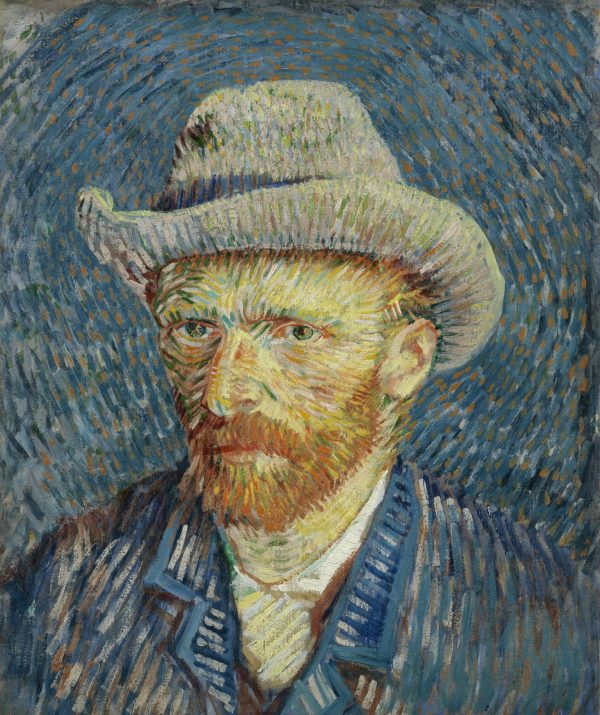
He laid the paint on thick, often straight from the tube, so you can follow every stroke. He set complementary colours side by side, yellow against blue and red against green, to make each one louder, and he learned flat colour and bold outlines from the Japanese prints he collected in Paris. Swirls, dashes and dots give his skies, fields and cypresses their movement. That surface is exactly what a print cannot copy and a hand-painted reproduction can.
Van Gogh died in 1890, so all of his paintings are in the public domain. That is why Van Gogh reproductions are everywhere, and why the quality varies so much. Look at the surface first. He loaded his brush and left thick ridges of paint, so a flat Van Gogh has lost what made him different. A print can copy his colours, but it cannot copy those ridges.
Every painting on this page can be ordered as a hand-painted oil reproduction, painted on canvas by our artists in the size you choose. You can see finished canvases next to the originals on our samples page. Before you buy from anyone, read how to choose an oil painting reproduction.
Van Gogh painted around 860 oil paintings in just ten years, and the thick, swirling paint is what people fall for. That texture is exactly what a hand-painted reproduction keeps and a print loses.
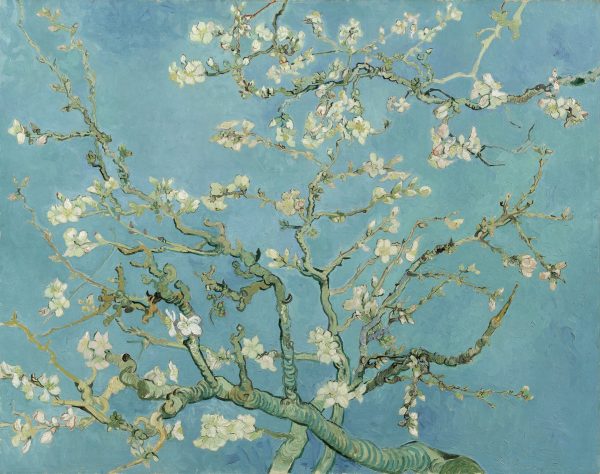
Most collectors begin with The Starry Night, Café Terrace at Night, Almond Blossom and Sunflowers.
Blossom branches and flowers, like Almond Blossom or Vase with Peonies, suit bedrooms and dining rooms. Night scenes, like Starry Night Over the Rhône, make a bolder living-room piece.
Van Gogh worked on modest canvases: The Starry Night is only 74 x 92 cm. A size near the original keeps the brushstrokes in proportion, while a larger canvas turns the swirls into a statement wall.
Quick answers for anyone choosing a Vincent Van Gogh reproduction.
The Starry Night (1889), Sunflowers (1888), Café Terrace at Night (1888), The Bedroom in Arles (1888) and Almond Blossom (1890). All five can be ordered here as hand-painted reproductions.
Yes. Our guide to Van Gogh's paintings and the stories of The Starry Night, Café Terrace at Night and Sunflowers explain what you are looking at.
Yes. Van Gogh died in 1890 and his paintings are in the public domain. Ours are new paintings sold as reproductions; the originals stay in their museums.
No. A trained painter rebuilds the image with oil paint on artist canvas, preserving visible brushwork, layered colour and surface variation.
Yes. Choose a listed dimension or contact ByMuseum when your wall requires a custom size that keeps the painting’s original proportions.
Browse curated painting collections, compare art movements, or visit the complete painting shop.

Man Writing a Letter
Gabriel Metsu, c. 1664
The gallery list
Every painting is already 50% off. Join the list and we will send you an extra $15 code, plus first access to new collections.
No spam. Unsubscribe anytime. · Privacy Policy
Welcome
Your $15 code is on its way. Explore the gallery while you wait.