Loading cart…
No products in the cart.

Original price was: $518.00.$259.00Current price is: $259.00.
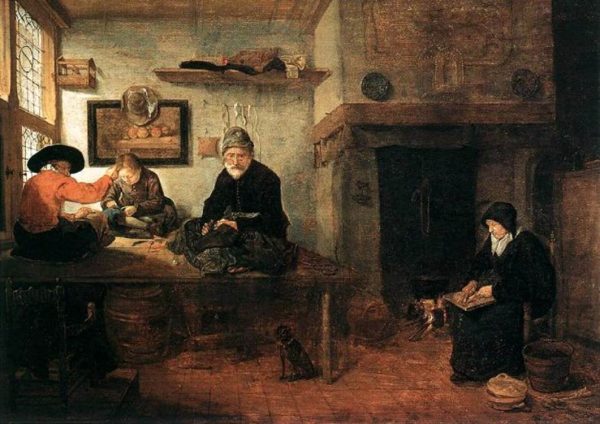
Interior of a Tailor’s Shop by Quiringh van Brekelenkam brings a quiet study of light and labour to your wall, hand-painted in oil with the tonal depth of the original.
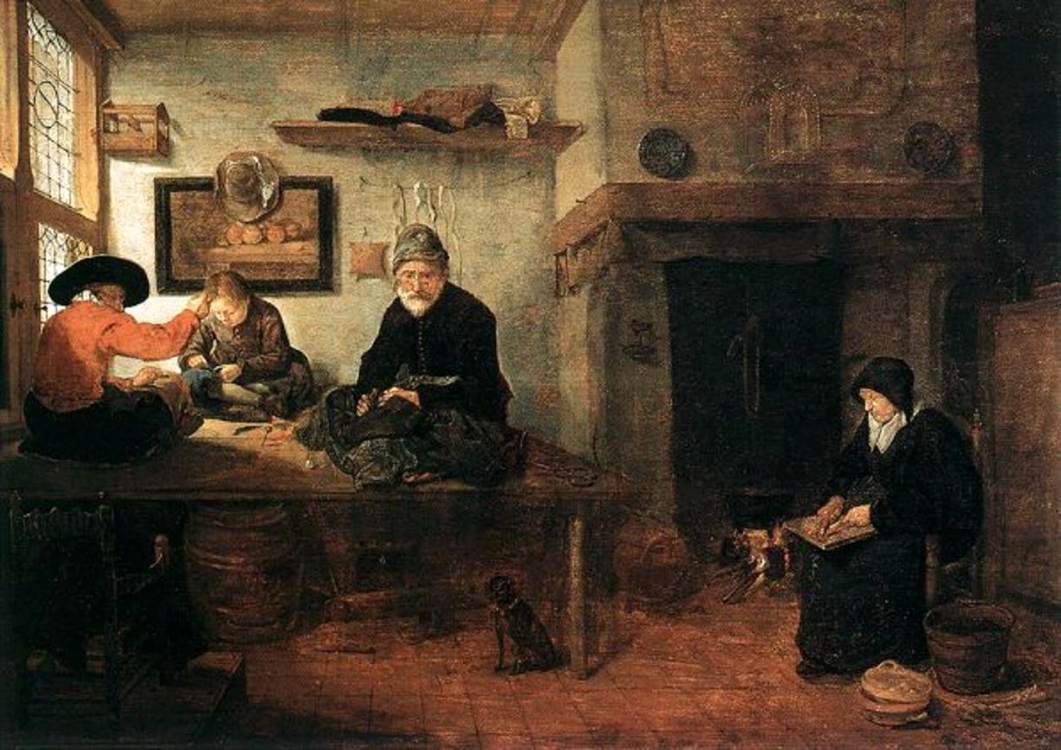
A tailor bends over his worktable, needle and cloth caught mid-motion, while an apprentice or customer occupies the middle distance, and the modest room around them fills with the quiet particulars of daily labour. This kind of scene, the working interior rather than the grand hall or portrait sitting, drew Quiringh van Brekelenkam again and again, and it held his attention because it let him study how ordinary light falls across ordinary tasks.
The composition is built on careful visual pacing: a focal area of hands and fabric anchors the eye, while secondary passages, a window, a shelf, a doorway, extend the story outward without competing for attention. Brekelenkam shapes mood through tonal range as much as through subject, letting warm chromatic accents surface against a controlled field of browns and greys. Edges are judged rather than sharpened uniformly; some dissolve into shadow, others hold firm where the narrative needs clarity. This balance of restraint and incident places the painting within the broader Dutch interest in genre scenes during the mid seventeenth century, when painters increasingly found subject matter in trades, households, and the textures of everyday work rather than in myth or allegory.
Repeated shapes and measured intervals tie the principal figures to their surroundings, and the longer one looks, the more the smaller passages, a fold of cloth, a glint on a tool, contribute to the overall continuity of the image. This is a painting that rewards patience, and that quality is exactly what a hand-painted oil painting reproduction is built to carry forward. ByMuseum artists work from the original palette and tonal structure, applying layered oil colour by hand so that the worked edges, the responsive brushwork, and the surface texture of the composition survive the transition to a new canvas. Each piece is hand-painted by a professional artist, not printed, which means the raised texture of impasto and the subtle variation between one brushstroke and the next remain visible on the finished surface.
What is carried across is not just the image but the physical logic behind it: the way pigment sits differently in shadow than in light, the way a single accent of colour carries weight against a muted field. That fidelity is what separates a painted object from a mechanical copy, and it is why the interior still feels considered rather than merely reproduced.
Empty walls flatten a room. A classical artwork restores structure and visual hierarchy. One painting defines the space, anchors furniture, and establishes identity.
Worldwide shipping included. Each painting is produced to order and safely packed for international transport.
All payments are encrypted and processed through trusted payment providers.
Real brushwork, layered oil paint, and durable pigments on museum-quality canvas.
If the result does not meet expectations, return it for a full refund.


Your artwork is painted on premium cotton canvas, then shipped safely rolled in a rigid tube with extra blank canvas border — ready for stretching or framing locally.
Select a handcrafted frame and we’ll deliver your painting fully assembled, protected, and ready to hang.
For safe shipping, framing is available up to a maximum size. Larger sizes will automatically disable the frame option.


Choose “Stretched” to receive your canvas mounted on wooden stretcher bars — perfect if you’ll frame it later or display it as-is.
Gallery Wrap is a deeper, 1.5" style stretcher. The canvas wraps around the sides and is stapled on the back for a clean, modern, frameless look.
We ship with UPS, FedEx, or DHL straight to your door. You’ll receive a tracking number as soon as your order leaves our studio. Typical delivery is 5 to 7 days after dispatch; large, framed, or stretched pieces may take longer depending on the safest shipping route.


Unframed canvases are protected with a film, carefully rolled, and secured inside a rigid shipping tube.

Stretched, Gallery Wrapped, and Framed paintings are wrapped, cushioned with foam protection, and boxed for safe transit.
Baroque
Quiringh Van Brekelenkam