Loading cart…
No products in the cart.

Original price was: $518.00.$259.00Current price is: $259.00.
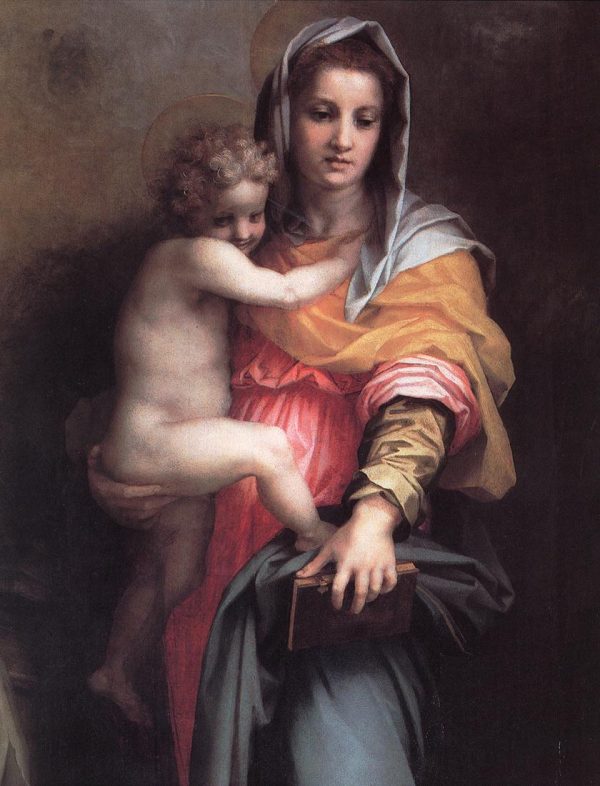
Own the close, luminous detail of Madonna of the Harpies by Andrea del Sarto, hand-painted in oil on canvas with the tonal subtlety of the original.
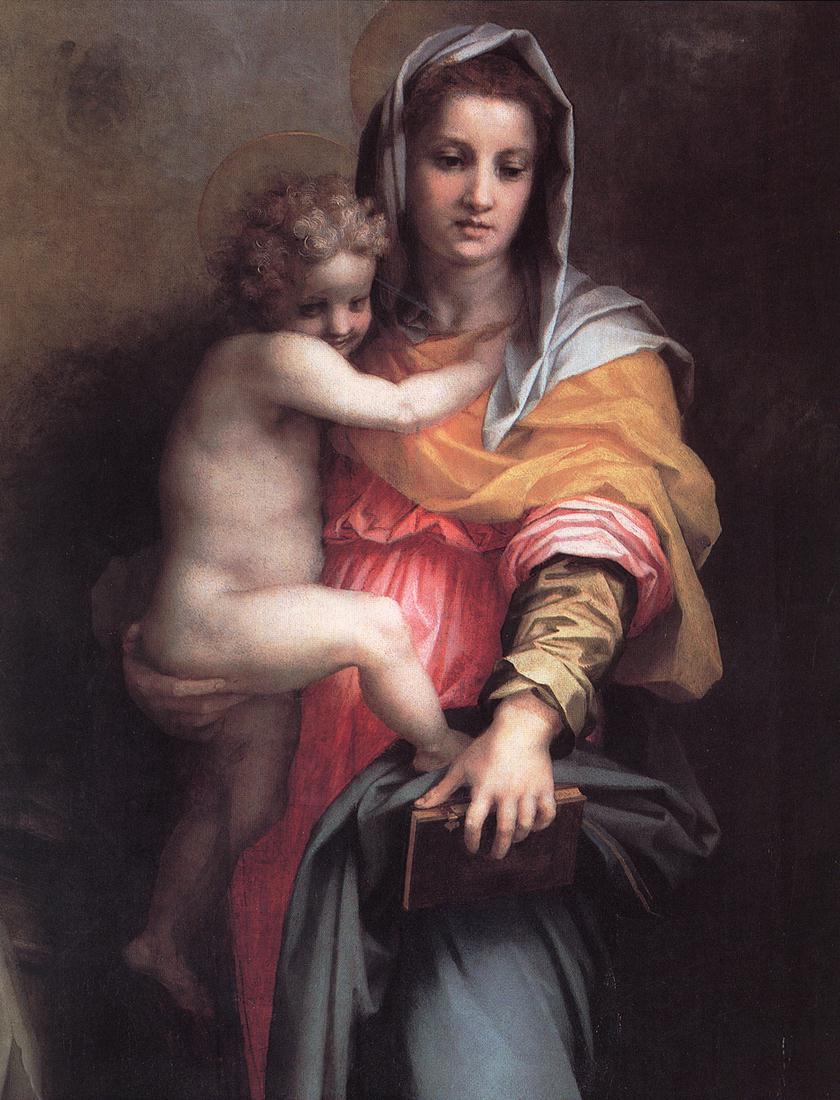
This detail commands the wall the way its full altarpiece once commanded a chapel: the figures rise close to life size, and the cropped view pulls the Virgin and Child forward until the eye has nowhere to rest but on them. Standing before it, the proportions do the work that distance usually does in a large altarpiece, drawing the viewer near rather than back.
The subject is the Virgin standing on a pedestal carved with the small monstrous figures, part sphinx, part harpy, that give the painting its name, the Christ Child balanced on her arm and two young saints flanking the group below. Andrea del Sarto builds the composition on a quiet pyramid, the Madonna at its apex, and lets soft transitions of light across her face and drapery carry the emotional weight rather than any dramatic gesture. This is Florentine painting at its most assured, made in the second decade of the sixteenth century, when Sarto had absorbed the lessons of Michelangelo and Fra Bartolomeo and was working toward the fluent, almost effortless naturalism that later painters, Vasari among them, singled out for praise.
What holds the eye longest is the handling of color and edge: the golds and deep reds are set against passages of near-monochrome shadow, and the modeling of flesh moves from light to dark with barely a visible seam, an effect Sarto achieved through patient glazing rather than sharp contour. The intervals between the larger masses, robe against pedestal, face against halo, are as carefully judged as the figures themselves, which is part of why the picture rewards slow looking rather than a single glance.
Every ByMuseum canvas of this detail is hand-painted by a professional artist working in oil, matching Sarto palette of warm gold and shadowed red and preserving the visible brushwork and layered surface of the original. This oil painting reproduction is built up in real paint on canvas, not printed, so the texture of the impasto and the subtle variation between one brushstroke and the next remain part of the object itself. Living with a hand-painted version means the picture keeps changing slightly with the light in the room, the way the original does in its chapel, and the small carved harpies at the base tend to be the detail a viewer notices only after weeks of walking past.
Empty walls flatten a room. A classical artwork restores structure and visual hierarchy. One painting defines the space, anchors furniture, and establishes identity.
Worldwide shipping included. Each painting is produced to order and safely packed for international transport.
All payments are encrypted and processed through trusted payment providers.
Real brushwork, layered oil paint, and durable pigments on museum-quality canvas.
If the result does not meet expectations, return it for a full refund.


Your artwork is painted on premium cotton canvas, then shipped safely rolled in a rigid tube with extra blank canvas border — ready for stretching or framing locally.
Select a handcrafted frame and we’ll deliver your painting fully assembled, protected, and ready to hang.
For safe shipping, framing is available up to a maximum size. Larger sizes will automatically disable the frame option.


Choose “Stretched” to receive your canvas mounted on wooden stretcher bars — perfect if you’ll frame it later or display it as-is.
Gallery Wrap is a deeper, 1.5" style stretcher. The canvas wraps around the sides and is stapled on the back for a clean, modern, frameless look.
We ship with UPS, FedEx, or DHL straight to your door. You’ll receive a tracking number as soon as your order leaves our studio. Typical delivery is 5 to 7 days after dispatch; large, framed, or stretched pieces may take longer depending on the safest shipping route.


Unframed canvases are protected with a film, carefully rolled, and secured inside a rigid shipping tube.

Stretched, Gallery Wrapped, and Framed paintings are wrapped, cushioned with foam protection, and boxed for safe transit.
Renaissance
Andrea del Sarto