Loading cart…
No products in the cart.

Original price was: $518.00.$259.00Current price is: $259.00.
Punishment of the Gamblers by Andrea del Sarto, recreated as a hand-painted oil reproduction with the layered brushwork and quiet drama of the original.
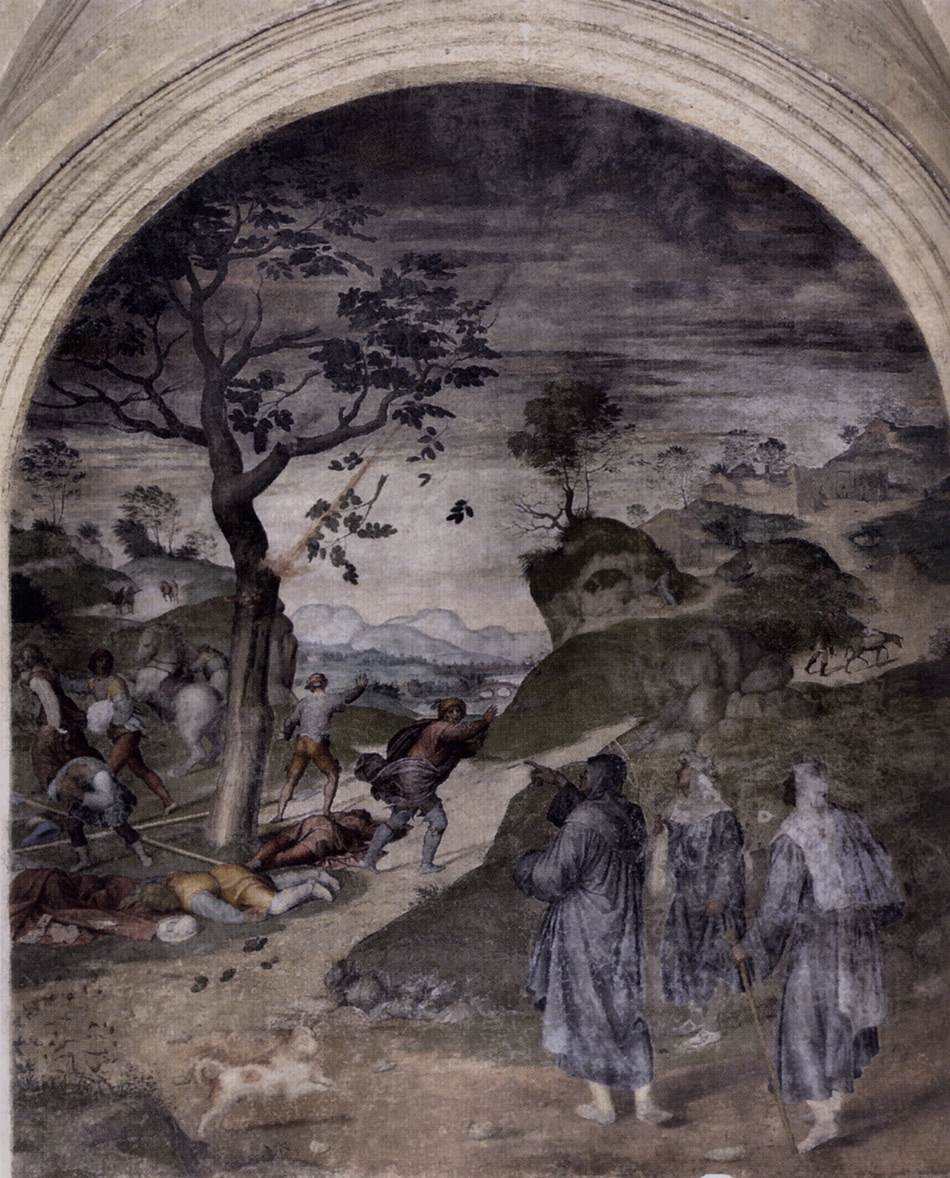
Around the mid 1520s, in the years when fresco commissions kept him occupied across Florentine convents and civic halls, Andrea del Sarto turned to a subject rarely painted with such moral weight: men caught in the grip of dice and cards, and the retribution that follows. The picture belongs to a period when Sarto, already established as a painter of quiet, humane grace, was pushing his figures toward greater dramatic tension without abandoning the fluid, closely observed naturalism that had made his reputation.
The composition gathers its figures into a tight, almost theatrical cluster, gamblers caught mid gesture as violence and consequence erupt among them. Light falls unevenly across the group, catching a raised arm here, a turned face there, while other passages sink into shadow, and this contrast of illumination does much of the storytelling. Sarto builds the scene through overlapping poses and controlled diagonals, so that the eye moves from the central altercation outward to onlookers whose stillness sharpens the sense of disorder at the centre.
The palette favours warm flesh tones set against muted drapery, a restraint that keeps the eye on gesture and expression rather than on decorative colour. This is characteristic of Sarto at his most assured, when sfumato modelling and a sculptural sense of anatomy combine to give even a scene of chaos a settled, considered structure. A hand-painted oil painting reproduction of this work is built the same way the original was, layer by layer in real pigment, so that the transitions of light across skin and cloth keep their softness rather than flattening into a single printed tone. Each canvas is painted individually by a trained artist working from the original palette, with visible brushwork and the texture of raised impasto left intact, producing an object with genuine surface depth rather than a mechanically produced copy.
Hung in a study, a library, or any room that takes reading and reflection seriously, the painting rewards steady, indirect light, the kind that lets its shadows stay dark without losing the modelling within them. Its drama suits a wall meant to be looked at rather than passed, somewhere the eye can return to the same gesture and notice something new each time.
Empty walls flatten a room. A classical artwork restores structure and visual hierarchy. One painting defines the space, anchors furniture, and establishes identity.
Worldwide shipping included. Each painting is produced to order and safely packed for international transport.
All payments are encrypted and processed through trusted payment providers.
Real brushwork, layered oil paint, and durable pigments on museum-quality canvas.
If the result does not meet expectations, return it for a full refund.


Your artwork is painted on premium cotton canvas, then shipped safely rolled in a rigid tube with extra blank canvas border — ready for stretching or framing locally.
Select a handcrafted frame and we’ll deliver your painting fully assembled, protected, and ready to hang.
For safe shipping, framing is available up to a maximum size. Larger sizes will automatically disable the frame option.


Choose “Stretched” to receive your canvas mounted on wooden stretcher bars — perfect if you’ll frame it later or display it as-is.
Gallery Wrap is a deeper, 1.5" style stretcher. The canvas wraps around the sides and is stapled on the back for a clean, modern, frameless look.
We ship with UPS, FedEx, or DHL straight to your door. You’ll receive a tracking number as soon as your order leaves our studio. Typical delivery is 5 to 7 days after dispatch; large, framed, or stretched pieces may take longer depending on the safest shipping route.


Unframed canvases are protected with a film, carefully rolled, and secured inside a rigid shipping tube.

Stretched, Gallery Wrapped, and Framed paintings are wrapped, cushioned with foam protection, and boxed for safe transit.
Renaissance
Andrea del Sarto