Loading cart…
No products in the cart.

Original price was: $518.00.$259.00Current price is: $259.00.
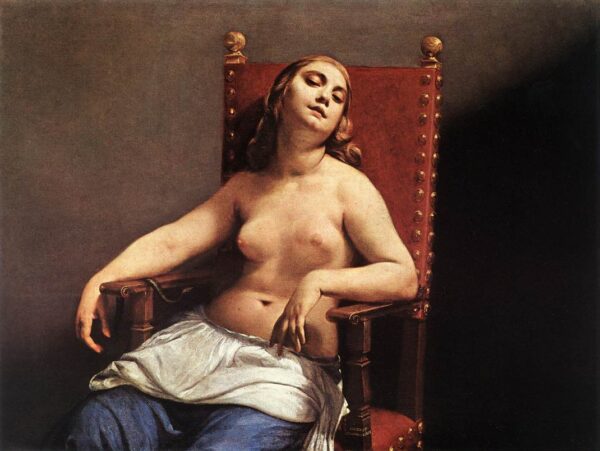
The Death of Cleopatra by Guido Cagnacci, hand-painted in oil on canvas, brings the frank, quiet drama of this famous painting into a room as a painted object, not a print.

Guido Cagnacci built much of his career on paintings of female saints and biblical heroines caught at moments of crisis, but few of his canvases push that theme as far as this one. Many of his religious works soften the drama with quiet interiors or gentle daylight. Here the mood is different: the body of Cleopatra is laid bare with a frankness that borders on clinical, even as the light around her stays soft and painterly. It is a picture that asks to be looked at slowly.
The composition centres on the dying queen, her form angled across the canvas so that the eye moves from her face down through the length of her body before settling on the asp at her side. Cagnacci gives her skin a pale, almost lit-from-within quality, set against darker drapery and the shadowed figures who attend her. The palette leans on warm flesh tones and deep reds, a contrast that keeps the death scene from feeling cold. This handling of flesh, developed across a series of related pictures Cagnacci painted on the same theme, reflects work from the mature phase of his output, when he had left Rimini for a wider Italian and eventually European audience.
What sets the picture apart is its restraint in the middle of extremity. The attendants do not weep or gesture wildly; their stillness lets the queet death read as inevitable rather than staged. Light falls unevenly across the room, picking out the queen and leaving the rest in a soft dimness that draws the eye back to her again and again. It is this control of attention, more than the subject itself, that keeps the composition working as a whole rather than as a single dramatic gesture.
Each ByMuseum reproduction of this famous painting is completed by a trained artist working in oil on canvas, not printed or reproduced by machine. The painter studies the original palette and brushwork closely, then rebuilds the image layer by layer, so the finished piece carries the same variation in tone and the same physical texture as a hand-painted canvas should. As an oil painting reproduction, it is made to be looked at as a painted object, with ridges of pigment and shifts in surface that a flat print cannot hold.
Four centuries on, the picture still holds attention because it refuses to look away from its subject, and a hand-painted version brings that same directness into a room rather than flattening it onto glossy paper. Owning a version painted stroke by stroke keeps something of the original discipline intact.
Empty walls flatten a room. A classical artwork restores structure and visual hierarchy. One painting defines the space, anchors furniture, and establishes identity.
Worldwide shipping included. Each painting is produced to order and safely packed for international transport.
All payments are encrypted and processed through trusted payment providers.
Real brushwork, layered oil paint, and durable pigments on museum-quality canvas.
If the result does not meet expectations, return it for a full refund.


Your artwork is painted on premium cotton canvas, then shipped safely rolled in a rigid tube with extra blank canvas border — ready for stretching or framing locally.
Select a handcrafted frame and we’ll deliver your painting fully assembled, protected, and ready to hang.
For safe shipping, framing is available up to a maximum size. Larger sizes will automatically disable the frame option.


Choose “Stretched” to receive your canvas mounted on wooden stretcher bars — perfect if you’ll frame it later or display it as-is.
Gallery Wrap is a deeper, 1.5" style stretcher. The canvas wraps around the sides and is stapled on the back for a clean, modern, frameless look.
We ship with UPS, FedEx, or DHL straight to your door. You’ll receive a tracking number as soon as your order leaves our studio. Typical delivery is 5 to 7 days after dispatch; large, framed, or stretched pieces may take longer depending on the safest shipping route.


Unframed canvases are protected with a film, carefully rolled, and secured inside a rigid shipping tube.

Stretched, Gallery Wrapped, and Framed paintings are wrapped, cushioned with foam protection, and boxed for safe transit.