Loading cart…
No products in the cart.

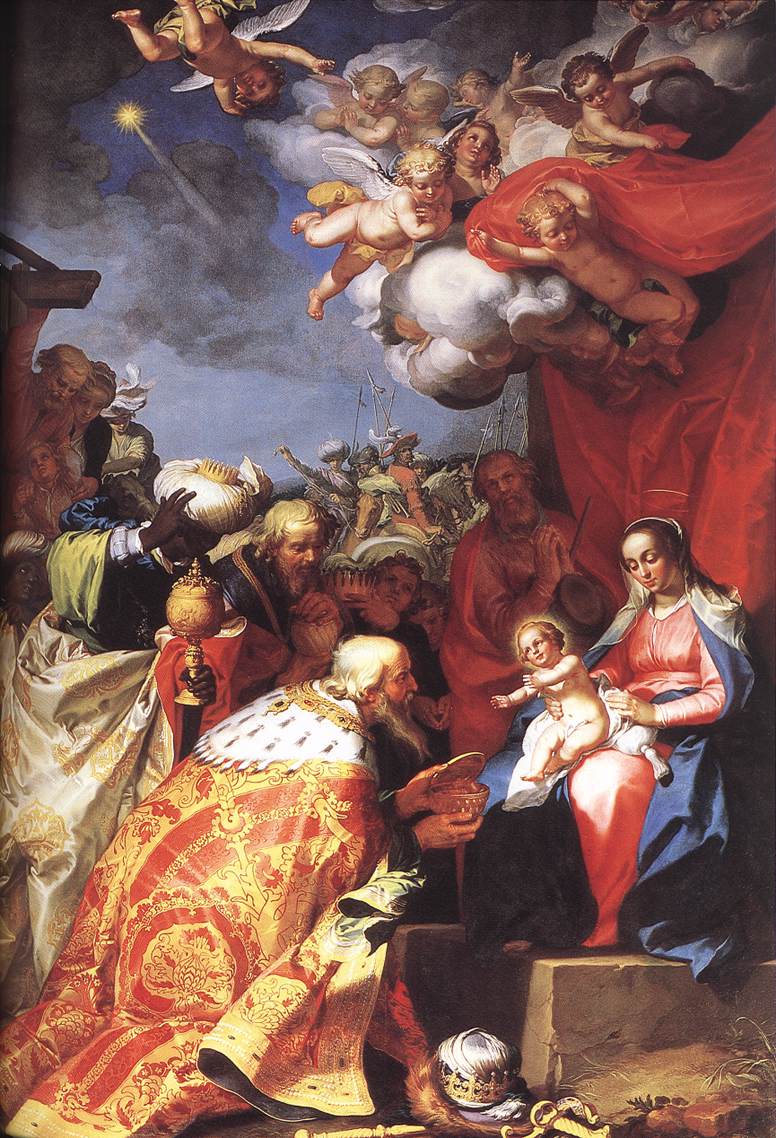
1905 · Oil on canvas · Private Collection
Save articles to your collection
Log in or create a free account, and this article will be waiting in your Private Collection.
Log in or sign upThe Adoration of the Magi was completed by Hirémy-Hirschl in 1905, during a period in which the artist was consolidating his reputation in both Rome and across Central European exhibition venues. By this point in his career, Hirémy-Hirschl had already achieved widespread recognition for The Souls of Acheron, and he was in demand for large-scale figurative works that drew on both classical and Christian iconographic traditions. The subject of the Adoration was a natural choice for an artist of his background and inclinations. It offered the challenge of organizing a complex, multi-figure composition around a single sacred focal point, and it placed the artist in direct dialogue with the greatest Italian and Northern European masters of the Renaissance and Baroque periods who had treated the same theme.
Hirémy-Hirschl approached the subject with characteristic seriousness, conducting extensive preparatory studies for the individual figures and researching historical costume and material culture to lend the scene an air of archaeological authenticity while preserving its spiritual resonance. The painting was exhibited publicly and received with admiration for the solemnity and richness of its treatment. It represents the religious dimension of the artist, a dimension that ran parallel to his mythological and allegorical work throughout his career, demonstrating that his interest in profound human experiences extended across both classical and Christian traditions. Today this painting exists in a private collection, but its visual power and historical importance make it among the most sought-after works in the catalog of the artist. Own this painting as a hand-painted oil reproduction and experience its devotional intensity in your own home.
The composition of the Adoration of the Magi by Hirémy-Hirschl follows a pyramidal structure that has deep roots in Renaissance treatments of the same subject, yet the artist inflects this traditional form with his own characteristic atmospheric intensity. The three Magi are presented with individualized faces and richly differentiated costumes that suggest distinct cultural and geographic origins, reinforcing the traditional interpretation of the scene as a gathering of the entire known world in homage before a single divine child. The figures are arranged so that the eye is drawn naturally inward and upward toward the luminous center of the composition, where the Christ child is positioned as both narrative focus and source of symbolic light.
The painterly handling in this work reflects the full maturity of Hirémy-Hirschl as a technician. Fabric textures, from the heavy brocade of royal garments to the coarser weave of the attendants, are rendered with a tactile precision that rewards close examination. The lighting scheme is complex, balancing a natural ambient light with the implied supernatural radiance emanating from the holy figures at the center. Facial expressions are rendered with psychological nuance rather than generic piety, giving each figure a distinct inner life and a specific relationship to the sacred moment being depicted. Shadow passages are deep and warm, built up through layers of transparent glaze that give the darker areas of the canvas a luminous quality rather than a flat opacity. The result is a painting of considerable visual and spiritual presence that holds its own within the long tradition of this beloved sacred subject. You can own this as a hand-painted oil reproduction through ByMuseum.
The Adoration of the Magi carries one of the richest and most layered symbolic programs in the entire history of Christian art. The gathering of the three wise men from the East before the newborn Christ is traditionally understood as a prefiguration of the universal scope of Christian salvation, an image of the entire world, represented by its wisest and most powerful figures, acknowledging a divine authority that transcends all human hierarchies. Hirémy-Hirschl engages with this tradition fully while bringing to it his own distinctive emphasis on the human dimension of spiritual experience. The figures in his version are not merely symbolic stand-ins but psychologically present individuals who appear to be genuinely moved by what they witness.
Within the broader context of the artist's work, the Adoration also reflects a persistent theme in the paintings of Hirémy-Hirschl, namely the encounter between mortal human beings and forces or presences that exceed human comprehension. Whether those presences are the gods and spirits of classical mythology or the sacred figures of Christian tradition, the painter consistently represents the human response to such encounters with empathy and seriousness. The Adoration of the Magi thus belongs to the same moral and emotional universe as The Souls of Acheron, even as it operates within a completely different iconographic register. Both paintings ask what it means to stand before something that utterly surpasses human power, and both answer that question through the close, compassionate observation of human faces, bodies, and gestures. This thematic continuity across different subject matter is one of the qualities that gives the body of work of Hirémy-Hirschl its coherence and depth.
Enjoyed this story?
Save articles to your collection
Log in or create a free account, and this article will be waiting in your Private Collection.
Log in or sign up