Loading cart…
No products in the cart.

Original price was: $599.00.$299.00Current price is: $299.00.
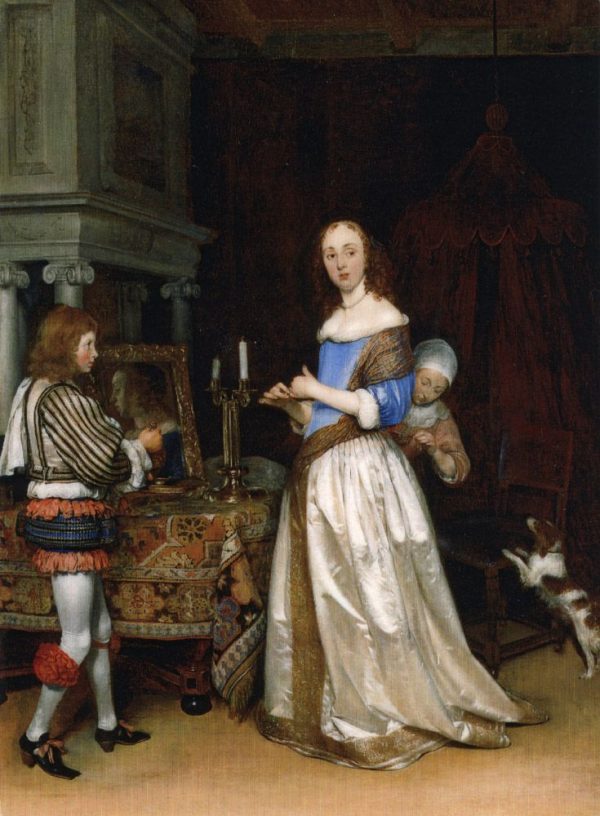
A hushed dressing-room scene by Gerard ter Borch, recreated as a museum quality hand-painted oil on canvas that keeps his subtle tonal brushwork intact.
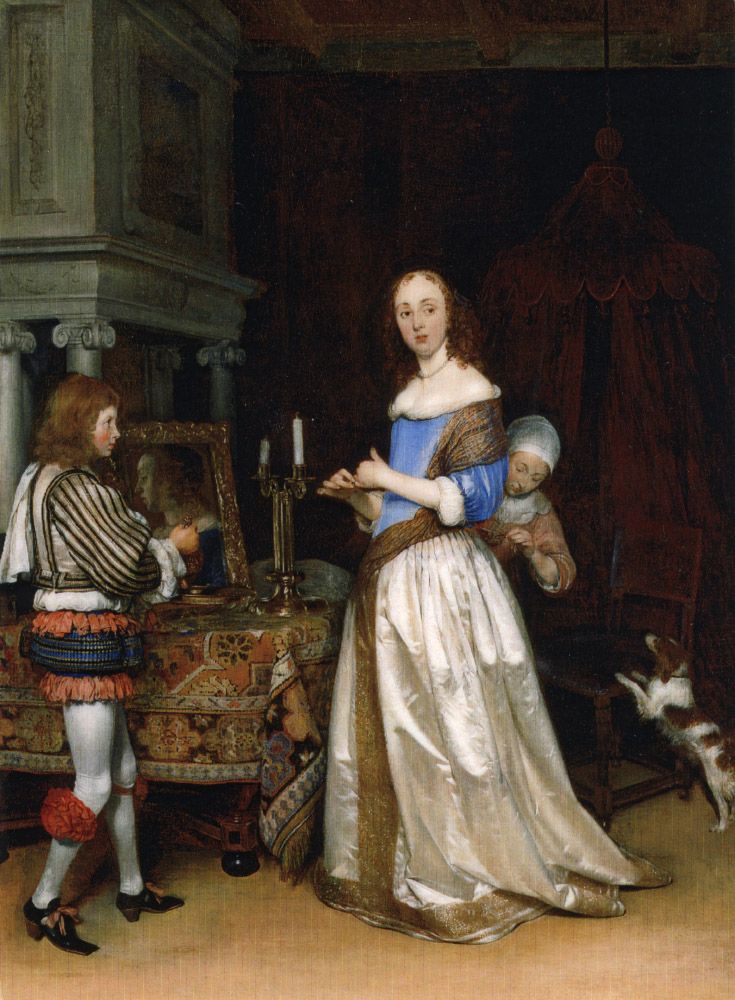
A maid steadies a silver basin as her mistress leans forward, caught between the loosening of a sleeve and the settling of a fold of satin. Nothing dramatic happens, yet everything in the room seems to pause around this small, private act of preparation. It is the kind of quiet domestic moment that rewards a long look, and a painting built to live with, not merely glance at.
Gerard ter Borch made his reputation painting exactly this register of Dutch interior life: women dressing, reading letters, or attended by servants in rooms lit by a single unseen window. In A Lady at Her Toilet, the composition is arranged with the restraint typical of his mature work from the mid seventeenth century, the figures set at an angle that lets the eye travel from the polished basin to the folds of costly fabric without ever losing the human centre of the scene. Space is used sparingly; every object present, from the drapery to the metal vessel, earns its place in the design.
What distinguishes Borch from many contemporaries is his handling of texture within a limited, largely neutral palette. Satin, fur, and skin are differentiated almost entirely through subtle shifts in tone and the direction of the brush rather than through strong colour contrast, a technical feat that historians have long singled out as central to his achievement. Light falls softly across the scene, gathering at the edges of fabric and the curve of the basin, giving the picture a hushed, concentrated atmosphere that belongs to the same tradition of refined genre painting practised by Vermeer and Metsu.
Recreating this kind of surface by hand is precisely why ByMuseum works in oil rather than in print. A trained painter builds up the same layered tonal transitions Borch relied on, matching his muted palette and reconstructing the fall of light across satin and skin stroke by stroke, so the finished oil painting reproduction carries actual brushwork and raised texture rather than a flat printed image. Held at an angle, the canvas catches light the way an oil surface should, with the same physical depth a museum quality reproduction is expected to offer a serious collector.
Faithfulness here means matching more than the outline of the composition. It means carrying across the specific temperature of the grays and browns Borch favoured, the softness at the edges where light dissolves into shadow, and the restrained, almost tactile rendering of fabric that gives the original its quiet authority. A collector who values condition and surface will look for exactly these qualities, and they are what the hand-painted copy is built to preserve.
Empty walls flatten a room. A classical artwork restores structure and visual hierarchy. One painting defines the space, anchors furniture, and establishes identity.
Worldwide shipping included. Each painting is produced to order and safely packed for international transport.
All payments are encrypted and processed through trusted payment providers.
Real brushwork, layered oil paint, and durable pigments on museum-quality canvas.
If the result does not meet expectations, return it for a full refund.


Your artwork is painted on premium cotton canvas, then shipped safely rolled in a rigid tube with extra blank canvas border — ready for stretching or framing locally.
Select a handcrafted frame and we’ll deliver your painting fully assembled, protected, and ready to hang.
For safe shipping, framing is available up to a maximum size. Larger sizes will automatically disable the frame option.


Choose “Stretched” to receive your canvas mounted on wooden stretcher bars — perfect if you’ll frame it later or display it as-is.
Gallery Wrap is a deeper, 1.5" style stretcher. The canvas wraps around the sides and is stapled on the back for a clean, modern, frameless look.
We ship with UPS, FedEx, or DHL straight to your door. You’ll receive a tracking number as soon as your order leaves our studio. Typical delivery is 5 to 7 days after dispatch; large, framed, or stretched pieces may take longer depending on the safest shipping route.


Unframed canvases are protected with a film, carefully rolled, and secured inside a rigid shipping tube.

Stretched, Gallery Wrapped, and Framed paintings are wrapped, cushioned with foam protection, and boxed for safe transit.