Loading cart…
No products in the cart.

Original price was: $599.00.$299.00Current price is: $299.00.
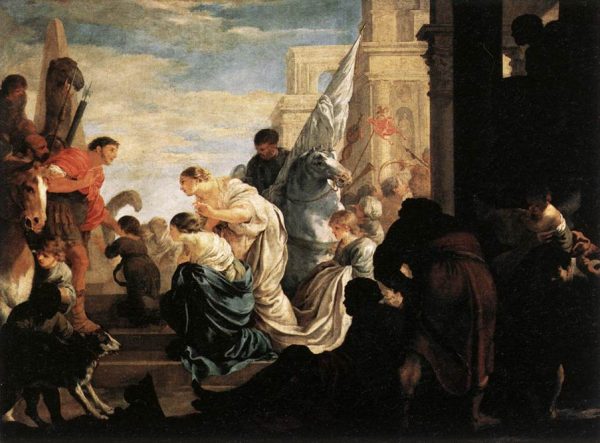
A Scene from Roman History by Sebastien Bourdon, recreated as a hand-painted oil reproduction on canvas that preserves the original composition, palette, and surface texture.
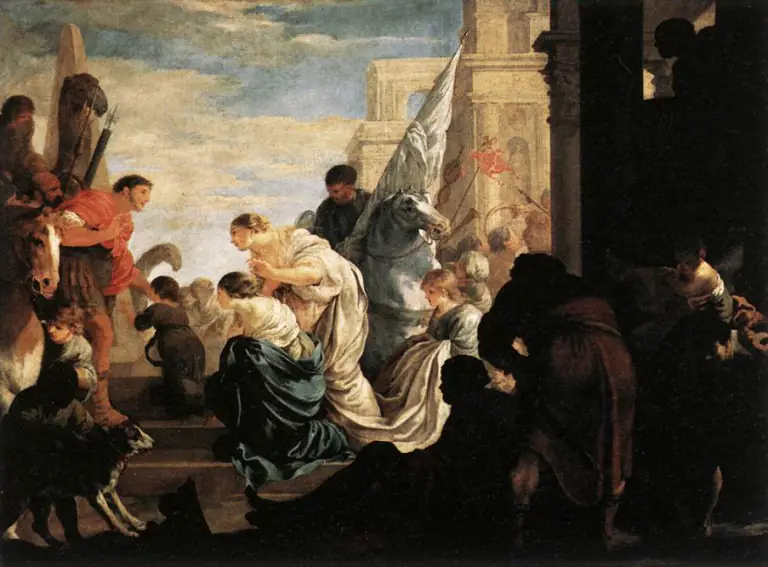
A large canvas commands a room in a way that smaller works cannot, and A Scene from Roman History is built on exactly that kind of scale. Its extended horizontal format asks the viewer to stand back and take in the full sweep of the composition before approaching for the incidental detail worked into drapery, armor, and architecture. That relationship between distance and proximity is not accidental; it governs how the figures are grouped and how the eye is meant to travel across the surface.
The subject draws on the repertoire of Roman history painting that occupied Sebastien Bourdon across much of his career, a genre that let seventeenth century painters stage moral or civic drama through gesture and grouping rather than through any single dramatic incident. Figures are arranged with a classical sense of order, their poses calibrated against the architecture behind them, and the eye is guided between the principal actors and the open passages of space that give the scene room to breathe. The influence of Poussin sits close to the surface here, evident in the disciplined geometry and the restrained, almost sculptural handling of the human form.
Bourdon builds the scene through a controlled interplay of light and shadow, using concentrated passages of detail in the foreground figures against broader, more thinly worked areas in the middle distance. This hierarchy of finish keeps the composition legible from across a room while rewarding closer study, and it reflects a maturity of technique that places the work among the more accomplished examples of French Baroque narrative painting, a genuinely famous painting within its genre even where the specific episode it depicts remains open to interpretation.
Recreating this oil painting reproduction by hand means a trained painter works pigment onto artist-grade canvas much as Bourdon once did, matching the original palette tone by tone and following the same passages of concentrated detail and looser, broader handling that structure the source composition. Brush by brush, the surface accumulates real depth, with visible texture standing where impasto once stood, so that light falls across it the way it falls across an oil painting rather than a flat printed sheet. The result is a painted object built by hand, not manufactured.
Empty walls flatten a room. A classical artwork restores structure and visual hierarchy. One painting defines the space, anchors furniture, and establishes identity.
Worldwide shipping included. Each painting is produced to order and safely packed for international transport.
All payments are encrypted and processed through trusted payment providers.
Real brushwork, layered oil paint, and durable pigments on museum-quality canvas.
If the result does not meet expectations, return it for a full refund.


Your artwork is painted on premium cotton canvas, then shipped safely rolled in a rigid tube with extra blank canvas border — ready for stretching or framing locally.
Select a handcrafted frame and we’ll deliver your painting fully assembled, protected, and ready to hang.
For safe shipping, framing is available up to a maximum size. Larger sizes will automatically disable the frame option.


Choose “Stretched” to receive your canvas mounted on wooden stretcher bars — perfect if you’ll frame it later or display it as-is.
Gallery Wrap is a deeper, 1.5" style stretcher. The canvas wraps around the sides and is stapled on the back for a clean, modern, frameless look.
We ship with UPS, FedEx, or DHL straight to your door. You’ll receive a tracking number as soon as your order leaves our studio. Typical delivery is 5 to 7 days after dispatch; large, framed, or stretched pieces may take longer depending on the safest shipping route.


Unframed canvases are protected with a film, carefully rolled, and secured inside a rigid shipping tube.

Stretched, Gallery Wrapped, and Framed paintings are wrapped, cushioned with foam protection, and boxed for safe transit.

Man Writing a Letter
Gabriel Metsu, c. 1664
The gallery list
Every painting is already 50% off. Join the list and we will send you an extra $15 code, plus first access to new collections.
No spam. Unsubscribe anytime. · Privacy Policy
Welcome
Your $15 code is on its way. Explore the gallery while you wait.