Loading cart…
No products in the cart.

Original price was: $599.00.$299.00Current price is: $299.00.
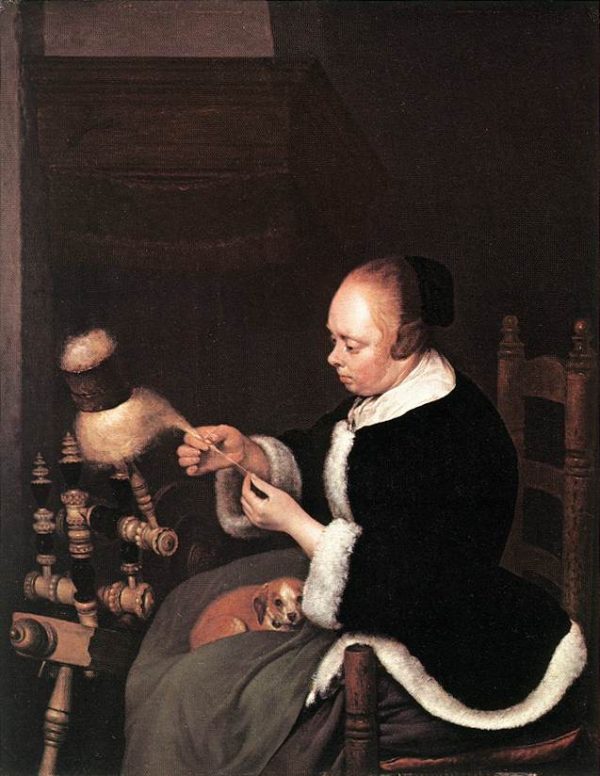
A Woman Spinning by Gerard ter Borch, recreated as a hand-painted oil reproduction with the layered colour and quiet stillness of the original Dutch interior.
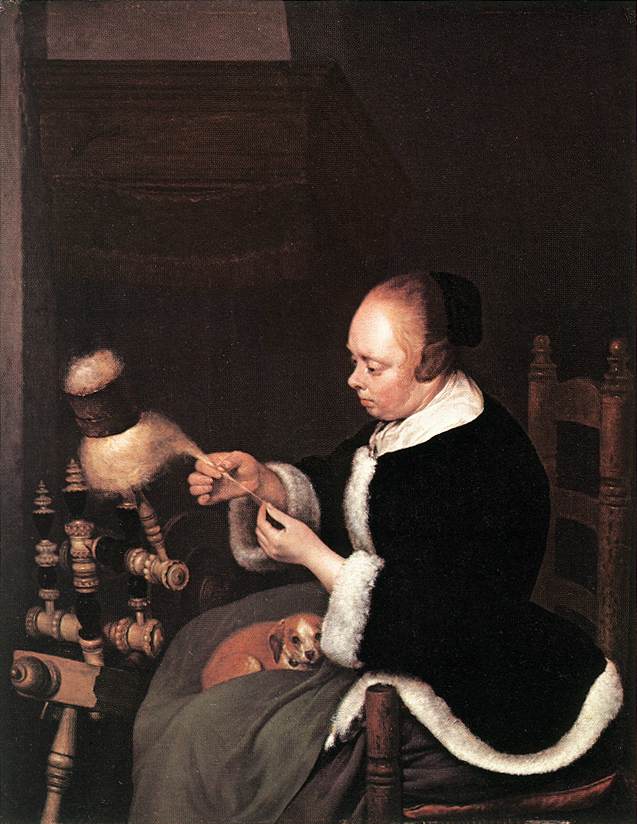
In the domestic interiors of the Dutch Republic during the mid seventeenth century, a quiet economy of gesture and light became its own subject, and few painters pursued that quiet as patiently as Gerard ter Borch. A Woman Spinning belongs to the years when Ter Borch had settled into the genre scenes that defined his mature career, having moved from portraiture toward small, closely observed pictures of women absorbed in domestic labour or private thought. The painting likely reflects the household routines of Deventer or a similar Dutch town, where spinning was both a practical task and a familiar emblem of diligence and thrift.
The composition centres on a single figure bent to her wheel, her attention entirely given to the thread passing between her fingers. Ter Borch arranges the room around her with restraint: a modest interval of floor, a wall catching daylight from an unseen window, furnishings kept spare so that nothing competes with the sitter for notice. Light falls obliquely, picking out the folds of her dress and the curve of the wheel while leaving the corners of the room in soft shadow, a device Ter Borch used repeatedly to draw the eye toward the human presence at the centre of his scenes.
What distinguishes the picture is the handling of surface and texture, the fine calibration for which Ter Borch was admired even in his own lifetime. Fabric is rendered with a tactile precision that suggests weight and weave rather than mere outline, and the muted palette of browns, greys, and warm flesh tones is built up in thin, controlled layers rather than broad strokes. This economy of colour, joined to an almost tactile rendering of cloth and skin, gives the work its particular stillness, a sense of a moment held rather than staged.
ByMuseum recreates this painting as a hand-painted oil painting reproduction, worked by a trained artist directly onto artist-grade canvas rather than printed or mechanically copied. The painter studies the original palette, the fall of light across the room, and the worked edges that define the figure and her surroundings, then rebuilds them stroke by stroke in oil. The result is a fine art reproduction with genuine surface variation, visible brushwork, and the layered depth of traditional painting, an object with material presence rather than a flat facsimile.
Nearly four centuries after it was painted, the picture still holds attention because it asks so little and offers so much: a woman, a task, a room lit by ordinary daylight, rendered with a discipline that never calls attention to itself. Owning a painted version of that discipline, worked by hand rather than reproduced by machine, is a way of keeping something of that patience within reach.
Empty walls flatten a room. A classical artwork restores structure and visual hierarchy. One painting defines the space, anchors furniture, and establishes identity.
Worldwide shipping included. Each painting is produced to order and safely packed for international transport.
All payments are encrypted and processed through trusted payment providers.
Real brushwork, layered oil paint, and durable pigments on museum-quality canvas.
If the result does not meet expectations, return it for a full refund.


Your artwork is painted on premium cotton canvas, then shipped safely rolled in a rigid tube with extra blank canvas border — ready for stretching or framing locally.
Select a handcrafted frame and we’ll deliver your painting fully assembled, protected, and ready to hang.
For safe shipping, framing is available up to a maximum size. Larger sizes will automatically disable the frame option.


Choose “Stretched” to receive your canvas mounted on wooden stretcher bars — perfect if you’ll frame it later or display it as-is.
Gallery Wrap is a deeper, 1.5" style stretcher. The canvas wraps around the sides and is stapled on the back for a clean, modern, frameless look.
We ship with UPS, FedEx, or DHL straight to your door. You’ll receive a tracking number as soon as your order leaves our studio. Typical delivery is 5 to 7 days after dispatch; large, framed, or stretched pieces may take longer depending on the safest shipping route.


Unframed canvases are protected with a film, carefully rolled, and secured inside a rigid shipping tube.

Stretched, Gallery Wrapped, and Framed paintings are wrapped, cushioned with foam protection, and boxed for safe transit.