Loading cart…
No products in the cart.

$1,499.00
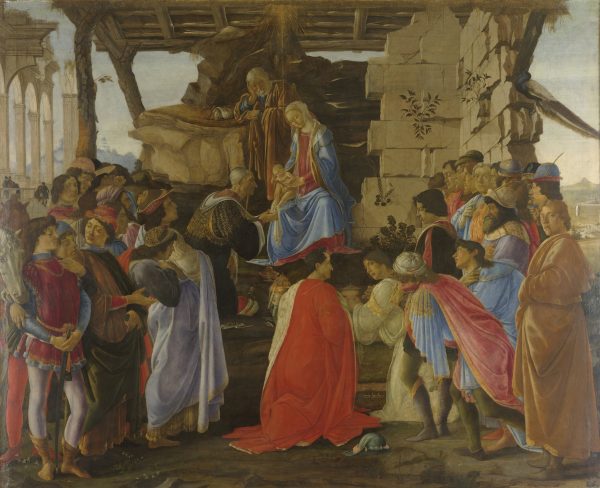
A hand-painted reproduction of Adoration of the Magi by Botticelli, the Zanobi Altarpiece that turns the Gospel scene into a gallery of Medici portraits, including the artist own self-portrait at right.
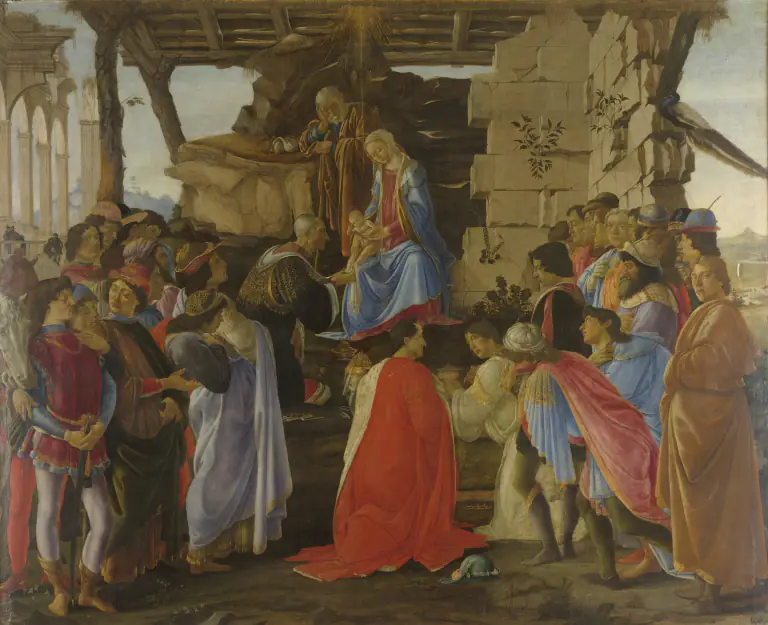
Tempera grassa, oil mixed into egg tempera, gives this panel its particular surface: the paint sits smooth and dense, catching light in a way drier tempera never does, while the drawing beneath stays crisp at every edge. This Adoration of the Magi reproduction follows that layering closely, so the warmth in the robes and the modelling of the faces carry across from panel to canvas rather than flattening into a single tone. Painted around 1475 for a chapel in the Florentine church of Santa Maria Novella, the composition announces itself less as a devotional scene than as a crowd portrait, built from dozens of individual likenesses rendered with equal care.
The Virgin and the infant Christ sit enthroned at the centre, with Joseph standing behind them, but the real activity of the picture happens around that still core. Kneeling before the Holy Family are the Three Magi, painted as recognisable members of the Medici family and their circle rather than as generic kings, a choice that turns the altarpiece into a document of Florentine political life as much as a Gospel subject. Botticelli commissioned by the banker Gaspare di Zanobi del Lama arranges the crowd in loose, overlapping groups rather than a formal procession, each man given his own stance, his own expression, his own fall of cloth. A ruined classical arcade and a rocky landscape fill the background, setting the sacred event among the physical remains of the ancient world.
On the far right edge of the gathering, a young man in a flowing gold-toned robe turns to face the viewer directly, widely identified as the only known self-portrait by Botticelli. ByMuseum artists paint this oil painting reproduction by hand on canvas, working from the same palette of gold ochre, rose, and deep blue-green that structures the original, and preserving the visible brushwork that gives each face its separate weight and presence. Nothing here is printed; every passage of colour is built up in real oil pigment, so the surface holds texture the way the panel does, and the result functions as a museum quality reproduction rather than a flattened copy.
Five centuries on, the picture still holds attention because it refuses to stay still: a crowd of named individuals caught mid-gesture, arranged with a control that keeps dozens of faces legible at once. Owning a painted version of that composition means living with the same density of detail, worked by hand rather than machine.
| artists |
|---|
Empty walls flatten a room. A classical artwork restores structure and visual hierarchy. One painting defines the space, anchors furniture, and establishes identity.
Worldwide shipping included. Each painting is produced to order and safely packed for international transport.
All payments are encrypted and processed through trusted payment providers.
Real brushwork, layered oil paint, and durable pigments on museum-quality canvas.
If the result does not meet expectations, return it for a full refund.


Your artwork is painted on premium cotton canvas, then shipped safely rolled in a rigid tube with extra blank canvas border — ready for stretching or framing locally.
Select a handcrafted frame and we’ll deliver your painting fully assembled, protected, and ready to hang.
For safe shipping, framing is available up to a maximum size. Larger sizes will automatically disable the frame option.


Choose “Stretched” to receive your canvas mounted on wooden stretcher bars — perfect if you’ll frame it later or display it as-is.
Gallery Wrap is a deeper, 1.5" style stretcher. The canvas wraps around the sides and is stapled on the back for a clean, modern, frameless look.
We ship with UPS, FedEx, or DHL straight to your door. You’ll receive a tracking number as soon as your order leaves our studio. Typical delivery is 5 to 7 days after dispatch; large, framed, or stretched pieces may take longer depending on the safest shipping route.


Unframed canvases are protected with a film, carefully rolled, and secured inside a rigid shipping tube.

Stretched, Gallery Wrapped, and Framed paintings are wrapped, cushioned with foam protection, and boxed for safe transit.

Man Writing a Letter
Gabriel Metsu, c. 1664
The gallery list
Every painting is already 50% off. Join the list and we will send you an extra $15 code, plus first access to new collections.
No spam. Unsubscribe anytime. · Privacy Policy
Welcome
Your $15 code is on its way. Explore the gallery while you wait.