Loading cart…
No products in the cart.

Original price was: $518.00.$259.00Current price is: $259.00.
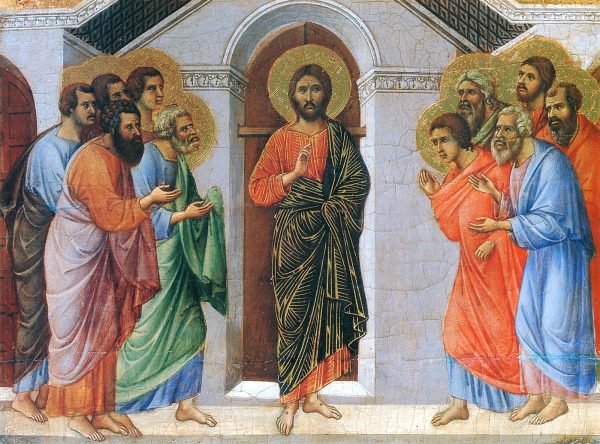
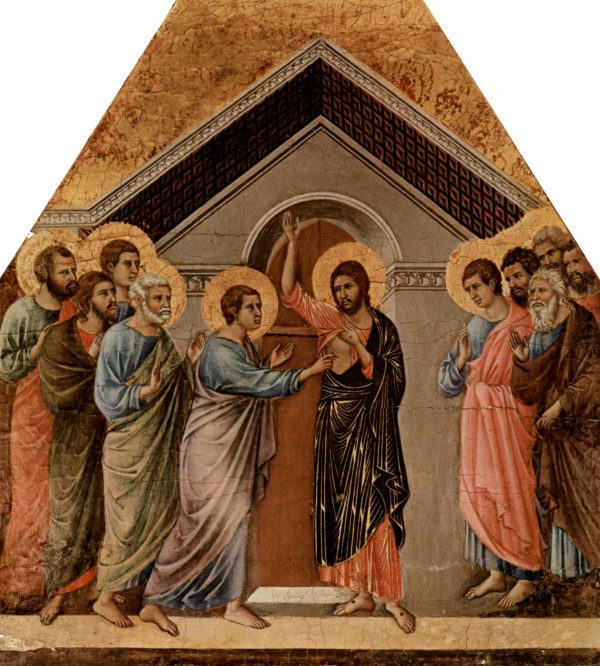
A closed door and a quietly astonished gathering of apostles: Appearence Behind Locked Doors by Duccio di Buoninsegna, reproduced by hand in oil for collectors of early Sienese painting.
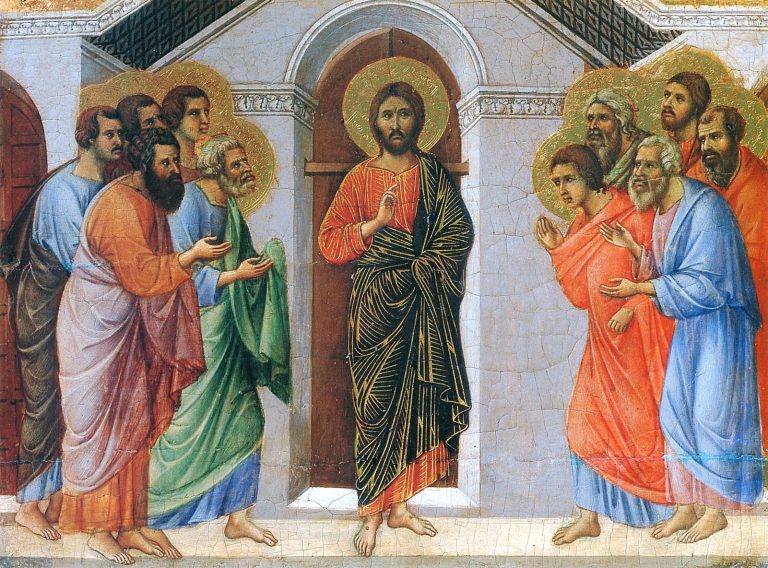
A closed door catches the light differently from the wall around it, and in that narrow band of gold leaf and shadow, the whole drama of this panel is concentrated. Christ stands among the apostles though no door has opened to admit him, and Duccio di Buoninsegna renders the moment not through gesture alone but through the quiet geometry of the architecture that should have kept him out.
Painted for the reverse of the Maesta, the great altarpiece made for Siena Cathedral, this small scene belongs to a sequence in which Duccio worked through the events following the Passion with a narrative clarity that had few equals in early fourteenth century Italy. The figures are arranged in a shallow, boxlike interior, their drapery falling in long rhythmic folds that owe something to Byzantine convention and something to a new interest in weight and presence. Gold ground, deep reds, and a cool blue for the mantle of Christ carry the eye across the panel, while the architecture, drawn with a schematic perspective that predates any consistent system, encloses the scene like a stage set built from memory rather than observation.
What distinguishes the panel is the restraint of its emotion. The apostles register astonishment through posture and the tilt of a head rather than open display, and Duccio holds the whole composition together through carefully placed accents of colour against the gold, so that the eye settles on gesture before it registers narrative. This economy of means, achieved at the far edge of the Gothic tradition just as Sienese painting was beginning to absorb a new naturalism, is part of what makes the panel rewarding to study closely, panel by panel, alongside the rest of the Maesta cycle.
Bringing that economy back into physical form is the task of the ByMuseum oil painting reproduction, painted by hand rather than printed, so that the gold ground and the layered reds retain something of their original density. A trained artist works in oil on artist-grade canvas, matching the palette panel by panel and preserving the visible brushwork that gives the surface its depth, so the finished piece functions as a fine art reproduction rather than a flat facsimile, with the texture of an object made rather than manufactured.
For a collector drawn to early Sienese painting, or for a room that wants a single considered image rather than a decorative gesture, this is a panel that repays slow looking. It suits a study, a library, or any wall where a visitor is expected to stop and look twice.
Empty walls flatten a room. A classical artwork restores structure and visual hierarchy. One painting defines the space, anchors furniture, and establishes identity.
Worldwide shipping included. Each painting is produced to order and safely packed for international transport.
All payments are encrypted and processed through trusted payment providers.
Real brushwork, layered oil paint, and durable pigments on museum-quality canvas.
If the result does not meet expectations, return it for a full refund.


Your artwork is painted on premium cotton canvas, then shipped safely rolled in a rigid tube with extra blank canvas border — ready for stretching or framing locally.
Select a handcrafted frame and we’ll deliver your painting fully assembled, protected, and ready to hang.
For safe shipping, framing is available up to a maximum size. Larger sizes will automatically disable the frame option.


Choose “Stretched” to receive your canvas mounted on wooden stretcher bars — perfect if you’ll frame it later or display it as-is.
Gallery Wrap is a deeper, 1.5" style stretcher. The canvas wraps around the sides and is stapled on the back for a clean, modern, frameless look.
We ship with UPS, FedEx, or DHL straight to your door. You’ll receive a tracking number as soon as your order leaves our studio. Typical delivery is 5 to 7 days after dispatch; large, framed, or stretched pieces may take longer depending on the safest shipping route.


Unframed canvases are protected with a film, carefully rolled, and secured inside a rigid shipping tube.

Stretched, Gallery Wrapped, and Framed paintings are wrapped, cushioned with foam protection, and boxed for safe transit.