Loading cart…
No products in the cart.

Original price was: $518.00.$259.00Current price is: $259.00.
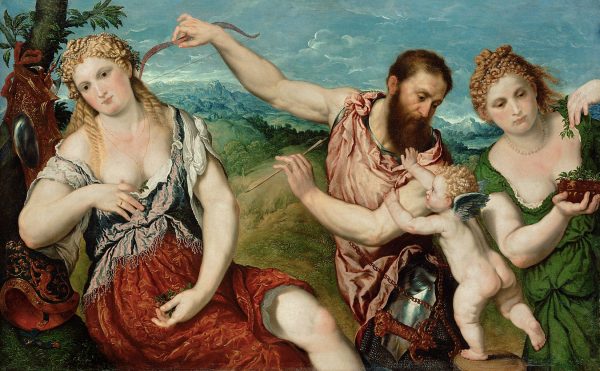
A hand-painted oil reproduction of Athena Scorning the Advances of Hephaestus by Paris Bordone, capturing the tension of the original in layered oil on canvas.

A woman turns her body away from a figure who leans toward her, one hand raised in a gesture that reads at once as refusal and control. The space between the two figures carries the charge of the picture: a diagonal pull met with an equally firm resistance, staged against warm shadow and passages of light that fall unevenly across skin and drapery. This is the moment the painting holds, and the eye returns to it before taking in anything else.
The composition belongs to the tradition of Venetian mythological painting that flourished in the sixteenth century, and Paris Bordone handles it with the confidence of a painter trained in that school. Color carries much of the meaning here: flushed tones in the flesh, deep reds and golds in the fabric, and a surrounding darkness that pushes the two central forms forward. Light does not fall evenly across the scene but gathers at specific points, catching a shoulder, a raised arm, a fold of cloth, while the rest recedes into shadow. This selective illumination is typical of the period and gives the scene a theatrical, almost staged quality, as though caught at a single decisive instant.
Bordone worked in the orbit of Titian, and this famous painting reflects that lineage in its rich surface and its willingness to let color, rather than outline, define form. The brushwork is loose where it needs to suggest movement and tighter where the narrative demands clarity, particularly in the faces and hands, where the emotional stakes of the scene are concentrated. It belongs to a body of mythological subjects that Venetian painters returned to repeatedly, using ancient stories to explore desire, refusal, and the tension between the two.
ByMuseum recreates this work as a hand-painted oil painting reproduction, built layer by layer on artist-grade canvas rather than produced by any mechanical process. A trained painter studies the original palette and reworks it stroke by stroke, so the raised texture of impasto, the visible movement of the brush, and the depth that comes from layered oil color are all present on the finished canvas. The result is a painted object with its own surface life, not a flat facsimile of one.
Living with a painting like this rewards attention over time. A detail that seemed minor on the first viewing, the angle of a wrist, the exact shade at the edge of a shadow, tends to surface later, once the eye has settled into the rhythm of the composition. That slow discovery is part of what a hand-painted reproduction preserves, since the texture of real brushwork changes subtly with the light in a room across the day.
Empty walls flatten a room. A classical artwork restores structure and visual hierarchy. One painting defines the space, anchors furniture, and establishes identity.
Worldwide shipping included. Each painting is produced to order and safely packed for international transport.
All payments are encrypted and processed through trusted payment providers.
Real brushwork, layered oil paint, and durable pigments on museum-quality canvas.
If the result does not meet expectations, return it for a full refund.


Your artwork is painted on premium cotton canvas, then shipped safely rolled in a rigid tube with extra blank canvas border — ready for stretching or framing locally.
Select a handcrafted frame and we’ll deliver your painting fully assembled, protected, and ready to hang.
For safe shipping, framing is available up to a maximum size. Larger sizes will automatically disable the frame option.


Choose “Stretched” to receive your canvas mounted on wooden stretcher bars — perfect if you’ll frame it later or display it as-is.
Gallery Wrap is a deeper, 1.5" style stretcher. The canvas wraps around the sides and is stapled on the back for a clean, modern, frameless look.
We ship with UPS, FedEx, or DHL straight to your door. You’ll receive a tracking number as soon as your order leaves our studio. Typical delivery is 5 to 7 days after dispatch; large, framed, or stretched pieces may take longer depending on the safest shipping route.


Unframed canvases are protected with a film, carefully rolled, and secured inside a rigid shipping tube.

Stretched, Gallery Wrapped, and Framed paintings are wrapped, cushioned with foam protection, and boxed for safe transit.