Loading cart…
No products in the cart.

Original price was: $599.00.$299.00Current price is: $299.00.
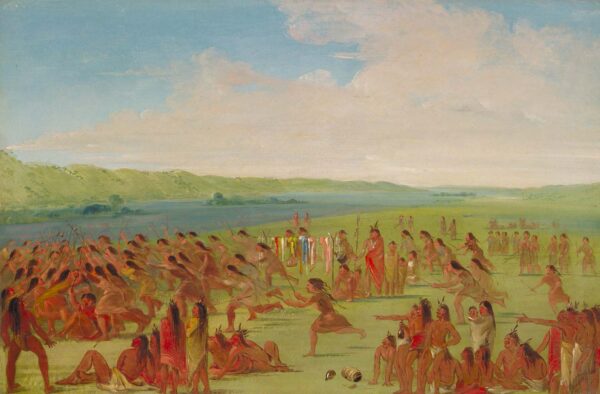
Ball play of the Women, Prairie du Chien by George Catlin, reproduced as a hand-painted oil on canvas that preserves the earthy palette and quiet documentary detail of the original.
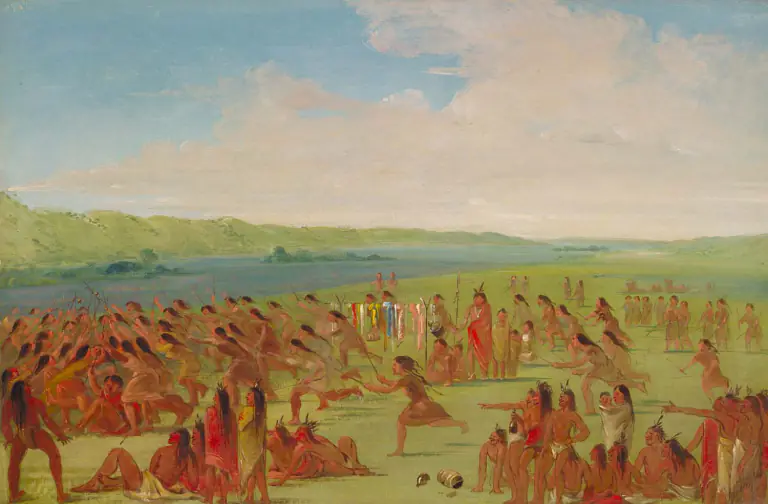
Warm earth tones dominate the surface of this scene: ochres and tanned buckskin browns, weathered greys, and passages of muted red and blue that mark out the figures moving across the open ground. These colours never compete for attention; instead they settle into a wide, even register that lets the eye travel across the whole gathering before resting on any single player. Small flashes of brighter pigment, a red sash, a blue trade cloth, punctuate the field of neutral tones and keep the composition alive without breaking its calm.
Painted during George Catlin travels among the tribes of the upper Mississippi in the 1830s, the work records a game played by the women at Prairie du Chien with the same ethnographic attention he brought to his portraits of chiefs and warriors. Figures are spaced with care across the middle ground, their postures caught mid motion, so that the painting reads as a document of activity rather than a posed tableau. Catlin worked quickly and often under difficult conditions on his expeditions, and something of that urgency survives in the loose, direct handling of paint, particularly in the treatment of ground and sky.
Light falls evenly across the scene, without the dramatic contrasts of a studio composition, which suits the outdoor subject and gives the whole canvas a flattened, documentary clarity. This is characteristic of Catlin approach throughout his Indian Gallery: description before drama, observation before invention. The composition rewards a slower look, where the relationships between the scattered figures and the open ground become the real subject of the painting.
ByMuseum artists translate this record into a hand-painted oil painting reproduction, working in oil on artist-grade canvas to match the original palette of ochre, grey, and muted colour rather than approximating it with print inks. Brushwork is rebuilt by hand, stroke by stroke, so the surface carries the same texture and quiet variation as a painting made at the easel, not a flat reproduction pulled from a printer. The result is a museum quality reproduction that sits on the wall as an object with real depth, layered pigment catching light the way the original does.
What survives in the transfer from original to reproduction is the balance of the composition, the exact placement of every figure across the ground, and the specific warmth of the palette that gives the scene its unity. These are the details a trained painter has to see and rebuild by hand, and they are what separate a faithful reproduction from a generic likeness.
Empty walls flatten a room. A classical artwork restores structure and visual hierarchy. One painting defines the space, anchors furniture, and establishes identity.
Worldwide shipping included. Each painting is produced to order and safely packed for international transport.
All payments are encrypted and processed through trusted payment providers.
Real brushwork, layered oil paint, and durable pigments on museum-quality canvas.
If the result does not meet expectations, return it for a full refund.


Your artwork is painted on premium cotton canvas, then shipped safely rolled in a rigid tube with extra blank canvas border — ready for stretching or framing locally.
Select a handcrafted frame and we’ll deliver your painting fully assembled, protected, and ready to hang.
For safe shipping, framing is available up to a maximum size. Larger sizes will automatically disable the frame option.


Choose “Stretched” to receive your canvas mounted on wooden stretcher bars — perfect if you’ll frame it later or display it as-is.
Gallery Wrap is a deeper, 1.5" style stretcher. The canvas wraps around the sides and is stapled on the back for a clean, modern, frameless look.
We ship with UPS, FedEx, or DHL straight to your door. You’ll receive a tracking number as soon as your order leaves our studio. Typical delivery is 5 to 7 days after dispatch; large, framed, or stretched pieces may take longer depending on the safest shipping route.


Unframed canvases are protected with a film, carefully rolled, and secured inside a rigid shipping tube.

Stretched, Gallery Wrapped, and Framed paintings are wrapped, cushioned with foam protection, and boxed for safe transit.

Man Writing a Letter
Gabriel Metsu, c. 1664
The gallery list
Every painting is already 50% off. Join the list and we will send you an extra $15 code, plus first access to new collections.
No spam. Unsubscribe anytime. · Privacy Policy
Welcome
Your $15 code is on its way. Explore the gallery while you wait.