Loading cart…
No products in the cart.

Original price was: $599.00.$299.00Current price is: $299.00.
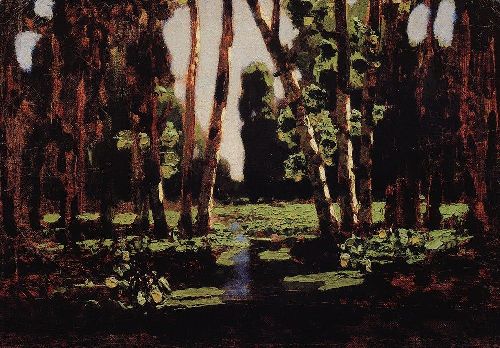
A hand-painted oil reproduction of Birchwood 2 1898 1908 by Arhip Kuindzhi, capturing the layered paint and quiet atmosphere of his late woodland studies.

Loosely worked strokes of muted green and silvered white build the trunks of the birches before any single tree fully resolves; the paint sits thick in places, thinned to a wash in others, and it is this shifting density that lets the wood emerge from the canvas rather than sit upon it. Light does not fall so much as gather, pooling along certain trunks while others recede into shadowed grey-violet, and the effect is of a clearing glimpsed rather than described.
The composition belongs to the later, more experimental years of Kuindzhi, painted in the decade around the turn of the century when he withdrew from public exhibition and worked largely for himself, testing colour relationships with a freedom his earlier, more finished landscapes did not allow. Birchwood 2 1898 1908 shows that private research: the trunks are placed with a rhythm closer to music than to botanical accuracy, upright verticals breaking a horizontal band of undergrowth, and the eye is guided through the depth of the wood by tonal shift alone rather than by drawn line. Edges blur and sharpen in turn, a technique that owes something to his early training in the effects of light and something to his own restless late experiments with surface.
What survives from this period of work is a surface built from decision rather than description, and that is exactly what a hand-painted oil painting reproduction is able to carry forward. Each canvas is painted by a trained artist working in oil on artist-grade canvas, matching the palette stroke by stroke and preserving the changes in paint density that give the original its particular hush. This is a handmade oil painting, built up in layers as the original was, not a flat facsimile of one; the raised ridges of impasto and the softer passages beside them are worked by hand so the surface reads correctly from across a room and holds up under close inspection.
What is carried across is not merely the image but the manner of its making: the balance of thick paint against thin, the muted key of the palette, and the soft transitions between light and shadow that give the wood its atmosphere. That fidelity matters because it is the handling, more than the subject, that makes the picture recognisably the work of Kuindzhi.
Empty walls flatten a room. A classical artwork restores structure and visual hierarchy. One painting defines the space, anchors furniture, and establishes identity.
Worldwide shipping included. Each painting is produced to order and safely packed for international transport.
All payments are encrypted and processed through trusted payment providers.
Real brushwork, layered oil paint, and durable pigments on museum-quality canvas.
If the result does not meet expectations, return it for a full refund.


Your artwork is painted on premium cotton canvas, then shipped safely rolled in a rigid tube with extra blank canvas border — ready for stretching or framing locally.
Select a handcrafted frame and we’ll deliver your painting fully assembled, protected, and ready to hang.
For safe shipping, framing is available up to a maximum size. Larger sizes will automatically disable the frame option.


Choose “Stretched” to receive your canvas mounted on wooden stretcher bars — perfect if you’ll frame it later or display it as-is.
Gallery Wrap is a deeper, 1.5" style stretcher. The canvas wraps around the sides and is stapled on the back for a clean, modern, frameless look.
We ship with UPS, FedEx, or DHL straight to your door. You’ll receive a tracking number as soon as your order leaves our studio. Typical delivery is 5 to 7 days after dispatch; large, framed, or stretched pieces may take longer depending on the safest shipping route.


Unframed canvases are protected with a film, carefully rolled, and secured inside a rigid shipping tube.

Stretched, Gallery Wrapped, and Framed paintings are wrapped, cushioned with foam protection, and boxed for safe transit.