Loading cart…
No products in the cart.

Original price was: $518.00.$259.00Current price is: $259.00.
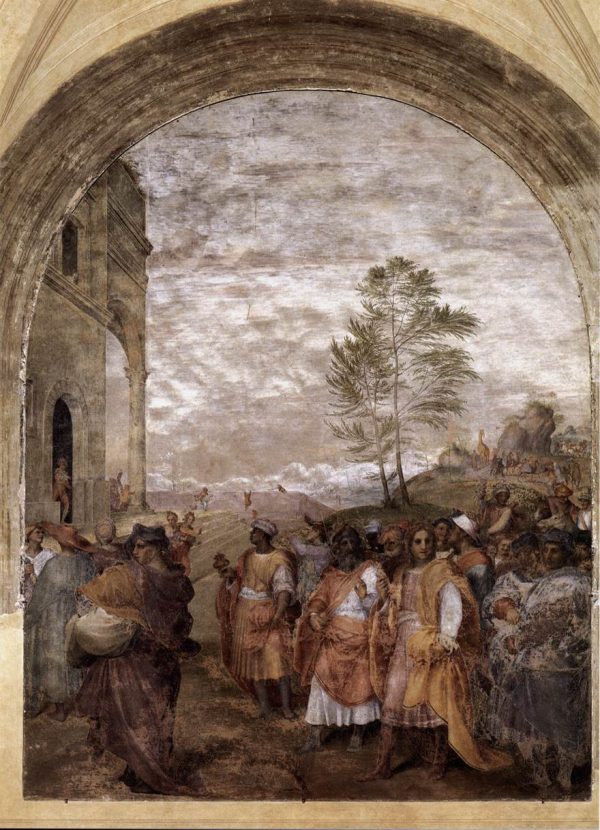
Birth of the Virgin by Andrea del Sarto, recreated as a hand-painted oil reproduction on canvas, brings the quiet balance of this Renaissance interior into a painted object for the home.

Scholars and visitors have returned to this fresco cycle for centuries, drawn less by drama than by the calm authority of its arrangement. Birth of the Virgin has long been discussed as a moment when Florentine painting settled into a quieter kind of eloquence, where gesture and gaze replace incident, and where the room itself seems to hold its breath around the figures gathered inside it.
The scene unfolds in a domestic interior rendered with the confidence of an artist fully in command of spatial illusion. Attendants move around the newborn and her mother with unhurried purpose, their draperies falling in soft, voluminous folds that catch light without exaggeration. Andrea del Sarto arranges the group so that no single figure dominates; instead, the eye travels across a sequence of quiet exchanges, from a woman pouring water to another folding linen, each gesture calibrated to keep the composition moving without disturbing its balance.
What makes the picture hold together is the handling of colour against structure. Warm flesh tones sit beside cooler greys and muted golds, and the light falls in a way that models form gently rather than carving it. This work belongs to the period when the painter, sometimes called by later writers the faultless painter for the evenness of his technique, was refining a personal grammar of soft transitions and unforced naturalism, learned in part from the example of Florentine fresco tradition and pushed toward a more intimate register.
A hand-painted oil painting reproduction of this composition is built the same way the original was conceived, through layered colour and individually worked passages rather than a single flat pass of ink. Trained painters study the original palette and rebuild it stroke by stroke on canvas, so the drapery, the flesh tones, and the architectural shadows carry real paint texture, ridges of impasto and the visible movement of the brush. The finished canvas functions as a replica painting in the fullest sense, a physical object with the tactile presence of traditional painting rather than a printed surface standing in for one.
Interest in the scene persists because its stillness rewards patience rather than exhausting it on first glance, and a version painted by hand lets that patience live permanently on a wall rather than in a book or a screen.
Empty walls flatten a room. A classical artwork restores structure and visual hierarchy. One painting defines the space, anchors furniture, and establishes identity.
Worldwide shipping included. Each painting is produced to order and safely packed for international transport.
All payments are encrypted and processed through trusted payment providers.
Real brushwork, layered oil paint, and durable pigments on museum-quality canvas.
If the result does not meet expectations, return it for a full refund.


Your artwork is painted on premium cotton canvas, then shipped safely rolled in a rigid tube with extra blank canvas border — ready for stretching or framing locally.
Select a handcrafted frame and we’ll deliver your painting fully assembled, protected, and ready to hang.
For safe shipping, framing is available up to a maximum size. Larger sizes will automatically disable the frame option.


Choose “Stretched” to receive your canvas mounted on wooden stretcher bars — perfect if you’ll frame it later or display it as-is.
Gallery Wrap is a deeper, 1.5" style stretcher. The canvas wraps around the sides and is stapled on the back for a clean, modern, frameless look.
We ship with UPS, FedEx, or DHL straight to your door. You’ll receive a tracking number as soon as your order leaves our studio. Typical delivery is 4–5 business days after dispatch; large, framed, or stretched pieces may take longer depending on the safest shipping route.


Unframed canvases are protected with a film, carefully rolled, and secured inside a rigid shipping tube.

Stretched, Gallery Wrapped, and Framed paintings are wrapped, cushioned with foam protection, and boxed for safe transit.