Loading cart…
No products in the cart.

Original price was: $518.00.$259.00Current price is: $259.00.
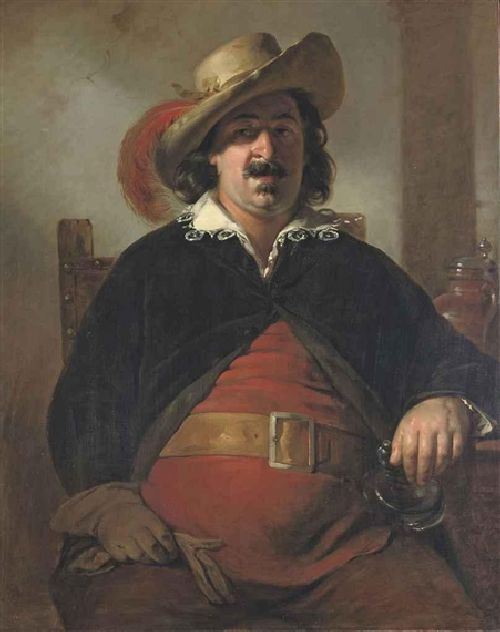
A hand-painted reproduction of Bogumil Dawison as Richard III by Friedrich von Amerling, prized for its dramatic light and richly built surface.
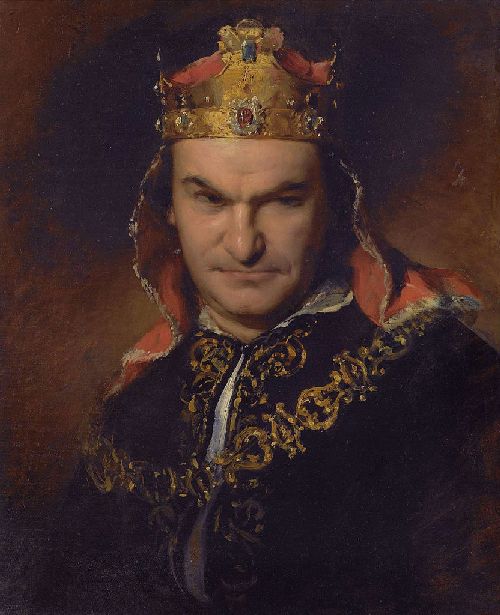
A single figure holds the canvas in a costume of theatrical weight, the face turned with an intensity that suggests a moment caught mid-gesture rather than a formal sitting. Dark drapery falls in heavy folds around the shoulders, and a shaft of light finds the features and the fabric at once, leaving the background to recede into shadow. The eye settles first on that face, then travels outward to the costume detail before returning, which is exactly how a well-built portrait composition is meant to work.
Friedrich von Amerling painted Bogumil Dawison, a celebrated actor of his day, in the role of Richard III, and the choice of subject tells us something about Viennese portraiture in the mid-nineteenth century: the stage and the studio were closely linked, and a sitter known for dramatic presence invited a portrait that matched it. Amerling built his reputation on exactly this kind of psychological immediacy, and by the time this work was made he had already established himself as the portraitist favoured by the court and by the cultural figures of Vienna. The handling here favours warm, controlled tonal contrast over broad colour incident, with the darks kept rich rather than flat and the lit passages built up with a confidence that reads as spontaneous even where it is carefully staged.
What holds attention on close inspection is the restraint in the brushwork around the face against the freer handling of the costume, a contrast that gives the picture its sense of a living presence caught in performance. The composition keeps the figure slightly off centre, allowing the drapery and the fall of light to carry as much weight as the features themselves, and this balance is part of what makes the portrait sit so comfortably as a large-format wall piece rather than a strictly documentary likeness.
ByMuseum artists produce this painting as a hand-painted oil painting reproduction, working directly from the source image to match the palette, the tonal structure, and the density of the darks that give the original its dramatic charge. Each canvas is painted by a trained professional artist rather than printed, so the raised texture of the drapery, the built-up highlights on the face, and the layered oil colour across the background are all physically present on the surface, the kind of detail a discerning eye looks for when judging a fine art reproduction against a flat print. The result is a painted object with genuine surface variation, not a reproduction that merely resembles one at a glance.
Lived with over time, the portrait tends to reward patience: the shift of light through a room changes what the drapery gives up and what the face holds back, and details that seemed settled on the first viewing keep asking to be looked at again.
Empty walls flatten a room. A classical artwork restores structure and visual hierarchy. One painting defines the space, anchors furniture, and establishes identity.
Worldwide shipping included. Each painting is produced to order and safely packed for international transport.
All payments are encrypted and processed through trusted payment providers.
Real brushwork, layered oil paint, and durable pigments on museum-quality canvas.
If the result does not meet expectations, return it for a full refund.


Your artwork is painted on premium cotton canvas, then shipped safely rolled in a rigid tube with extra blank canvas border — ready for stretching or framing locally.
Select a handcrafted frame and we’ll deliver your painting fully assembled, protected, and ready to hang.
For safe shipping, framing is available up to a maximum size. Larger sizes will automatically disable the frame option.


Choose “Stretched” to receive your canvas mounted on wooden stretcher bars — perfect if you’ll frame it later or display it as-is.
Gallery Wrap is a deeper, 1.5" style stretcher. The canvas wraps around the sides and is stapled on the back for a clean, modern, frameless look.
We ship with UPS, FedEx, or DHL straight to your door. You’ll receive a tracking number as soon as your order leaves our studio. Typical delivery is 4–5 business days after dispatch; large, framed, or stretched pieces may take longer depending on the safest shipping route.


Unframed canvases are protected with a film, carefully rolled, and secured inside a rigid shipping tube.

Stretched, Gallery Wrapped, and Framed paintings are wrapped, cushioned with foam protection, and boxed for safe transit.