Loading cart…
No products in the cart.

Original price was: $599.00.$299.00Current price is: $299.00.
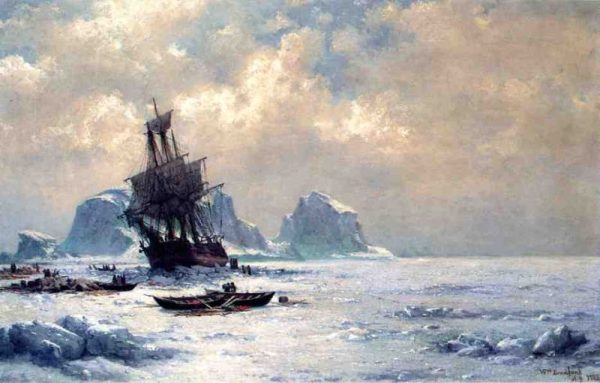
Own Caught in the Ice by William Bradford as a hand-painted oil reproduction, its icebound light and layered surface recreated stroke by stroke on canvas.
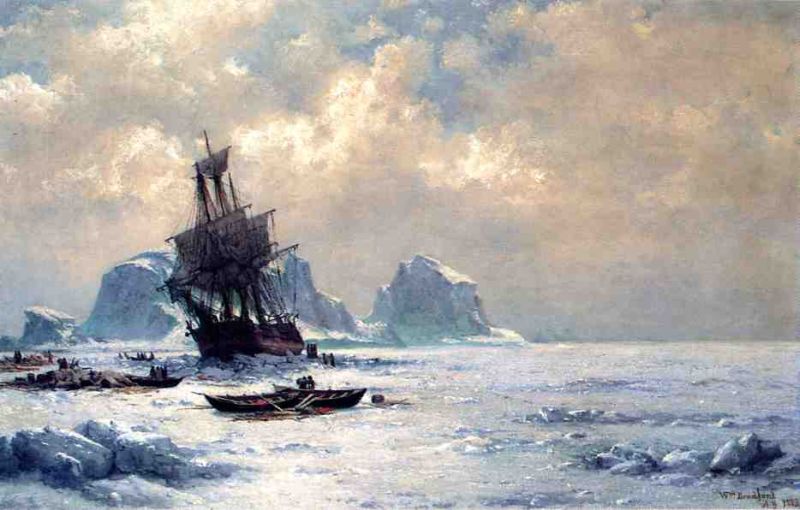
Arctic subjects held a particular fascination for nineteenth-century audiences, and few painters answered that appetite with the authority of William Bradford, whose polar scenes were admired in their own time as a kind of eyewitness testimony from a world few of his viewers would ever see. Caught in the Ice belongs to that body of work, and it has been read ever since as both a famous painting of Arctic exploration and a study in how light behaves on ice and open water.
The composition sets a vessel against a field of pack ice, the ship rendered small within the vastness that surrounds it, so that scale itself becomes part of the subject. Bradford builds the scene through careful gradations of white, grey, and pale blue, letting the density of paint thin and thicken to separate the solid mass of ice from the softer distances of sky and open sea. The effect is not decorative; it is observational, the product of an artist who had sailed into these waters and studied their light directly rather than imagined it from a studio.
That documentary instinct shapes every passage of the picture. Edges are handled with a precision that suggests measured looking rather than invention, while the broader tonal design holds the whole together so the eye can move from the ship to the ice field and back without losing the sense of one continuous, frozen atmosphere. It is a painting built on restraint, its drama coming from accumulation of detail rather than incident.
ByMuseum reproduces Caught in the Ice as a hand-painted oil painting reproduction, worked by a trained artist in oil on artist-grade canvas rather than printed or reproduced by mechanical means. The palette is matched passage by passage, the layered brushwork left visible so the surface carries the same texture and depth of colour as the original composition. What arrives is a painted object, with the raised weight of oil and the grain of canvas beneath it, not a flat facsimile.
Hung where morning light can cross its surface, the picture holds a cool, contemplative quiet well suited to a study, a hallway, or any room where a measured northern light is welcome. It reads well from a distance, where the tonal masses carry the composition, and rewards closer study of its layered surface at nearer range.
Empty walls flatten a room. A classical artwork restores structure and visual hierarchy. One painting defines the space, anchors furniture, and establishes identity.
Worldwide shipping included. Each painting is produced to order and safely packed for international transport.
All payments are encrypted and processed through trusted payment providers.
Real brushwork, layered oil paint, and durable pigments on museum-quality canvas.
If the result does not meet expectations, return it for a full refund.


Your artwork is painted on premium cotton canvas, then shipped safely rolled in a rigid tube with extra blank canvas border — ready for stretching or framing locally.
Select a handcrafted frame and we’ll deliver your painting fully assembled, protected, and ready to hang.
For safe shipping, framing is available up to a maximum size. Larger sizes will automatically disable the frame option.


Choose “Stretched” to receive your canvas mounted on wooden stretcher bars — perfect if you’ll frame it later or display it as-is.
Gallery Wrap is a deeper, 1.5" style stretcher. The canvas wraps around the sides and is stapled on the back for a clean, modern, frameless look.
We ship with UPS, FedEx, or DHL straight to your door. You’ll receive a tracking number as soon as your order leaves our studio. Typical delivery is 5 to 7 days after dispatch; large, framed, or stretched pieces may take longer depending on the safest shipping route.


Unframed canvases are protected with a film, carefully rolled, and secured inside a rigid shipping tube.

Stretched, Gallery Wrapped, and Framed paintings are wrapped, cushioned with foam protection, and boxed for safe transit.