Loading cart…
No products in the cart.

Original price was: $599.00.$299.00Current price is: $299.00.
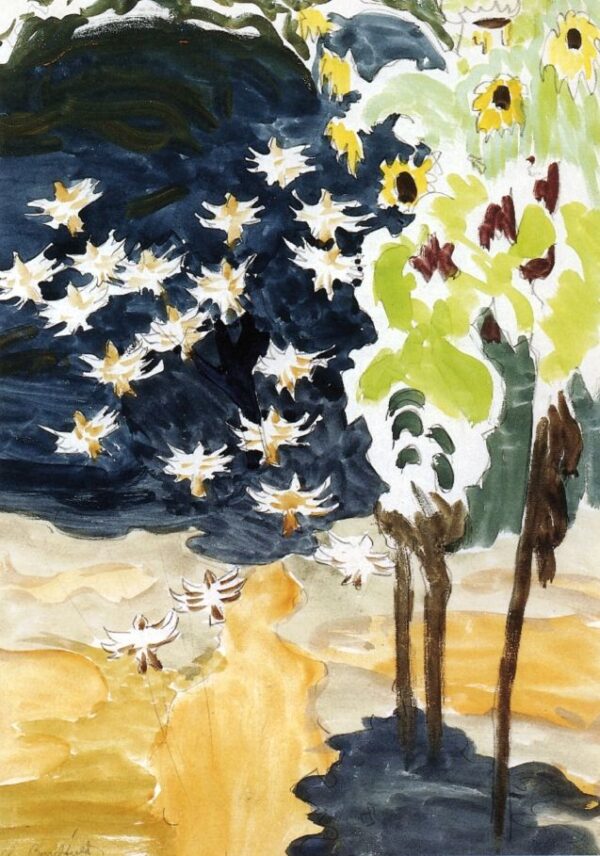
Choose Childhood’s Garden by Charles Burchfield as a hand-painted oil reproduction that carries across every shift of colour, from mossy green to sudden rust, exactly as the artist laid it down.

Look at where the greens turn: a damp, mossy green pressing against a drier olive, then giving way without warning to a rust or ochre that has no business being there and yet holds the whole passage together. That is where Childhood’s Garden begins, in the friction of colour rather than in any single shape. Charles Burchfield lets a cool shadow-blue sit right beside a warm yellow-green, so the two seem to vibrate where they touch, and it is this quiet argument of hues, more than any object in the scene, that carries the feeling of the picture.
Burchfield came to this kind of garden subject with an eye already trained on the strangeness inside ordinary things, the way a hedge or a patch of overgrown grass could hold something closer to memory than to botany. In Childhood’s Garden the composition is built from close, related tones that are then interrupted by a sharper accent, a passage of colour pitched a little too intensely for naturalism, which is exactly the point. The edges are handled with real judgement: some dissolve softly into the surrounding air, others are drawn firmly, almost nervously, so the eye keeps discovering new thresholds between one zone of colour and the next.
What holds the painting together is rhythm rather than symmetry. Denser, more saturated passages sit near quieter, more diluted ones, and the alternation pulls your attention gently around the canvas instead of anchoring it in one place. This is Expressionism used to describe an emotional register, not a literal one; the garden becomes a state of feeling built out of colour relationships, and that feeling is what stays with you once the specific forms have faded from memory.
Reproducing that requires more than matching a swatch of green to a swatch of green. Our painters study how one hue is laid beside another, at what thickness, with what direction of brushstroke, so the same friction and the same quiet accents reappear on the new canvas. This is a hand-painted oil painting reproduction, worked in real pigment and built up in layers the way the original was, not a flat facsimile, and the surface carries the same visible texture and the same small variations in the paint film that give the picture its life. The result is a museum quality reproduction meant to be looked at closely, the way you would look at the original.
What we carry across, deliberately and by hand, is the exact sequence of colour: which tone sits under which, where a warm note breaks a cool passage, how far an edge is allowed to soften before it disappears. Getting the palette right is what makes a reproduction faithful, more than getting the outline right, because the palette is where Burchfield put the meaning of the picture. Here is what you receive when you choose this painting for your own wall:
Empty walls flatten a room. A classical artwork restores structure and visual hierarchy. One painting defines the space, anchors furniture, and establishes identity.
Worldwide shipping included. Each painting is produced to order and safely packed for international transport.
All payments are encrypted and processed through trusted payment providers.
Real brushwork, layered oil paint, and durable pigments on museum-quality canvas.
If the result does not meet expectations, return it for a full refund.


Your artwork is painted on premium cotton canvas, then shipped safely rolled in a rigid tube with extra blank canvas border — ready for stretching or framing locally.
Select a handcrafted frame and we’ll deliver your painting fully assembled, protected, and ready to hang.
For safe shipping, framing is available up to a maximum size. Larger sizes will automatically disable the frame option.


Choose “Stretched” to receive your canvas mounted on wooden stretcher bars — perfect if you’ll frame it later or display it as-is.
Gallery Wrap is a deeper, 1.5" style stretcher. The canvas wraps around the sides and is stapled on the back for a clean, modern, frameless look.
We ship with UPS, FedEx, or DHL straight to your door. You’ll receive a tracking number as soon as your order leaves our studio. Typical delivery is 5 to 7 days after dispatch; large, framed, or stretched pieces may take longer depending on the safest shipping route.


Unframed canvases are protected with a film, carefully rolled, and secured inside a rigid shipping tube.

Stretched, Gallery Wrapped, and Framed paintings are wrapped, cushioned with foam protection, and boxed for safe transit.

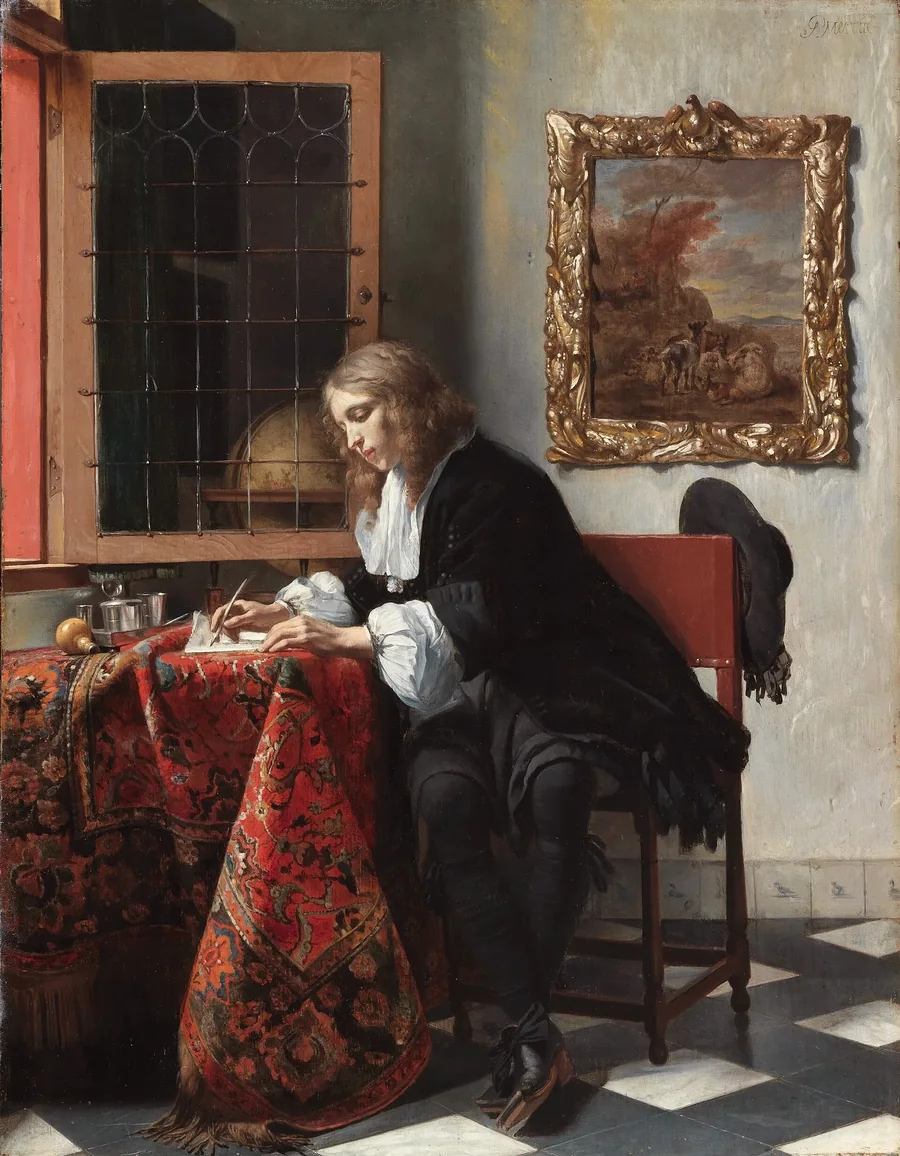
Man Writing a Letter
Gabriel Metsu, c. 1664
The gallery list
Every painting is already 50% off. Join the list and we will send you an extra $15 code, plus first access to new collections.
No spam. Unsubscribe anytime. · Privacy Policy
Welcome
Your $15 code is on its way. Explore the gallery while you wait.