Loading cart…
No products in the cart.

Original price was: $518.00.$259.00Current price is: $259.00.
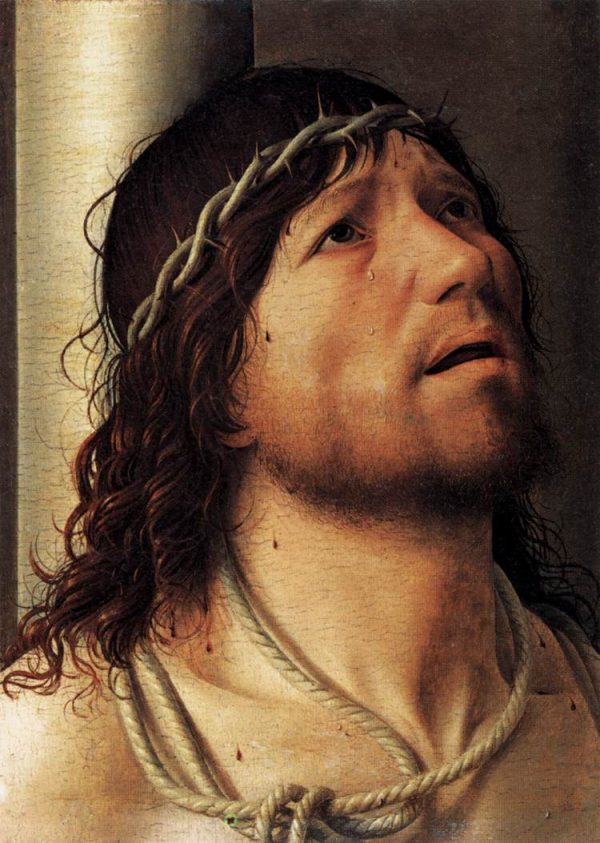
A hand-painted replica of Christ at the Column by Antonello da Messina, its ochre flesh tones set against deep shadow in oil on canvas.

A pale flesh tone, bruised at the shoulder and wrist, meets a ground of deep, almost black-green shadow, and the whole surface seems to hold its breath between the two. Warm ochre and cool grey pass close to one another without quite touching, and this narrow distance is where the picture does its work.
Christ at the Column presents its subject bound to a stone shaft, the body turned so that the column and the figure share a single vertical axis. Antonello da Messina sets this axis against a shallow, dim space, so the eye has nowhere to travel but back to the torso and the quiet angle of the head. The paint is built in thin, controlled layers, a technique associated with Netherlandish panel painting that Messina absorbed and carried into his own practice, and it gives the flesh a soft, almost translucent glow against the surrounding dark. Light falls from a single unseen source, catching the ribs and the collarbone while leaving the column and the background to sink into shadow.
This restraint places the picture within the mature phase of the career of Messina, when Sicilian and Netherlandish habits of looking had settled into something distinct: closely observed surfaces, an economy of gesture, and a refusal of excess narrative detail. The face carries the emotional weight of the image, and its expression is held rather than displayed, a choice that separates this work from more theatrical treatments of the same subject by his contemporaries.
ByMuseum artists study this balance of warm flesh and cold shadow before they begin, matching pigment to pigment so the transitions read as they do in the original. Each hand-painted oil painting reproduction is worked in oil on canvas, with the brush passing over the surface the way it would on the original panel, building the same thin layers and leaving the same quiet variation in texture. It is a hand-painted replica in the fullest sense, not a mechanical copy, made by a trained painter working from close observation rather than a printed transfer.
What survives the move from panel to canvas is the relationship between the figure and its shadow, the particular grey that sits beside the flesh tone, and the stillness that keeps the image from tipping into melodrama. These are the qualities that make the picture worth living with, and they are what the reproduction is built to preserve.
Empty walls flatten a room. A classical artwork restores structure and visual hierarchy. One painting defines the space, anchors furniture, and establishes identity.
Worldwide shipping included. Each painting is produced to order and safely packed for international transport.
All payments are encrypted and processed through trusted payment providers.
Real brushwork, layered oil paint, and durable pigments on museum-quality canvas.
If the result does not meet expectations, return it for a full refund.


Your artwork is painted on premium cotton canvas, then shipped safely rolled in a rigid tube with extra blank canvas border — ready for stretching or framing locally.
Select a handcrafted frame and we’ll deliver your painting fully assembled, protected, and ready to hang.
For safe shipping, framing is available up to a maximum size. Larger sizes will automatically disable the frame option.


Choose “Stretched” to receive your canvas mounted on wooden stretcher bars — perfect if you’ll frame it later or display it as-is.
Gallery Wrap is a deeper, 1.5" style stretcher. The canvas wraps around the sides and is stapled on the back for a clean, modern, frameless look.
We ship with UPS, FedEx, or DHL straight to your door. You’ll receive a tracking number as soon as your order leaves our studio. Typical delivery is 5 to 7 days after dispatch; large, framed, or stretched pieces may take longer depending on the safest shipping route.


Unframed canvases are protected with a film, carefully rolled, and secured inside a rigid shipping tube.

Stretched, Gallery Wrapped, and Framed paintings are wrapped, cushioned with foam protection, and boxed for safe transit.