Loading cart…
No products in the cart.

Original price was: $518.00.$259.00Current price is: $259.00.
A solitary Christ on the Cross by Francisco de Zurbaran, painted alone against deep shadow with a sculptural realism that once fooled viewers into seeing stone, not canvas.
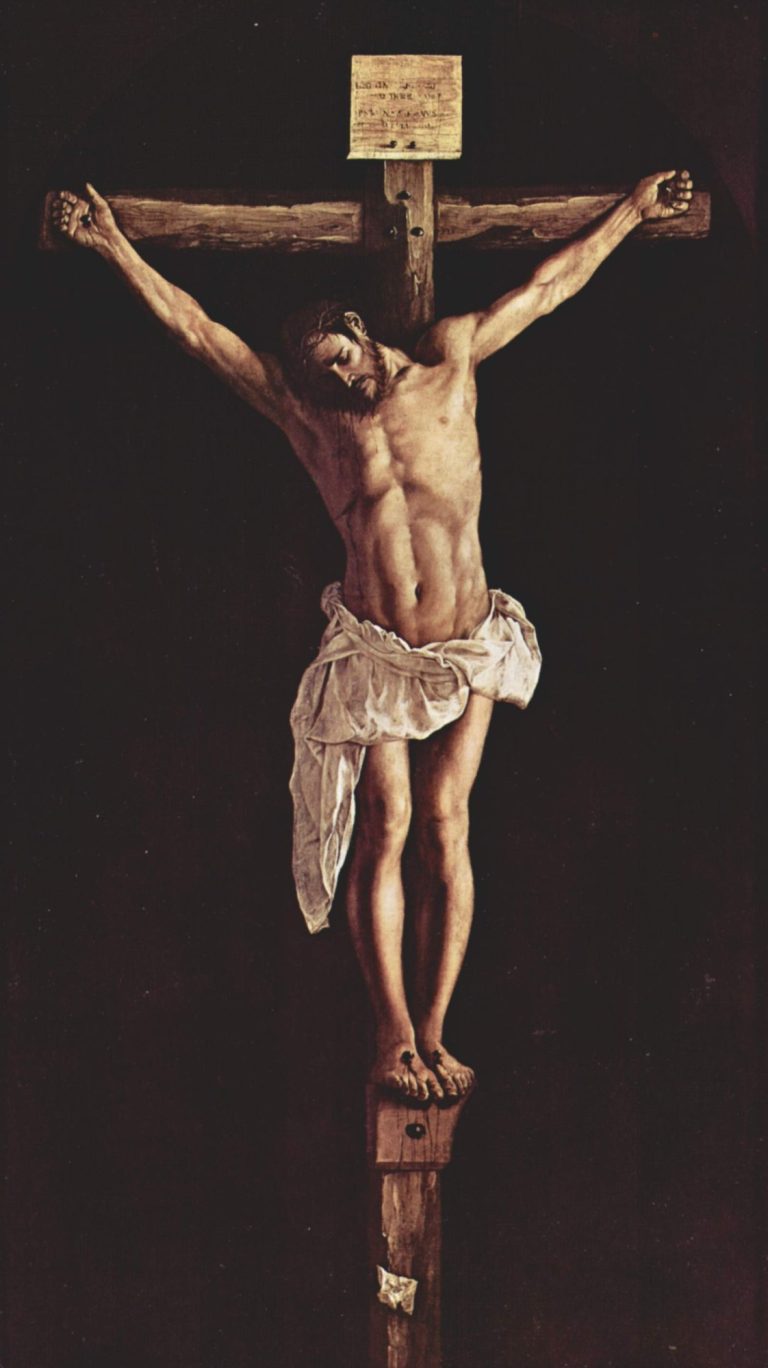
Look first at the small scrap of paper painted at the foot of the cross. It is barely larger than a thumbnail, curling at one corner as though it might lift away from the canvas, and on it Francisco de Zurbaran placed his signature and the date. That one illusionistic detail tells you everything about how this Christ on the Cross reproduction should be read: as an exercise in making paint behave like matter, stone, cloth, and flesh all rendered so convincingly that early viewers in Seville mistook the picture for a carved sculpture seen through the gloom of a monastery grill.
Zurbaran painted the work in 1627 for the Dominican monastery of San Pablo el Real, part of a larger commission for the young artist, and he made a deliberate choice that sets this crucifixion apart from the crowded, grieving scenes common before the Counter-Reformation. There are no mourners, no landscape, no narrative detail to soften or explain the moment. Christ hangs alone against a background so dark it reads as absence rather than place, and that isolation forces total attention onto the body. The feet are nailed separately, one above the other, a detail that reflects a live theological argument of the period over whether three nails or four were used at Calvary. Light falls across the figure at a sharp angle, carving the ribs, the tendons of the arms, and the slack weight of the head with a precision that owes as much to sculpture as to painting.
The white loincloth is where the brushwork does its most demanding work, folded and twisted into a sequence of crisp, almost geometric planes that catch the raking light and throw deep shadow into the hollows between them. Against the velvety black of the background, every fold reads as carved rather than drawn, and that contrast between illuminated cloth and swallowing darkness is the engine of the whole composition.
Producing an oil painting reproduction of a picture built this way means paying close attention to how the light lands, not just where it falls. Our painters work by hand on artist-grade canvas, building up the loincloth in the same layered, blocky strokes Zurbaran used and letting the background sink into a comparable depth of shadow rather than flattening it to a single tone. This is a handmade oil painting, reconstructed stroke by stroke rather than printed, so the raised texture of the pigment on the cloth and the subtle unevenness of the dark ground survive onto your wall exactly as they exist on the original canvas.
| artists |
|---|
Empty walls flatten a room. A classical artwork restores structure and visual hierarchy. One painting defines the space, anchors furniture, and establishes identity.
Worldwide shipping included. Each painting is produced to order and safely packed for international transport.
All payments are encrypted and processed through trusted payment providers.
Real brushwork, layered oil paint, and durable pigments on museum-quality canvas.
If the result does not meet expectations, return it for a full refund.


Your artwork is painted on premium cotton canvas, then shipped safely rolled in a rigid tube with extra blank canvas border — ready for stretching or framing locally.
Select a handcrafted frame and we’ll deliver your painting fully assembled, protected, and ready to hang.
For safe shipping, framing is available up to a maximum size. Larger sizes will automatically disable the frame option.


Choose “Stretched” to receive your canvas mounted on wooden stretcher bars — perfect if you’ll frame it later or display it as-is.
Gallery Wrap is a deeper, 1.5" style stretcher. The canvas wraps around the sides and is stapled on the back for a clean, modern, frameless look.
We ship with UPS, FedEx, or DHL straight to your door. You’ll receive a tracking number as soon as your order leaves our studio. Typical delivery is 5 to 7 days after dispatch; large, framed, or stretched pieces may take longer depending on the safest shipping route.


Unframed canvases are protected with a film, carefully rolled, and secured inside a rigid shipping tube.

Stretched, Gallery Wrapped, and Framed paintings are wrapped, cushioned with foam protection, and boxed for safe transit.

Reviews
There are no reviews yet.