Loading cart…
No products in the cart.

Original price was: $599.00.$299.00Current price is: $299.00.
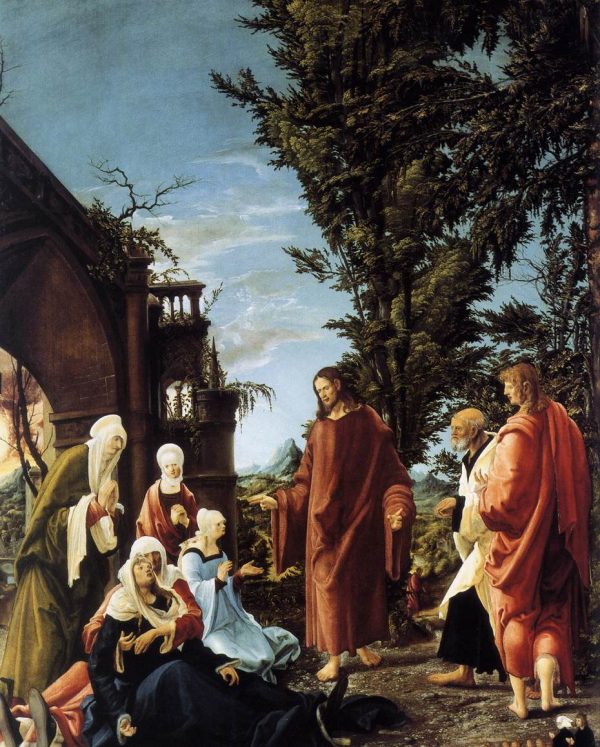
Christ Taking Leave of His Mother by Albrecht Altdorfer renders a quietly devastating farewell in rich Danube School colour, hand-painted in oil rather than printed.
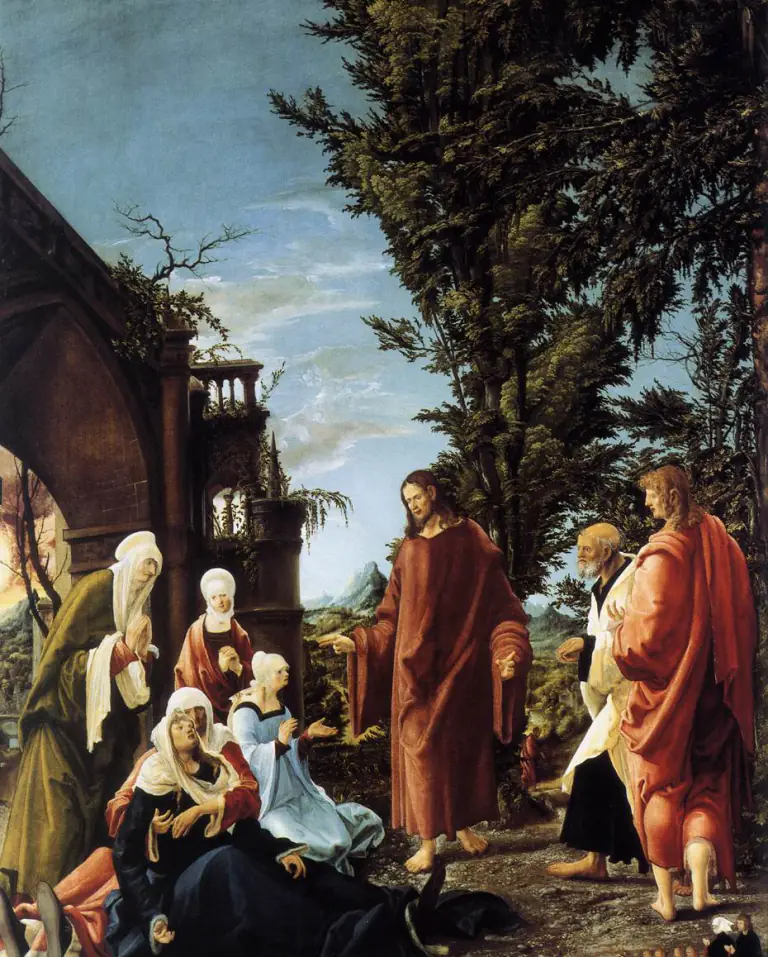
Mary reaches toward her son with one hand half raised, not quite touching him, and in that suspended gesture Albrecht Altdorfer compresses the entire weight of the scene. The moment is small and domestic rather than heroic: Christ is leaving for Jerusalem, and the farewell plays out among a cluster of figures pressed close together, their faces turned inward in grief rather than out toward the viewer.
The composition belongs to the Danube School, the group of painters working along the river in the early sixteenth century who favoured atmosphere and emotional charge over the classical clarity coming out of Italy at the same time. Altdorfer arranges his figures in a tight, almost theatrical huddle, letting drapery fold and pool in heavy, expressive masses that seem to carry as much feeling as the faces do. Colour is used with unusual boldness for a devotional subject, patches of saturated red and blue set against warmer, more muted flesh tones, and the paint handling throughout is loose and painterly rather than tightly finished, closer in spirit to the freedom of his landscape work than to the polished surfaces of his Northern contemporaries.
Light falls unevenly across the group, catching the folds of a sleeve or the curve of a cheek while leaving the background in shadow, a device that pulls attention toward the emotional centre of the scene rather than toward architectural or narrative detail. This is Altdorfer working at the height of his engagement with religious subjects, before his later years turned more decisively toward landscape and print, and the painting carries the psychological intensity that recurs across his devotional work.
Each ByMuseum reproduction of this composition is painted by hand rather than printed, a trained artist working in oil on artist-grade cotton canvas to match the palette and rebuild the layered glazes and gestural brushwork of the original. The result is a museum quality reproduction with real surface texture, the kind of raised, tactile paint that a screen or a print can only approximate, making it an oil painting reproduction in the fullest sense of the term rather than a flat facsimile.
This suits a collector drawn to Northern Renaissance intimacy over grandeur, or a room that wants a devotional scene with genuine emotional weight rather than decorative piety.
| artists |
|---|
Empty walls flatten a room. A classical artwork restores structure and visual hierarchy. One painting defines the space, anchors furniture, and establishes identity.
Worldwide shipping included. Each painting is produced to order and safely packed for international transport.
All payments are encrypted and processed through trusted payment providers.
Real brushwork, layered oil paint, and durable pigments on museum-quality canvas.
If the result does not meet expectations, return it for a full refund.


Your artwork is painted on premium cotton canvas, then shipped safely rolled in a rigid tube with extra blank canvas border — ready for stretching or framing locally.
Select a handcrafted frame and we’ll deliver your painting fully assembled, protected, and ready to hang.
For safe shipping, framing is available up to a maximum size. Larger sizes will automatically disable the frame option.


Choose “Stretched” to receive your canvas mounted on wooden stretcher bars — perfect if you’ll frame it later or display it as-is.
Gallery Wrap is a deeper, 1.5" style stretcher. The canvas wraps around the sides and is stapled on the back for a clean, modern, frameless look.
We ship with UPS, FedEx, or DHL straight to your door. You’ll receive a tracking number as soon as your order leaves our studio. Typical delivery is 5 to 7 days after dispatch; large, framed, or stretched pieces may take longer depending on the safest shipping route.


Unframed canvases are protected with a film, carefully rolled, and secured inside a rigid shipping tube.

Stretched, Gallery Wrapped, and Framed paintings are wrapped, cushioned with foam protection, and boxed for safe transit.

Man Writing a Letter
Gabriel Metsu, c. 1664
The gallery list
Every painting is already 50% off. Join the list and we will send you an extra $15 code, plus first access to new collections.
No spam. Unsubscribe anytime. · Privacy Policy
Welcome
Your $15 code is on its way. Explore the gallery while you wait.