Loading cart…
No products in the cart.

Original price was: $599.00.$299.00Current price is: $299.00.
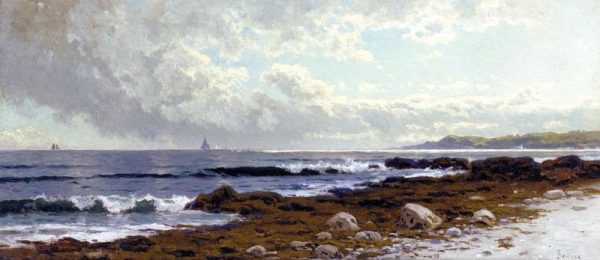
A quiet, light-filled coastal view by Alfred Thompson Bricher, recreated as a hand-painted oil reproduction with the layered colour and worked surface of the original.

Look at the strip of pale light where sky meets water. Bricher lays it in with a thin, almost dry pass of white and grey, just enough to suggest the horizon dissolving into haze, and that single passage sets the temperature for the whole canvas. It is a quiet trick, but it is the kind of quiet trick that tells you exactly who painted this.
Coastal Scene b belongs to the tradition Bricher absorbed from the Hudson River School and then pared down toward something more intimate and atmospheric. Rather than staging a dramatic wilderness, he builds the picture from small, exact observations: the placement of a rock, a shift in the density of cloud, the way a wave loses its edge as it runs onto sand. The composition moves the eye from a clearly stated foreground through a middle distance handled with real restraint, out to a horizon that is more suggested than drawn. Light does most of the work here, softened and diffused rather than dramatic, and it is this handling of light that gives the coastal scene its sense of stillness.
The structure beneath that stillness is carefully calculated. Bricher repeats certain shapes and intervals across the canvas, a low rock echoed by a distant sail, a band of shadow answered by a band of reflected light, so that the whole surface feels connected rather than assembled from separate parts. It is a mature, confident piece of picture-making, the work of an artist who understood exactly how much information a coastal view needs and how much it is better left unsaid.
When our painters take on a piece like this, they are not trying to copy a photograph of the canvas but to rebuild the decisions inside it, brushstroke by brushstroke, in oil on artist-grade canvas. This is what separates a genuine oil painting reproduction from a printed image: the horizon is worked again in real pigment, layered until it has the same soft dissolve as the original, and the rocks and water carry the same weight of paint that Bricher gave them. Colour is matched by eye against the source work, and the surface is left with its own texture, so the final piece reads as a fine art reproduction rather than a flat facsimile. What survives the translation is not just the image but the touch behind it, which is, in the end, what makes a painting worth having on a wall.
Empty walls flatten a room. A classical artwork restores structure and visual hierarchy. One painting defines the space, anchors furniture, and establishes identity.
Worldwide shipping included. Each painting is produced to order and safely packed for international transport.
All payments are encrypted and processed through trusted payment providers.
Real brushwork, layered oil paint, and durable pigments on museum-quality canvas.
If the result does not meet expectations, return it for a full refund.


Your artwork is painted on premium cotton canvas, then shipped safely rolled in a rigid tube with extra blank canvas border — ready for stretching or framing locally.
Select a handcrafted frame and we’ll deliver your painting fully assembled, protected, and ready to hang.
For safe shipping, framing is available up to a maximum size. Larger sizes will automatically disable the frame option.


Choose “Stretched” to receive your canvas mounted on wooden stretcher bars — perfect if you’ll frame it later or display it as-is.
Gallery Wrap is a deeper, 1.5" style stretcher. The canvas wraps around the sides and is stapled on the back for a clean, modern, frameless look.
We ship with UPS, FedEx, or DHL straight to your door. You’ll receive a tracking number as soon as your order leaves our studio. Typical delivery is 5 to 7 days after dispatch; large, framed, or stretched pieces may take longer depending on the safest shipping route.


Unframed canvases are protected with a film, carefully rolled, and secured inside a rigid shipping tube.

Stretched, Gallery Wrapped, and Framed paintings are wrapped, cushioned with foam protection, and boxed for safe transit.