Loading cart…
No products in the cart.

Original price was: $599.00.$299.00Current price is: $299.00.
A hand-painted oil on canvas reproduction of Comanche Feats of Horsemanship by Catlin, bringing a documented moment of Plains horsemanship into a painted surface built with real brushwork.
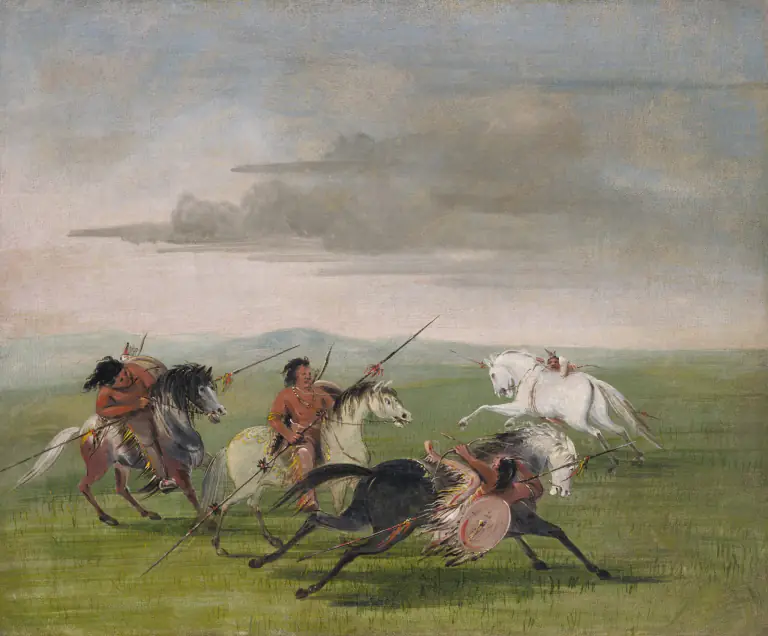
In the 1830s George Catlin travelled deep into the American West to record the lives of Plains peoples before, as he feared, those lives were changed beyond recognition. Comanche Feats of Horsemanship came out of that journey, painted after Catlin had watched Comanche riders perform the mounted displays for which they were already famed among traders and travellers on the southern plains. The picture is less a single portrait than a record of skill in motion, made by an artist who understood he was documenting something that would not last.
The composition spreads riders and horses across a wide, open ground, their bodies angled and overlapping so that the eye reads speed even in a still image. Catlin arranges the figures so attention moves from the foreground riders, caught mid-feat, out toward smaller groups at the edges, giving the scene the feel of a field seen all at once rather than a posed arrangement. Light falls evenly across the dust and grass, and the palette stays close to earth tones, ochres, browns, and pale sky, with brighter touches reserved for paint and feathered ornament on the riders themselves.
Edges soften where forms recede and sharpen where the action is thickest, a device Catlin used often to keep a busy scene readable. The brushwork is direct rather than polished, suited to a working method built on speed and observation in the field, then refined afterward in the studio. It belongs to the body of work that made Catlin one of the most consulted visual sources on Plains life in the nineteenth century, valued as much for its ethnographic detail as for its handling of paint.
ByMuseum recreates this composition as an oil on canvas reproduction, painted by hand rather than printed. A trained artist works from the original palette and structure, laying pigment in the same passages of thick and thin paint that give the surface its movement, so the raised strokes and the texture of the canvas weave remain visible under raking light. The result is a hand-painted oil painting reproduction meant to be looked at closely, the way the original invites, rather than glanced at as a flat image.
Almost two centuries on, the scene still holds attention because it records something no photograph could, a moment of skill and motion set down by someone who was there. Owning a painted version keeps that immediacy in the room rather than behind glass.
Empty walls flatten a room. A classical artwork restores structure and visual hierarchy. One painting defines the space, anchors furniture, and establishes identity.
Worldwide shipping included. Each painting is produced to order and safely packed for international transport.
All payments are encrypted and processed through trusted payment providers.
Real brushwork, layered oil paint, and durable pigments on museum-quality canvas.
If the result does not meet expectations, return it for a full refund.


Your artwork is painted on premium cotton canvas, then shipped safely rolled in a rigid tube with extra blank canvas border — ready for stretching or framing locally.
Select a handcrafted frame and we’ll deliver your painting fully assembled, protected, and ready to hang.
For safe shipping, framing is available up to a maximum size. Larger sizes will automatically disable the frame option.


Choose “Stretched” to receive your canvas mounted on wooden stretcher bars — perfect if you’ll frame it later or display it as-is.
Gallery Wrap is a deeper, 1.5" style stretcher. The canvas wraps around the sides and is stapled on the back for a clean, modern, frameless look.
We ship with UPS, FedEx, or DHL straight to your door. You’ll receive a tracking number as soon as your order leaves our studio. Typical delivery is 5 to 7 days after dispatch; large, framed, or stretched pieces may take longer depending on the safest shipping route.


Unframed canvases are protected with a film, carefully rolled, and secured inside a rigid shipping tube.

Stretched, Gallery Wrapped, and Framed paintings are wrapped, cushioned with foam protection, and boxed for safe transit.

Man Writing a Letter
Gabriel Metsu, c. 1664
The gallery list
Every painting is already 50% off. Join the list and we will send you an extra $15 code, plus first access to new collections.
No spam. Unsubscribe anytime. · Privacy Policy
Welcome
Your $15 code is on its way. Explore the gallery while you wait.