Loading cart…
No products in the cart.

Original price was: $518.00.$259.00Current price is: $259.00.
Own Comanche War Party, Chief Discovering the Enemy and Urging his Men at Sunrise by Catlin, a hand-painted replica that captures the tension of dawn on the plains in layered oil.
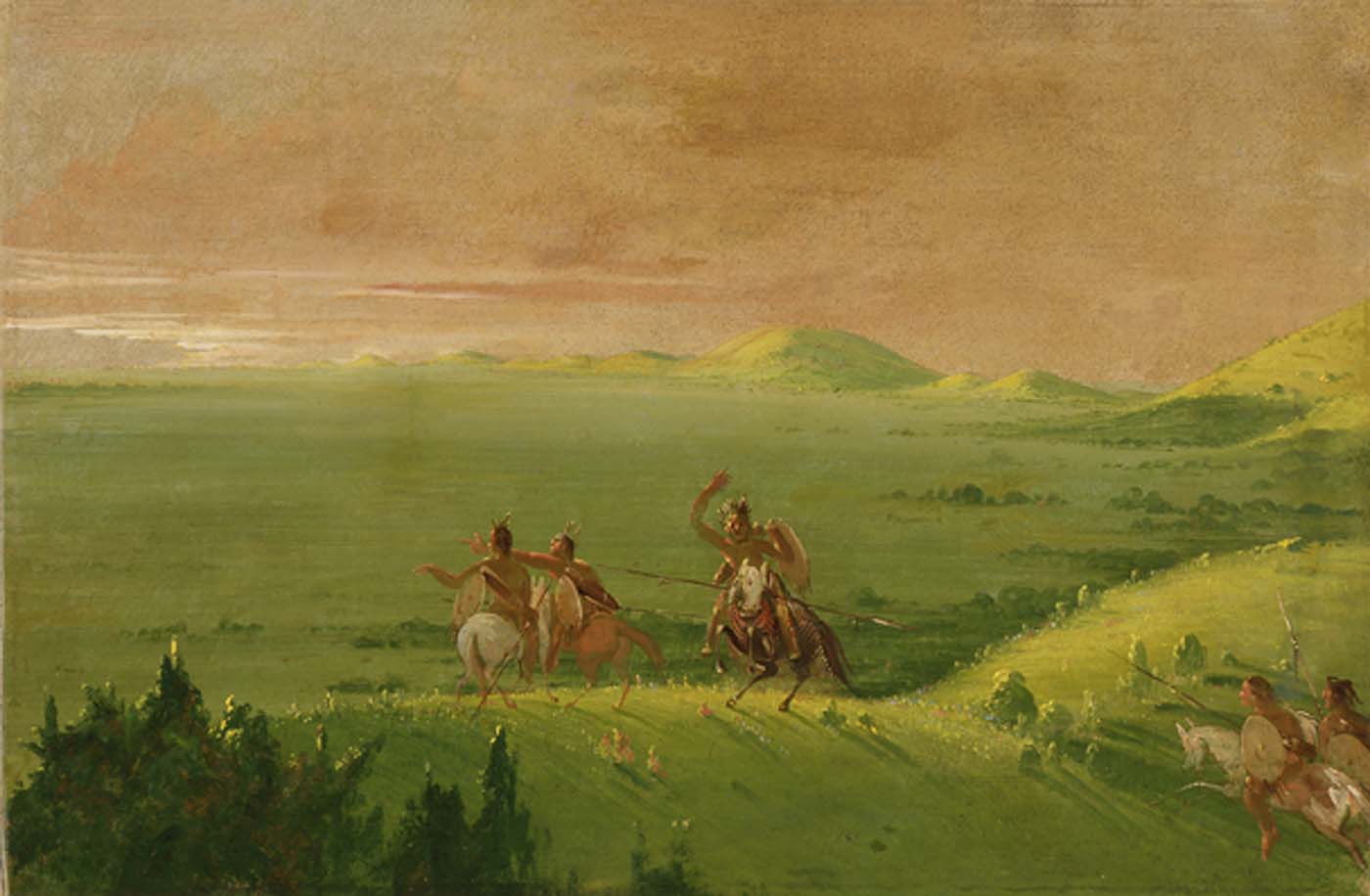
Dawn breaks over the plains and a war chief lifts his arm, having just spotted the enemy in the distance. His riders gather close, reading the urgency in his gesture before a word is spoken. This is the instant George Catlin fixes on canvas: not the battle itself, but the charged moment before it, when discipline and readiness matter more than motion.
Catlin painted this scene during his travels among the Plains tribes in the 1830s, a period when he set himself the task of recording Native American life before it was irrevocably altered by westward expansion. The composition is built around the chief, positioned to catch the first light of morning while his men fan out behind him in loose but purposeful formation. Horses turn their heads in the same direction as their riders, a small detail that unifies the group and pulls the eye toward the horizon where danger waits.
The palette leans on the warm ochres and rose tones of sunrise, set against the cooler shadow still clinging to the grass and the riders nearest the viewer. Catlin worked quickly in the field, and that immediacy survives in the loose, confident handling of paint, particularly in the horses and the sky, where broader strokes suggest movement without overworking the surface. It is a picture built on observation rather than invention, part of the larger body of work through which Catlin documented tribal customs, dress, and daily life with an ethnographic seriousness that set him apart from other painters of the American West.
Recreating this scene as a hand-painted oil painting reproduction means working from the same structural decisions Catlin made: the direction of the light, the placement of the chief against open sky, the density of the riders as they recede into the middle distance. A trained painter builds up the canvas in oil, layer by layer, so the surface carries the same visible brushwork and quiet variation in texture as the original composition. The result is a hand-painted replica rather than a flat copy, a physical object with depth and presence on the wall.
What carries across is the geometry of the moment, the balance between the chief and his men, the exact temperature of that early light, because these are the choices that make the scene legible and urgent, and losing any of them would flatten the picture into a generic riding scene rather than a specific dawn.
Empty walls flatten a room. A classical artwork restores structure and visual hierarchy. One painting defines the space, anchors furniture, and establishes identity.
Worldwide shipping included. Each painting is produced to order and safely packed for international transport.
All payments are encrypted and processed through trusted payment providers.
Real brushwork, layered oil paint, and durable pigments on museum-quality canvas.
If the result does not meet expectations, return it for a full refund.


Your artwork is painted on premium cotton canvas, then shipped safely rolled in a rigid tube with extra blank canvas border — ready for stretching or framing locally.
Select a handcrafted frame and we’ll deliver your painting fully assembled, protected, and ready to hang.
For safe shipping, framing is available up to a maximum size. Larger sizes will automatically disable the frame option.


Choose “Stretched” to receive your canvas mounted on wooden stretcher bars — perfect if you’ll frame it later or display it as-is.
Gallery Wrap is a deeper, 1.5" style stretcher. The canvas wraps around the sides and is stapled on the back for a clean, modern, frameless look.
We ship with UPS, FedEx, or DHL straight to your door. You’ll receive a tracking number as soon as your order leaves our studio. Typical delivery is 4–5 business days after dispatch; large, framed, or stretched pieces may take longer depending on the safest shipping route.


Unframed canvases are protected with a film, carefully rolled, and secured inside a rigid shipping tube.

Stretched, Gallery Wrapped, and Framed paintings are wrapped, cushioned with foam protection, and boxed for safe transit.