Loading cart…
No products in the cart.

Original price was: $599.00.$299.00Current price is: $299.00.
Composition VIII (Composition 8) by Wassily Kandinsky, painted by hand in oil on canvas: ruled lines, compass-drawn circles and clean flat colour on a pale ground. Abstract wall art from the Bauhaus that suits modern, mid-century and minimal interiors.
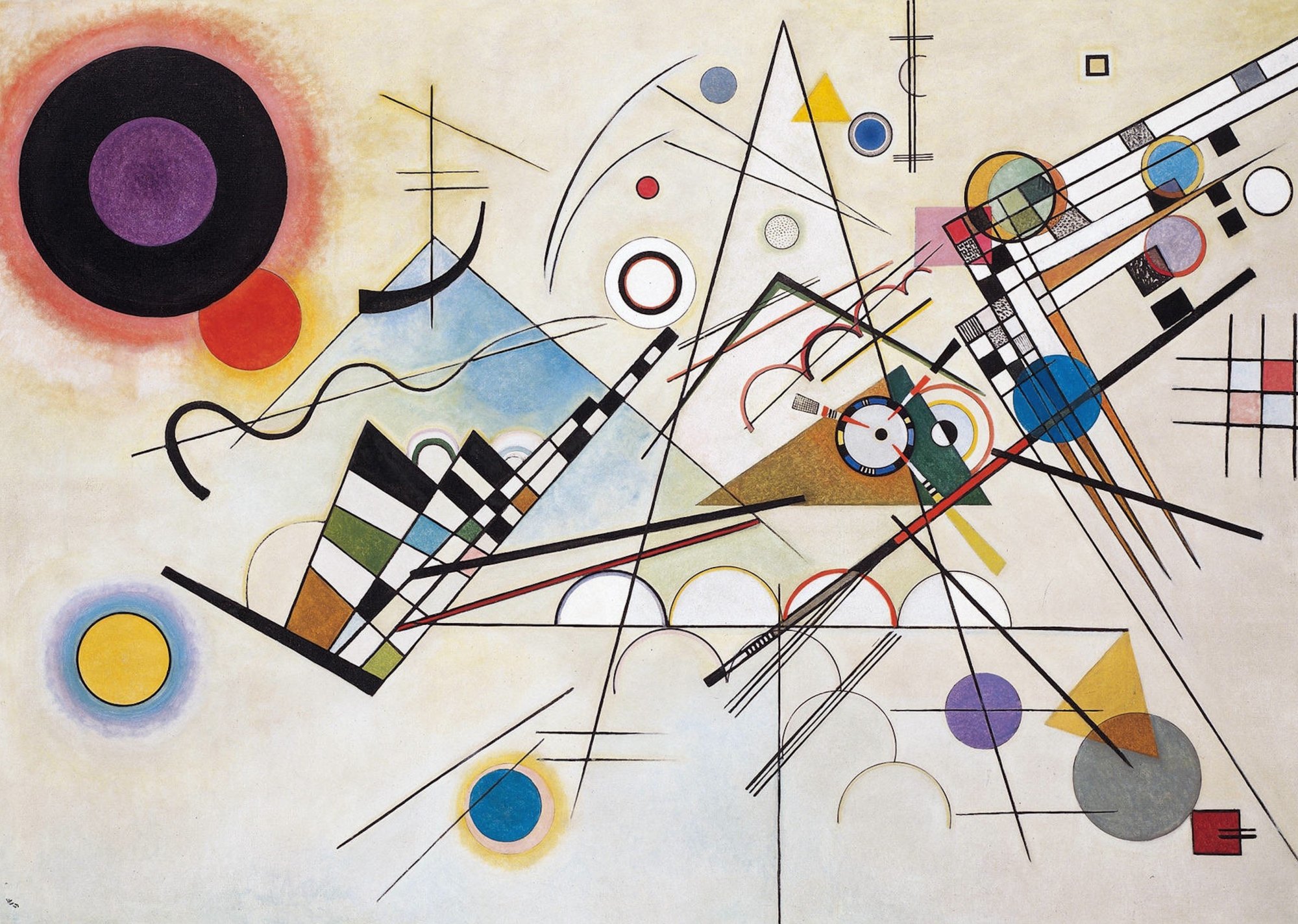
About the painting. Composition VIII, also known as Composition 8, sets circles, triangles, ruled lines and a tilted chequerboard on a pale cream ground, with a great black and violet circle in a pink halo weighing down the top left corner. Wassily Kandinsky painted it at the Bauhaus in July 1923, the moment his abstraction turned from storm to geometry, and in 1930 it became the first Kandinsky Solomon R. Guggenheim bought. Oil on canvas, 140 x 201 cm. Original in the Solomon R. Guggenheim Museum, New York. Read the full story in our guide to Composition VIII by Wassily Kandinsky.
Kandinsky built this painting like a piece of music. The big circle presses down from the corner, the triangles push back against it, the lines cut across, and in the middle a ring like a target holds everything in balance. He believed he could hear colour: yellow was a trumpet, deep blue an organ. Every shape is placed so the whole canvas feels alive and still at the same time.
Our reproduction is painted by hand in oil on canvas, the way Kandinsky made it. The straight lines are ruled, the circles are drawn with a compass, and the colours are laid on flat and clean, so the edges stay crisp and the cream ground stays calm. You get the real surface of paint, not the flat sheen of a Kandinsky print or poster.
It is one of the easiest abstract paintings to live with. The pale ground and clear shapes suit offices, studios, modern living rooms and mid-century or Bauhaus-style interiors, and they work with almost any furniture. If you are looking for abstract wall art with a real story behind it, few paintings changed design as much as this one. It looks best in a thin black or natural wood frame, or with no frame at all.
Artwork guide
Explore the painting’s history, composition and meaning in the ByMuseum art guide.
Read the history and meaning of Composition VIII by KandinskyEmpty walls flatten a room. A classical artwork restores structure and visual hierarchy. One painting defines the space, anchors furniture, and establishes identity.
Worldwide shipping included. Each painting is produced to order and safely packed for international transport.
All payments are encrypted and processed through trusted payment providers.
Real brushwork, layered oil paint, and durable pigments on museum-quality canvas.
If the result does not meet expectations, return it for a full refund.


Your artwork is painted on premium cotton canvas, then shipped safely rolled in a rigid tube with extra blank canvas border — ready for stretching or framing locally.
Select a handcrafted frame and we’ll deliver your painting fully assembled, protected, and ready to hang.
For safe shipping, framing is available up to a maximum size. Larger sizes will automatically disable the frame option.


Choose “Stretched” to receive your canvas mounted on wooden stretcher bars — perfect if you’ll frame it later or display it as-is.
Gallery Wrap is a deeper, 1.5" style stretcher. The canvas wraps around the sides and is stapled on the back for a clean, modern, frameless look.
We ship with UPS, FedEx, or DHL straight to your door. You’ll receive a tracking number as soon as your order leaves our studio. Typical delivery is 5 to 7 days after dispatch; large, framed, or stretched pieces may take longer depending on the safest shipping route.


Unframed canvases are protected with a film, carefully rolled, and secured inside a rigid shipping tube.

Stretched, Gallery Wrapped, and Framed paintings are wrapped, cushioned with foam protection, and boxed for safe transit.

Man Writing a Letter
Gabriel Metsu, c. 1664
The gallery list
Every painting is already 50% off. Join the list and we will send you an extra $15 code, plus first access to new collections.
No spam. Unsubscribe anytime. · Privacy Policy
Welcome
Your $15 code is on its way. Explore the gallery while you wait.