Loading cart…
No products in the cart.

Original price was: $599.00.$299.00Current price is: $299.00.
A quiet, closely observed portrait by Friedrich von Amerling, this hand-painted oil reproduction brings the warmth and fine brushwork of the original Countess Julie von Woyna into your home.
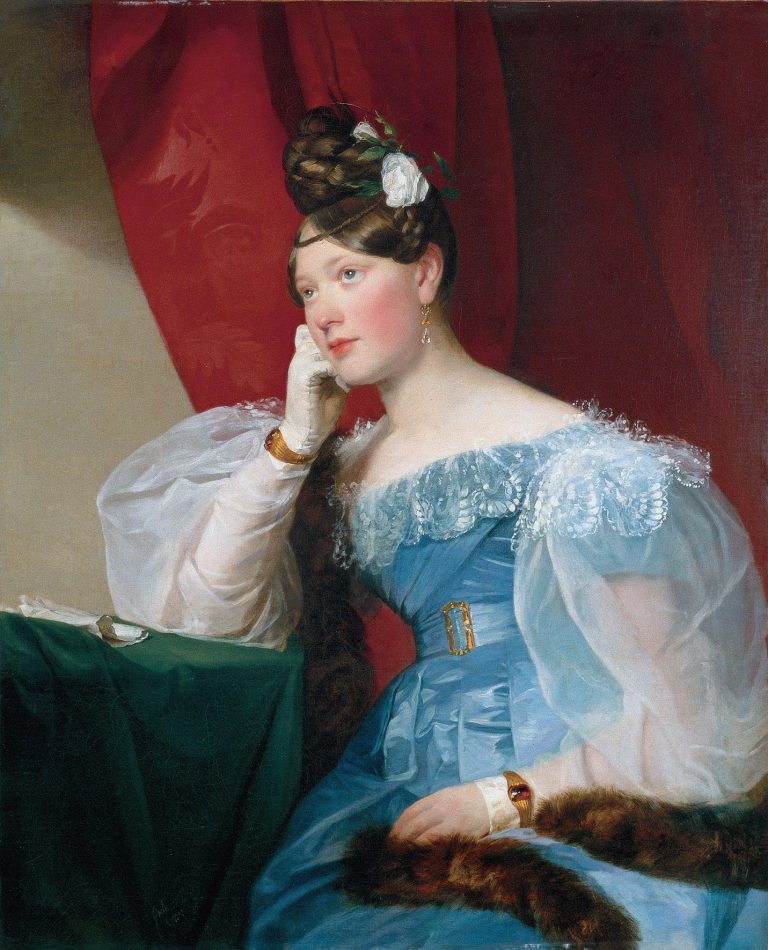
A portrait like this holds a viewer at close range. The scale is intimate, sized for a wall where a person might stand near enough to study the lace at the collar or the light on a cheek, not a grand hall piece meant to be seen from across a room. That closeness sets the terms for everything else in the picture.
The subject is Countess Julie von Woyna, painted by Friedrich von Amerling during the height of Viennese portraiture in the Romantic period, when likeness was expected to carry warmth and character alongside accuracy. Her figure sits within a composition built on quiet contrasts: a firmly modelled face and upper body against a softer, more atmospheric ground. Amerling worked light across the skin and fabric with a fine, almost polished touch, then let the surrounding space fall into shadow so nothing competes with the sitter for attention. The palette favours warm flesh tones set against darker, cooler surrounds, a combination that gives the face its glow without theatrics.
This balance of sharp focus and restrained background is typical of the portraits that made Amerling a sought-after painter among the Viennese elite, and it explains why the work still reads as a famous painting within that tradition today. The paint handling rewards close looking: thin, careful layers in the face give way to looser strokes in the drapery and backdrop, a shift you can trace by eye once you know to look for it.
Because this is a hand-painted oil painting reproduction, that shift in brushwork survives the copying process rather than flattening out. A trained artist works in oil on canvas, building up the same layered colour and matching the original palette tone by tone, so the surface keeps its texture and the small variations in touch that a printed copy would erase. The result is a painted object with real depth, not a flat reproduction of one.
Living with the portrait, you notice things gradually. The angle of light on the collar catches differently at different hours. A passage of shadow near the shoulder, barely visible at first, resolves into folded fabric once you have looked at it for a week. That kind of slow discovery is part of what a hand-painted canvas offers over a printed image, and it is why collectors keep this sort of portrait close rather than at a distance.
Empty walls flatten a room. A classical artwork restores structure and visual hierarchy. One painting defines the space, anchors furniture, and establishes identity.
Worldwide shipping included. Each painting is produced to order and safely packed for international transport.
All payments are encrypted and processed through trusted payment providers.
Real brushwork, layered oil paint, and durable pigments on museum-quality canvas.
If the result does not meet expectations, return it for a full refund.


Your artwork is painted on premium cotton canvas, then shipped safely rolled in a rigid tube with extra blank canvas border — ready for stretching or framing locally.
Select a handcrafted frame and we’ll deliver your painting fully assembled, protected, and ready to hang.
For safe shipping, framing is available up to a maximum size. Larger sizes will automatically disable the frame option.


Choose “Stretched” to receive your canvas mounted on wooden stretcher bars — perfect if you’ll frame it later or display it as-is.
Gallery Wrap is a deeper, 1.5" style stretcher. The canvas wraps around the sides and is stapled on the back for a clean, modern, frameless look.
We ship with UPS, FedEx, or DHL straight to your door. You’ll receive a tracking number as soon as your order leaves our studio. Typical delivery is 5 to 7 days after dispatch; large, framed, or stretched pieces may take longer depending on the safest shipping route.


Unframed canvases are protected with a film, carefully rolled, and secured inside a rigid shipping tube.

Stretched, Gallery Wrapped, and Framed paintings are wrapped, cushioned with foam protection, and boxed for safe transit.