Loading cart…
No products in the cart.

Original price was: $518.00.$259.00Current price is: $259.00.
Death and the Maiden by Hans Baldung Grien brings the unsettling closeness of youth and decay into a hand-painted oil reproduction, its cool palette and psychological weight rendered in real brushwork.
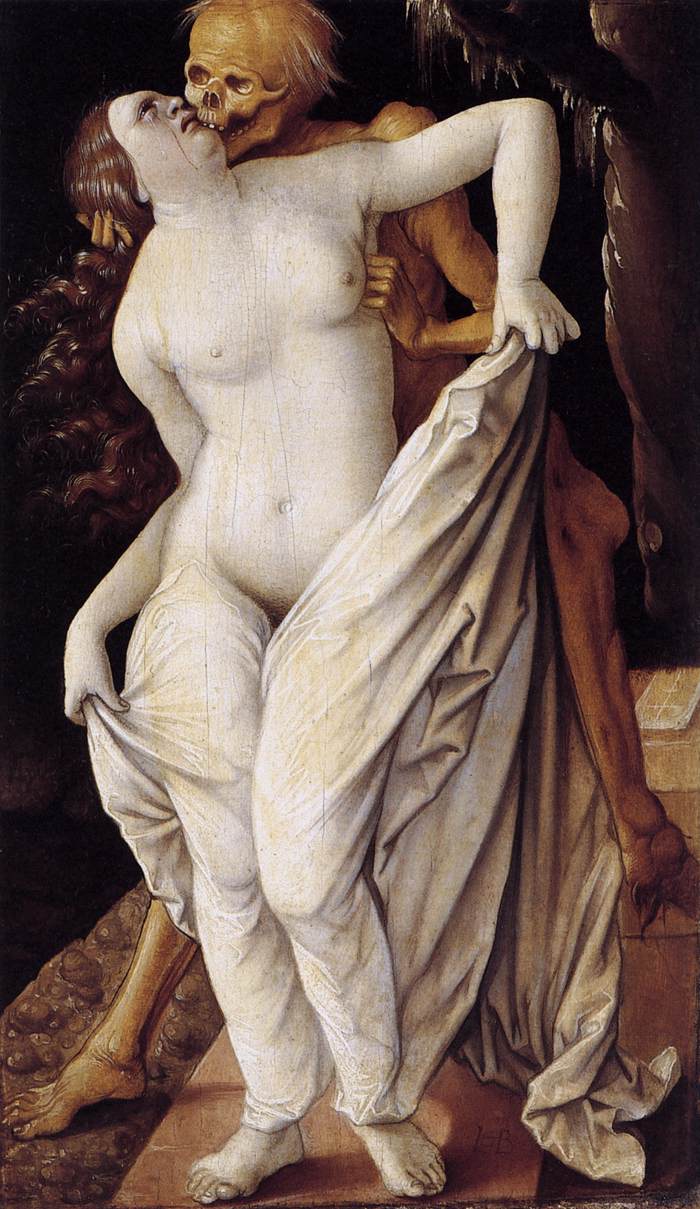
A young woman stands close beside a rotting corpse, its skin sloughing away, one bony hand reaching toward her hair. This is the encounter that held the attention of Hans Baldung Grien more than once in his career: not death as distant allegory, but death as an intimate, almost tender companion, pressed against the living body it will soon claim. Few Northern Renaissance painters returned to this pairing with such unease, and fewer still made it feel this personal.
The composition is deliberately close, the two figures crowded into the same shallow space so that the viewer cannot look away from their proximity. Baldung Grien builds the maiden from cool, pallid flesh tones, her skin almost luminous against the deep shadow that pools around the figure of Death, and that contrast of light and dark carries the emotional charge of the whole picture. The brushwork is precise where it needs to be, in the strands of hair and the folds of drapery, and looser in the passages of decay, where the paint itself seems to describe rot and dissolution.
This picture belongs to a period when Baldung, a student of the workshop tradition associated with Durer, had begun to develop the macabre, sensual vein that set his work apart from his contemporaries. He was drawn again and again to vanitas themes, to the fragility of beauty set against mortality, and he handled them with a psychological directness that reads as distinctly his own rather than borrowed from convention. The result is less a moral lesson than a confrontation, staged with unusual intimacy for its time.
What ByMuseum offers is a hand-painted oil painting reproduction, built layer by layer on artist-grade canvas by a trained painter working from close study of the original palette and composition. Nothing here is printed. The translucency of the shadows, the raised texture where paint has been worked wet into wet, the faint tooth of the canvas beneath the surface, all of it is recreated by hand, so the picture carries the same physical presence as an oil painting rather than the flatness of a fine art reproduction printed on paper.
Four centuries on, this scene still unsettles, and that is precisely why it belongs on a wall rather than in a book. Owning a painted version of it means living with something that has held attention for that long, in the form it was always meant to be seen.
Empty walls flatten a room. A classical artwork restores structure and visual hierarchy. One painting defines the space, anchors furniture, and establishes identity.
Worldwide shipping included. Each painting is produced to order and safely packed for international transport.
All payments are encrypted and processed through trusted payment providers.
Real brushwork, layered oil paint, and durable pigments on museum-quality canvas.
If the result does not meet expectations, return it for a full refund.


Your artwork is painted on premium cotton canvas, then shipped safely rolled in a rigid tube with extra blank canvas border — ready for stretching or framing locally.
Select a handcrafted frame and we’ll deliver your painting fully assembled, protected, and ready to hang.
For safe shipping, framing is available up to a maximum size. Larger sizes will automatically disable the frame option.


Choose “Stretched” to receive your canvas mounted on wooden stretcher bars — perfect if you’ll frame it later or display it as-is.
Gallery Wrap is a deeper, 1.5" style stretcher. The canvas wraps around the sides and is stapled on the back for a clean, modern, frameless look.
We ship with UPS, FedEx, or DHL straight to your door. You’ll receive a tracking number as soon as your order leaves our studio. Typical delivery is 5 to 7 days after dispatch; large, framed, or stretched pieces may take longer depending on the safest shipping route.


Unframed canvases are protected with a film, carefully rolled, and secured inside a rigid shipping tube.

Stretched, Gallery Wrapped, and Framed paintings are wrapped, cushioned with foam protection, and boxed for safe transit.