Loading cart…
No products in the cart.

Original price was: $518.00.$259.00Current price is: $259.00.
Divorce by William Holbrook Beard turns a domestic quarrel into satire through a cast of human-postured animals, its warm browns and cool greys built up here as a genuinely hand-painted oil reproduction rather than a print.
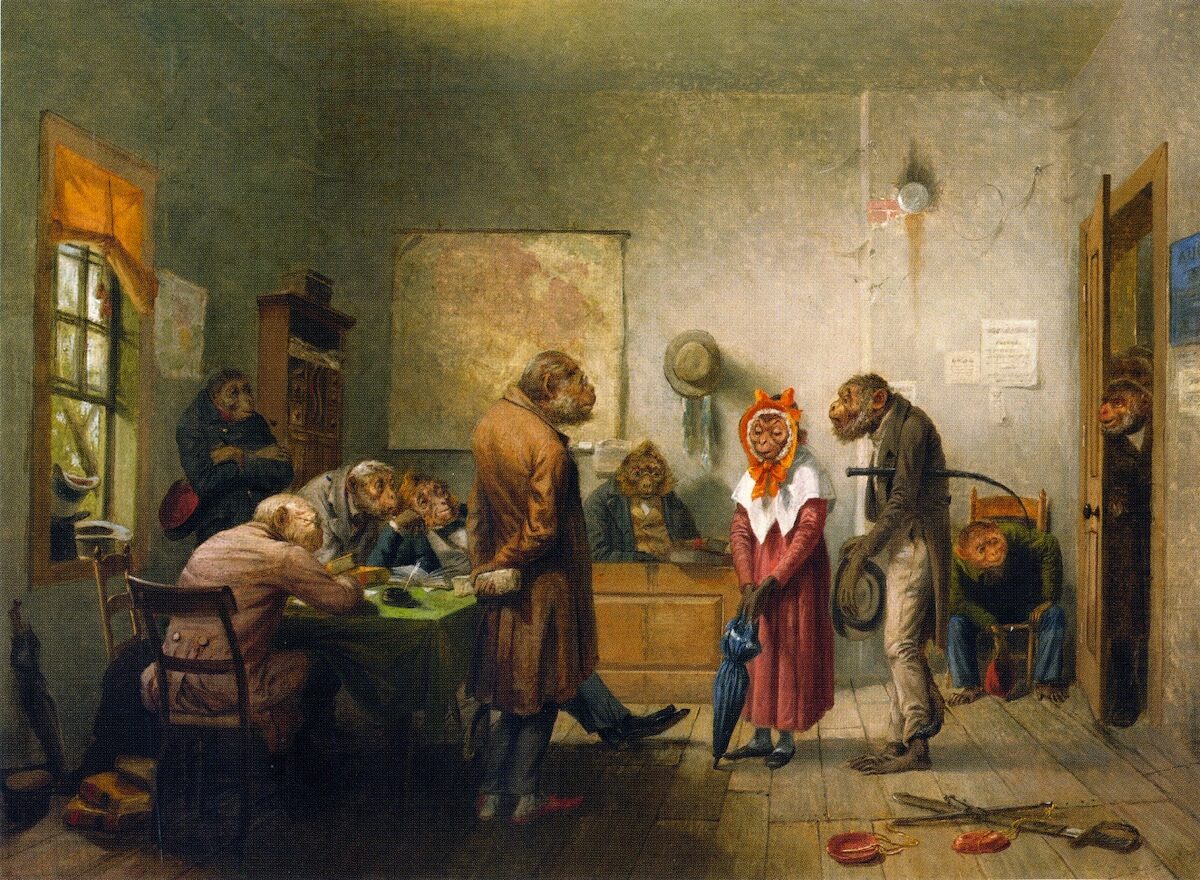
Warm umbers and dry, biscuit-toned browns dominate the surface of Divorce, set against passages of muted grey and a cool, almost mournful blue that pools around the central figures like a held breath. These tones do not blend so much as negotiate with one another, the browns advancing in thick, confident strokes while the blue recedes into shadow, giving the whole scene a subdued theatricality that suits its comic subject. A discerning eye will notice how little the palette relies on brightness for effect; instead the drama comes from tonal contrast, from the way a pale muzzle or a white ruff catches light against the surrounding dark.
The painting belongs to the body of anthropomorphic genre work that made William Holbrook Beard a familiar name among American audiences of the nineteenth century, animal actors standing in for the vanities and disputes of polite society. Here the cast, dressed and posed with unmistakably human bearing, enacts a domestic quarrel with the gravity of courtroom drama and the absurdity of a fable. Beard trained his eye on academic figure painting before turning it toward satire, and that discipline shows in the careful modelling of form beneath the humour, the anatomy convincing even where the subject is deliberately ridiculous.
Compositionally the picture is built on a shallow, stage-like space, the figures pressed toward the front plane so that gesture and expression carry the narrative rather than depth or landscape. Brushwork tightens around the faces, where Beard invests real observational rigour into wrinkled brows and downturned mouths, then loosens into broader, more gestural passages in the drapery and background, a contrast that keeps the eye moving and the mood buoyant despite the ironic subject. As a famous artwork within the genre of satirical animal painting, it rewards the kind of close looking that print reproduction tends to flatten.
ByMuseum artists produce this piece as a hand-painted oil painting reproduction, working in oil on artist-grade canvas and matching the original palette stroke by stroke rather than approximating it through mechanical printing. The painter builds the surface in layers, holding on to the ridges of impasto in the thicker passages and the thinner, more transparent handling elsewhere, so the finished canvas carries the same tactile variation a conservator would look for in an original nineteenth century oil. The result is a painted object with genuine depth and texture, not a flat facsimile.
Empty walls flatten a room. A classical artwork restores structure and visual hierarchy. One painting defines the space, anchors furniture, and establishes identity.
Worldwide shipping included. Each painting is produced to order and safely packed for international transport.
All payments are encrypted and processed through trusted payment providers.
Real brushwork, layered oil paint, and durable pigments on museum-quality canvas.
If the result does not meet expectations, return it for a full refund.


Your artwork is painted on premium cotton canvas, then shipped safely rolled in a rigid tube with extra blank canvas border — ready for stretching or framing locally.
Select a handcrafted frame and we’ll deliver your painting fully assembled, protected, and ready to hang.
For safe shipping, framing is available up to a maximum size. Larger sizes will automatically disable the frame option.


Choose “Stretched” to receive your canvas mounted on wooden stretcher bars — perfect if you’ll frame it later or display it as-is.
Gallery Wrap is a deeper, 1.5" style stretcher. The canvas wraps around the sides and is stapled on the back for a clean, modern, frameless look.
We ship with UPS, FedEx, or DHL straight to your door. You’ll receive a tracking number as soon as your order leaves our studio. Typical delivery is 4–5 business days after dispatch; large, framed, or stretched pieces may take longer depending on the safest shipping route.


Unframed canvases are protected with a film, carefully rolled, and secured inside a rigid shipping tube.

Stretched, Gallery Wrapped, and Framed paintings are wrapped, cushioned with foam protection, and boxed for safe transit.