Loading cart…
No products in the cart.

Original price was: $599.00.$299.00Current price is: $299.00.
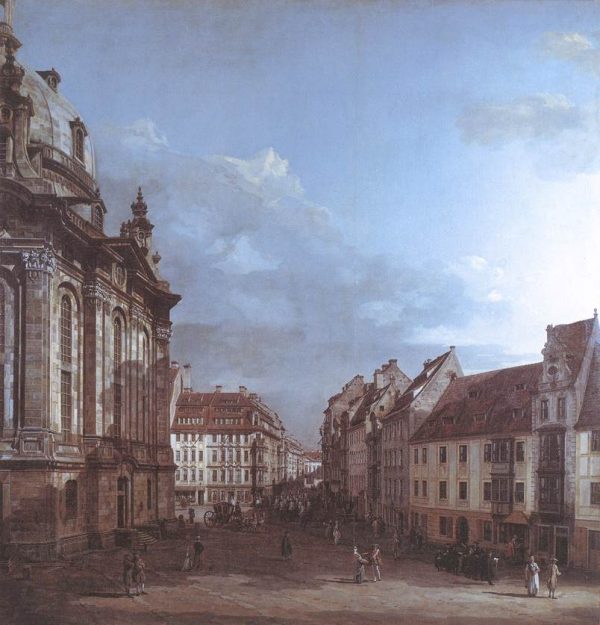
A hand-painted reproduction of Dresden, the Frauenkirche and the Rampische Gasse by Bernardo Bellotto, prized for its crystalline light and architectural precision.

When Bernardo Bellotto arrived in Dresden in 1747, summoned to the court of Augustus III, he brought with him the exacting vedute technique he had absorbed from his uncle Canaletto in Venice, and turned it on the streets of a Saxon capital rebuilding itself in stone and stucco. Dresden, the Frauenkirche and the Rampische Gasse belongs to the long series of city views he produced through the following decade, a body of work that would become his most enduring legacy and, for many, his famous painting above all others in the Dresden campaign.
The composition leads the eye down the Rampische Gasse, a working street of uneven facades and modest commerce, toward the great dome of the Frauenkirche rising behind the rooftops. Bellotto sets this architectural progression against a cool northern sky, and the light falls with the kind of clarity that lets every cornice, window frame, and paving stone declare itself with almost surveyor-like precision. Figures move through the lower register of the canvas, small in scale but carefully placed, giving the street a sense of ordinary life continuing beneath the monumental church.
What distinguishes this period of the career of Bellotto is the tension between documentary intent and painterly control. The shadows are calibrated rather than merely observed, built up in thin, deliberate layers that give the stonework its particular density and weight, and the overall effect is of a city rendered with the discipline of an architect and the eye of a painter working at the height of his powers. A hand-painted oil painting reproduction of this scene is built the same way, in layered oil on artist-grade canvas, with a trained painter matching the palette of Bellotto stroke by stroke rather than reproducing it as a flat printed image; the raised texture of impasto and the visible rhythm of brushwork remain part of the surface, exactly as they would in a work built up over weeks rather than printed in seconds.
Collectors drawn to architectural subjects, and to the particular discipline of the veduta tradition, will find this a satisfying addition to a room where surface and detail reward close looking. It suits a study, a library, or any wall where the eye is meant to travel rather than rest.
Empty walls flatten a room. A classical artwork restores structure and visual hierarchy. One painting defines the space, anchors furniture, and establishes identity.
Worldwide shipping included. Each painting is produced to order and safely packed for international transport.
All payments are encrypted and processed through trusted payment providers.
Real brushwork, layered oil paint, and durable pigments on museum-quality canvas.
If the result does not meet expectations, return it for a full refund.


Your artwork is painted on premium cotton canvas, then shipped safely rolled in a rigid tube with extra blank canvas border — ready for stretching or framing locally.
Select a handcrafted frame and we’ll deliver your painting fully assembled, protected, and ready to hang.
For safe shipping, framing is available up to a maximum size. Larger sizes will automatically disable the frame option.


Choose “Stretched” to receive your canvas mounted on wooden stretcher bars — perfect if you’ll frame it later or display it as-is.
Gallery Wrap is a deeper, 1.5" style stretcher. The canvas wraps around the sides and is stapled on the back for a clean, modern, frameless look.
We ship with UPS, FedEx, or DHL straight to your door. You’ll receive a tracking number as soon as your order leaves our studio. Typical delivery is 5 to 7 days after dispatch; large, framed, or stretched pieces may take longer depending on the safest shipping route.


Unframed canvases are protected with a film, carefully rolled, and secured inside a rigid shipping tube.

Stretched, Gallery Wrapped, and Framed paintings are wrapped, cushioned with foam protection, and boxed for safe transit.
Baroque
Bernardo Bellotto

Man Writing a Letter
Gabriel Metsu, c. 1664
The gallery list
Every painting is already 50% off. Join the list and we will send you an extra $15 code, plus first access to new collections.
No spam. Unsubscribe anytime. · Privacy Policy
Welcome
Your $15 code is on its way. Explore the gallery while you wait.