Loading cart…
No products in the cart.

Original price was: $518.00.$259.00Current price is: $259.00.
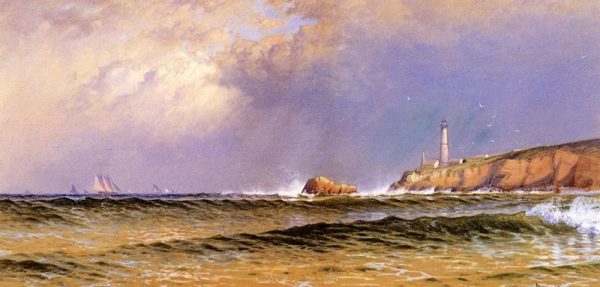
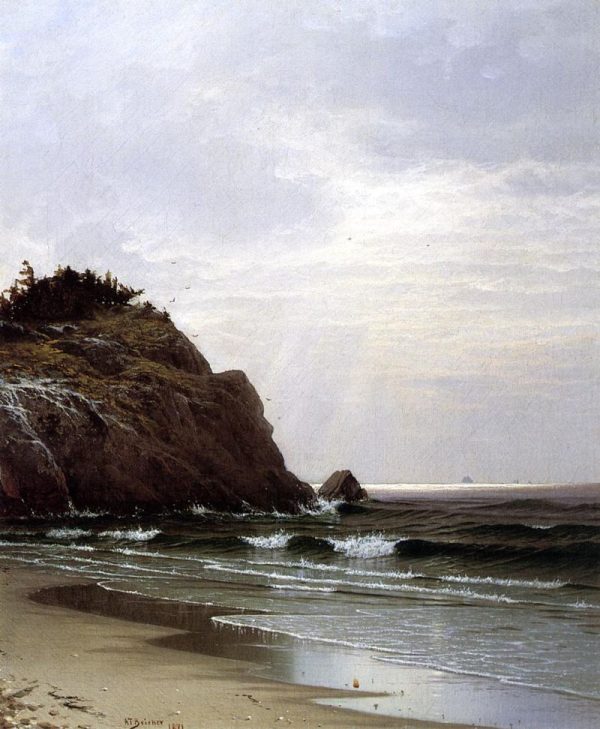
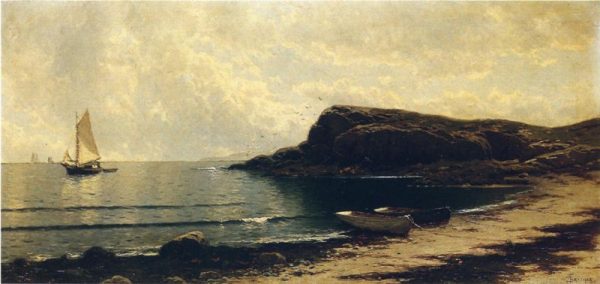
Drifting by Alfred Thompson Bricher, reimagined as a hand-painted oil on canvas that carries the quiet atmosphere of the original into a museum quality reproduction for your wall.

Alfred Thompson Bricher built a career on coastal light and the long, quiet horizon, but much of that output leans toward crisp, sunlit clarity. Drifting takes a softer route: rather than a fixed shoreline moment, it settles into an atmosphere of suspension, water and sky loosely resolved, form given over to mood rather than incident. It reads less like a record of a specific place and more like a study in how light disperses across a surface that refuses to sit still.
The composition favours restraint. Bricher distributes weight so that no single passage dominates, letting the eye drift, appropriately, across a horizon that dissolves rather than divides sea from air. Tonal contrast is kept deliberately narrow, built from close greys, muted blues, and warmer breaks near the light source, so that value does the work colour might otherwise carry. This was the mode of painting the Hudson River School artists turned to as their subject widened from dramatic wilderness to something more contemplative: an interest in atmosphere itself as the true subject, with the boat or shoreline reduced to a note within it.
What holds the picture together is the handling, not the incident. Layered glazes suggest depth in the sky without ever hardening into a line, and the brushwork loosens toward the edges of the canvas while staying controlled at the focal point, a technique that rewards close, sustained looking rather than a passing glance. A ByMuseum hand-painted oil painting reproduction of Drifting is built the same way the original demands: a trained painter working in oil on canvas, matching the palette stroke by stroke and preserving the layered glazes and visible texture that a printed copy simply cannot hold. The result is a museum quality reproduction, a painted object with its own surface and depth, not a flat facsimile.
Held up against the sharper, more anecdotal marine scenes Bricher is often known for, Drifting still holds attention precisely because it asks less and gives more time to give it. That patience is part of what makes it worth owning in paint rather than in print: a surface that catches light differently across a room and across the day, the way the original would have. Owning a hand-painted version of a work this quietly considered means living with a lasting piece of craft rather than a fixed image.
Empty walls flatten a room. A classical artwork restores structure and visual hierarchy. One painting defines the space, anchors furniture, and establishes identity.
Worldwide shipping included. Each painting is produced to order and safely packed for international transport.
All payments are encrypted and processed through trusted payment providers.
Real brushwork, layered oil paint, and durable pigments on museum-quality canvas.
If the result does not meet expectations, return it for a full refund.


Your artwork is painted on premium cotton canvas, then shipped safely rolled in a rigid tube with extra blank canvas border — ready for stretching or framing locally.
Select a handcrafted frame and we’ll deliver your painting fully assembled, protected, and ready to hang.
For safe shipping, framing is available up to a maximum size. Larger sizes will automatically disable the frame option.


Choose “Stretched” to receive your canvas mounted on wooden stretcher bars — perfect if you’ll frame it later or display it as-is.
Gallery Wrap is a deeper, 1.5" style stretcher. The canvas wraps around the sides and is stapled on the back for a clean, modern, frameless look.
We ship with UPS, FedEx, or DHL straight to your door. You’ll receive a tracking number as soon as your order leaves our studio. Typical delivery is 4–5 business days after dispatch; large, framed, or stretched pieces may take longer depending on the safest shipping route.


Unframed canvases are protected with a film, carefully rolled, and secured inside a rigid shipping tube.

Stretched, Gallery Wrapped, and Framed paintings are wrapped, cushioned with foam protection, and boxed for safe transit.