Loading cart…
No products in the cart.

Original price was: $518.00.$259.00Current price is: $259.00.
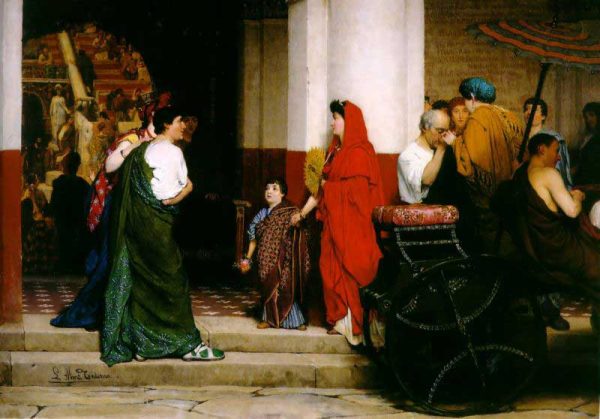
Step through the marble archway of Entrance to a Roman Theatre by Lawrence Alma-Tadema, a hand-painted oil reproduction prized for its light, stone, and archaeological precision.
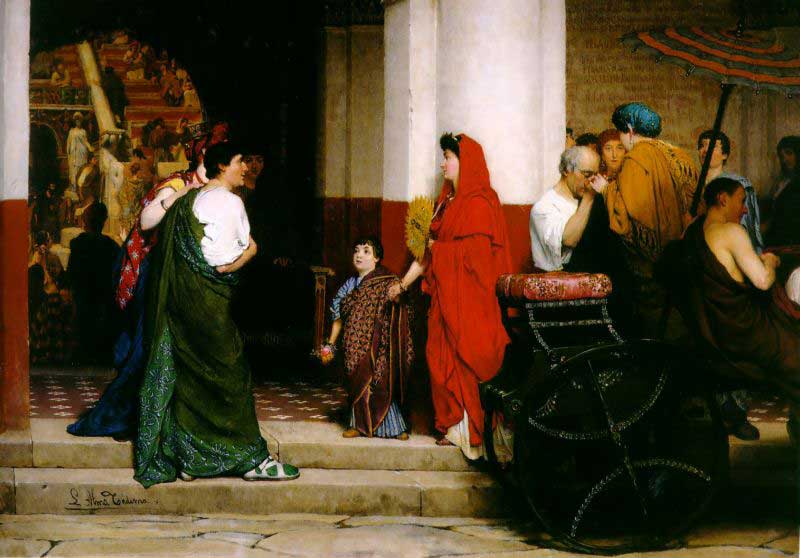
Sunlight falls flat and hard across a marble threshold, and for a moment the viewer stands exactly where a Roman citizen once paused before passing into a theatre crowded with noise and spectacle. The stone catches the light in bands, warm where it is struck directly, cool and violet in the recesses of the archway, and beyond it, only suggested, lies the promise of performance and public life.
Alma-Tadema builds the scene as an exercise in architectural observation rather than narrative drama. Figures are secondary to the structure itself: the worn steps, the carved lintels, the accumulated texture of stone that has been walked on and weathered for generations. His research into Roman material culture, drawn from excavated sites and museum collections he studied firsthand, gives the architecture a credibility that few of his contemporaries could match, and here that knowledge is applied not to a domestic interior but to the civic threshold, a space of transition rather than repose.
What distinguishes the painting is the handling of light as a structural device. It does not simply illuminate the scene; it organises it, leading the eye from the shadowed foreground through the framing archway toward the implied activity beyond. The palette stays largely within a controlled range of ochres, greys, and warm whites, punctuated by small passages of colour that carry disproportionate visual weight. This is a mature example of the architectural mode that made the reputation of Alma-Tadema, painted with the patience of an artist who treated stone with the same care others reserved for flesh.
ByMuseum reproduces this composition as a hand-painted oil painting reproduction, built up in layers on artist-grade canvas by a trained painter working from close study of the original palette and brushwork. Rather than a flat replica painting printed onto a surface, each canvas carries genuine impasto where the stonework was built up with a loaded brush, and the tonal shifts across the archway are worked in real oil colour, so the surface holds the same depth and the same catch of light that a discerning eye would look for in a painted object. It is this durability of surface, this capacity to be examined closely rather than glanced at, that lets the theatre threshold hold attention long after a print would have gone flat.
Empty walls flatten a room. A classical artwork restores structure and visual hierarchy. One painting defines the space, anchors furniture, and establishes identity.
Worldwide shipping included. Each painting is produced to order and safely packed for international transport.
All payments are encrypted and processed through trusted payment providers.
Real brushwork, layered oil paint, and durable pigments on museum-quality canvas.
If the result does not meet expectations, return it for a full refund.


Your artwork is painted on premium cotton canvas, then shipped safely rolled in a rigid tube with extra blank canvas border — ready for stretching or framing locally.
Select a handcrafted frame and we’ll deliver your painting fully assembled, protected, and ready to hang.
For safe shipping, framing is available up to a maximum size. Larger sizes will automatically disable the frame option.


Choose “Stretched” to receive your canvas mounted on wooden stretcher bars — perfect if you’ll frame it later or display it as-is.
Gallery Wrap is a deeper, 1.5" style stretcher. The canvas wraps around the sides and is stapled on the back for a clean, modern, frameless look.
We ship with UPS, FedEx, or DHL straight to your door. You’ll receive a tracking number as soon as your order leaves our studio. Typical delivery is 5 to 7 days after dispatch; large, framed, or stretched pieces may take longer depending on the safest shipping route.


Unframed canvases are protected with a film, carefully rolled, and secured inside a rigid shipping tube.

Stretched, Gallery Wrapped, and Framed paintings are wrapped, cushioned with foam protection, and boxed for safe transit.