Loading cart…
No products in the cart.

Original price was: $599.00.$299.00Current price is: $299.00.
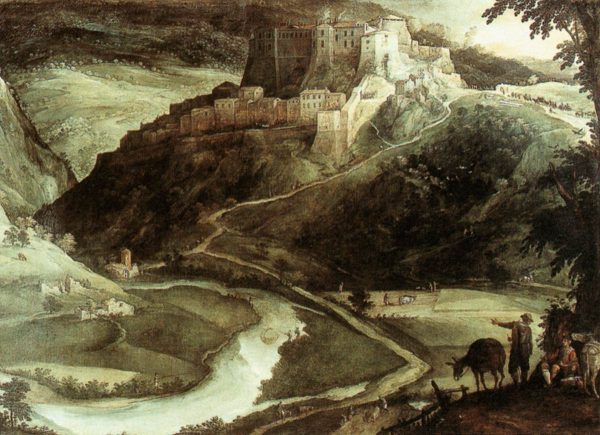
Feudo di Rocca Sinibalda by Paul Bril, rebuilt as a hand-painted replica in oil on canvas, keeps the calm structure and layered atmosphere of the original composition.
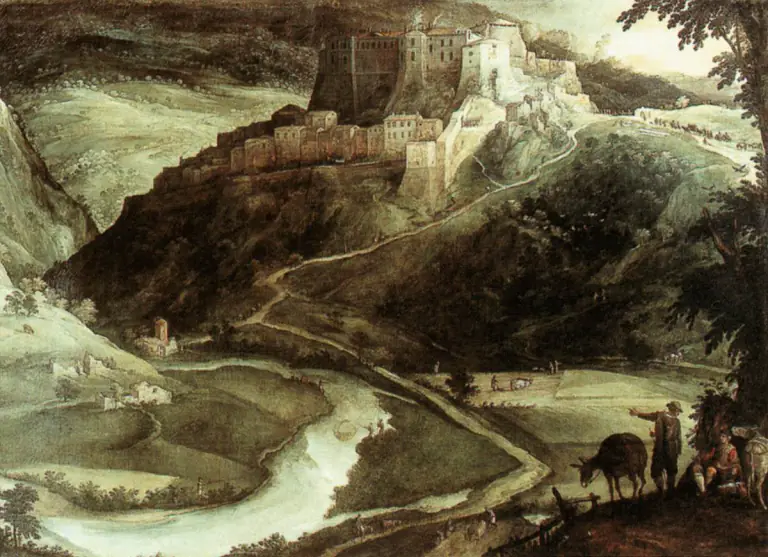
Landscape specialists of the seventeenth century looked to compositions like this one as a working model for how a view could be organised rather than merely observed, and later admirers have continued to read it the same way, as a demonstration of pictorial order applied to a real place. The estate at Rocca Sinibalda becomes, in the hands of Paul Bril, an exercise in structured recession, where the eye is guided from foreground incident to a hazier distance without ever losing the thread of the design.
The painting divides its space with a sure sense of where the viewer should linger and where the composition should simply carry them onward. Foreground forms are stated with more weight and definition, while distance is softened into passages of cooler, thinner colour, a device Bril used repeatedly to establish depth without resorting to obvious perspective lines. Light does not fall dramatically across the scene so much as accumulate gradually, warming the closer terrain and letting the far ground dissolve into atmosphere.
This handling of tone belongs to a mature phase of the career of Bril, when his early Flemish training had absorbed the Roman landscape tradition and produced something calmer and more architectural in its logic. Density shifts across the surface do real work here, separating the principal masses from the supporting detail while keeping the whole image legible as a single, unified view. Seen up close, the alternation between broad, quietly handled passages and small, more particular touches gives the composition much of its staying power, rewarding a longer look rather than a quick one.
ByMuseum artists rebuild this composition by hand, layer by layer, in an oil painting reproduction rather than a printed copy. Working from the original palette and structure, a trained painter reconstructs the picture in oil on artist-grade canvas, so the finished piece carries visible brushwork, the texture of the canvas weave, and the small variations that come from paint applied by hand rather than machine. The result functions as a genuine hand-painted replica, an individually made object rather than a duplicate produced in quantity.
Hung where the light shifts gradually through the day, in a study, a hallway, or a room used for reading and reflection, the painting settles into its surroundings rather than demanding attention from across the room. Its quieter register suits walls that already carry some architectural presence, panelling, deep mouldings, or simply a wall left otherwise bare, where the slow recession of the view can be taken in without competition.
Empty walls flatten a room. A classical artwork restores structure and visual hierarchy. One painting defines the space, anchors furniture, and establishes identity.
Worldwide shipping included. Each painting is produced to order and safely packed for international transport.
All payments are encrypted and processed through trusted payment providers.
Real brushwork, layered oil paint, and durable pigments on museum-quality canvas.
If the result does not meet expectations, return it for a full refund.


Your artwork is painted on premium cotton canvas, then shipped safely rolled in a rigid tube with extra blank canvas border — ready for stretching or framing locally.
Select a handcrafted frame and we’ll deliver your painting fully assembled, protected, and ready to hang.
For safe shipping, framing is available up to a maximum size. Larger sizes will automatically disable the frame option.


Choose “Stretched” to receive your canvas mounted on wooden stretcher bars — perfect if you’ll frame it later or display it as-is.
Gallery Wrap is a deeper, 1.5" style stretcher. The canvas wraps around the sides and is stapled on the back for a clean, modern, frameless look.
We ship with UPS, FedEx, or DHL straight to your door. You’ll receive a tracking number as soon as your order leaves our studio. Typical delivery is 5 to 7 days after dispatch; large, framed, or stretched pieces may take longer depending on the safest shipping route.


Unframed canvases are protected with a film, carefully rolled, and secured inside a rigid shipping tube.

Stretched, Gallery Wrapped, and Framed paintings are wrapped, cushioned with foam protection, and boxed for safe transit.

Man Writing a Letter
Gabriel Metsu, c. 1664
The gallery list
Every painting is already 50% off. Join the list and we will send you an extra $15 code, plus first access to new collections.
No spam. Unsubscribe anytime. · Privacy Policy
Welcome
Your $15 code is on its way. Explore the gallery while you wait.