Loading cart…
No products in the cart.

Original price was: $599.00.$299.00Current price is: $299.00.
A tighter, more vertical still life than is typical of Ast, Flowers in a Vase with Shells and Insects 1630 becomes a hand-painted oil on canvas reproduction with genuine brushwork and surface texture.
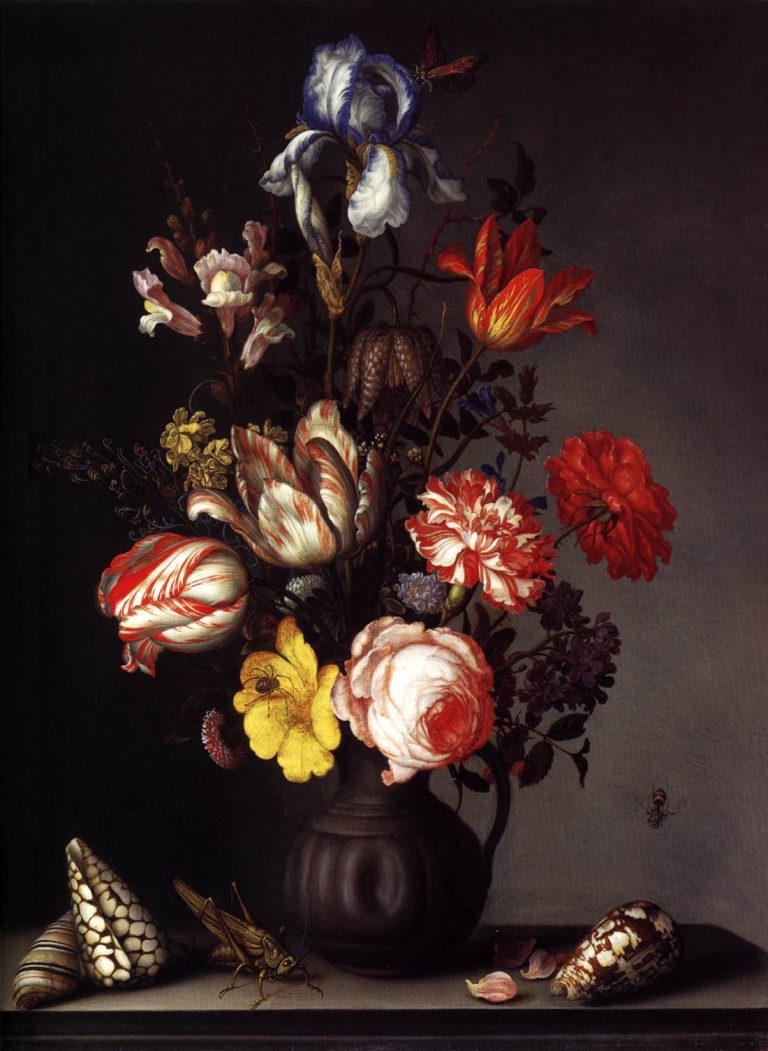
Balthasar van der Ast built a career on the still life of shells, flowers, and fruit, working within a genre that Dutch and Flemish painters of his generation had turned into a discipline of exacting observation. Many of his compositions favour a wide, low arrangement across a tabletop, with shells and insects scattered at the margins almost as afterthoughts. Flowers in a Vase with Shells and Insects 1630 works differently: the vase sits more upright and central, the flowers rise in a taller, more vertical arrangement, and the shells and insects are drawn into closer conversation with the blooms rather than left as separate incidents at the edge of the scene.
The bouquet gathers species that could not have bloomed together in a single season, a common convention of the period that let painters demonstrate range and precision rather than botanical accuracy. Ast handles each flower with a distinct touch: petals rendered with thin, translucent layers where the light passes through, leaves built with denser, more opaque strokes, and the vase itself given a cool reflective sheen that grounds the composition. The insects, a fly or a beetle poised on a petal, are not decorative flourishes but assertions of skill, since rendering their scale and translucency convincingly required a steadiness that separated the accomplished still life painter from the merely competent one.
Light falls across the arrangement from a single implied source, catching the curled edges of petals and the pearled interior of a shell while leaving the background in a dark, unbroken tone that pushes the whole composition forward. This use of shadow was standard practice in still life painting of the 1630s, but Ast applies it with a restraint that keeps the eye moving steadily across the canvas rather than jumping between isolated highlights. The ByMuseum reproduction is painted by hand as an oil painting reproduction on artist-grade canvas, with a trained painter working directly from the original palette to rebuild the layered translucency of the petals and the density of the darker passages stroke by stroke. This is an oil on canvas reproduction in the fullest sense: pigment mixed and applied by hand, not printed, so the surface carries the same variation in texture that separates a flat highlight from a built-up layer of colour, and the brushwork remains visible on close inspection just as it would on a traditionally painted canvas.
Empty walls flatten a room. A classical artwork restores structure and visual hierarchy. One painting defines the space, anchors furniture, and establishes identity.
Worldwide shipping included. Each painting is produced to order and safely packed for international transport.
All payments are encrypted and processed through trusted payment providers.
Real brushwork, layered oil paint, and durable pigments on museum-quality canvas.
If the result does not meet expectations, return it for a full refund.


Your artwork is painted on premium cotton canvas, then shipped safely rolled in a rigid tube with extra blank canvas border — ready for stretching or framing locally.
Select a handcrafted frame and we’ll deliver your painting fully assembled, protected, and ready to hang.
For safe shipping, framing is available up to a maximum size. Larger sizes will automatically disable the frame option.


Choose “Stretched” to receive your canvas mounted on wooden stretcher bars — perfect if you’ll frame it later or display it as-is.
Gallery Wrap is a deeper, 1.5" style stretcher. The canvas wraps around the sides and is stapled on the back for a clean, modern, frameless look.
We ship with UPS, FedEx, or DHL straight to your door. You’ll receive a tracking number as soon as your order leaves our studio. Typical delivery is 5 to 7 days after dispatch; large, framed, or stretched pieces may take longer depending on the safest shipping route.


Unframed canvases are protected with a film, carefully rolled, and secured inside a rigid shipping tube.

Stretched, Gallery Wrapped, and Framed paintings are wrapped, cushioned with foam protection, and boxed for safe transit.