Loading cart…
No products in the cart.

Original price was: $599.00.$299.00Current price is: $299.00.
Hand painted oil on canvas reproduction of Gay Head 1913 by Arthur Wesley Dow, focused on its visible composition.
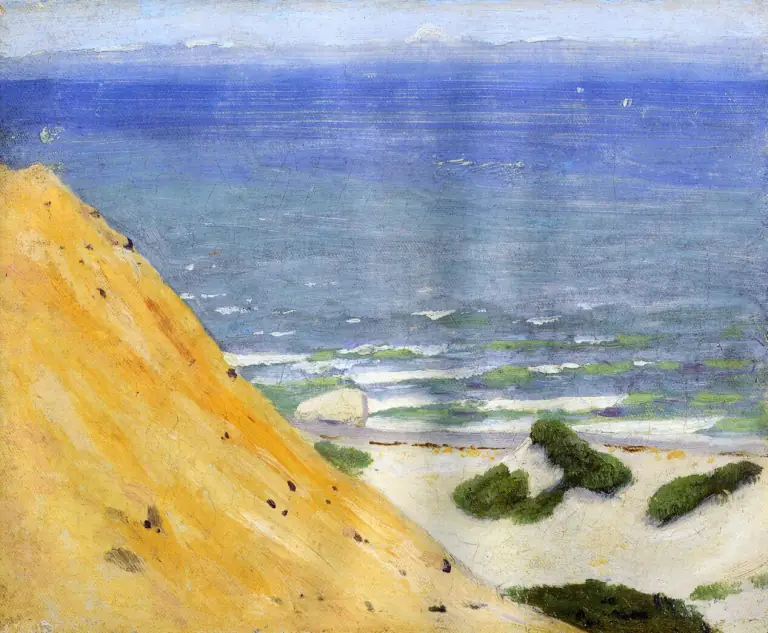
A pale sandy cliff descends toward blue water at the edge of the coast. White surf breaks along the shore, and dark rocks punctuate the beach. The open sea extends toward a level horizon. In Gay Head 1913 by Arthur Wesley Dow, the visible subject is presented through a few clear forms rather than a crowded setting. Their spacing leaves room around the main shapes and makes the scene readable as a whole.
The slope occupies the left foreground and leads down toward the water. The shore runs diagonally, while the sea and sky create broad horizontal bands. A few rocks mark the meeting of land and surf. The placement of figures, objects, and open areas keeps the full arrangement legible. These relationships describe the composition without adding a story or historical claim that is not shown in the image.
Yellow sand and pale foam contrast with blue and green water. The sky is light and the sea deeper in tone. Dark rocks add small points of contrast along the beach. Light and shade help separate the main subject from its surroundings. The palette stays tied to forms shown here, where small contrasts sit beside broader areas of color and open space.
The image emphasizes the meeting of slope, shore, and water. The high viewpoint gives the coast a clear diagonal. Small waves and rocks provide texture within the broad sea. The full arrangement links its principal forms to the surrounding setting.
This hand painted oil on canvas reproduction of Gay Head 1913 by Arthur Wesley Dow is described through the composition shown here. The product is painted on canvas in oil, with attention to principal forms and color relationships. Review the options displayed on this page for current choices.
Empty walls flatten a room. A classical artwork restores structure and visual hierarchy. One painting defines the space, anchors furniture, and establishes identity.
Worldwide shipping included. Each painting is produced to order and safely packed for international transport.
All payments are encrypted and processed through trusted payment providers.
Real brushwork, layered oil paint, and durable pigments on museum-quality canvas.
If the result does not meet expectations, return it for a full refund.


Your artwork is painted on premium cotton canvas, then shipped safely rolled in a rigid tube with extra blank canvas border — ready for stretching or framing locally.
Select a handcrafted frame and we’ll deliver your painting fully assembled, protected, and ready to hang.
For safe shipping, framing is available up to a maximum size. Larger sizes will automatically disable the frame option.


Choose “Stretched” to receive your canvas mounted on wooden stretcher bars — perfect if you’ll frame it later or display it as-is.
Gallery Wrap is a deeper, 1.5" style stretcher. The canvas wraps around the sides and is stapled on the back for a clean, modern, frameless look.
We ship with UPS, FedEx, or DHL straight to your door. You’ll receive a tracking number as soon as your order leaves our studio. Typical delivery is 5 to 7 days after dispatch; large, framed, or stretched pieces may take longer depending on the safest shipping route.


Unframed canvases are protected with a film, carefully rolled, and secured inside a rigid shipping tube.

Stretched, Gallery Wrapped, and Framed paintings are wrapped, cushioned with foam protection, and boxed for safe transit.

Man Writing a Letter
Gabriel Metsu, c. 1664
The gallery list
Every painting is already 50% off. Join the list and we will send you an extra $15 code, plus first access to new collections.
No spam. Unsubscribe anytime. · Privacy Policy
Welcome
Your $15 code is on its way. Explore the gallery while you wait.