Loading cart…
No products in the cart.

Original price was: $518.00.$259.00Current price is: $259.00.
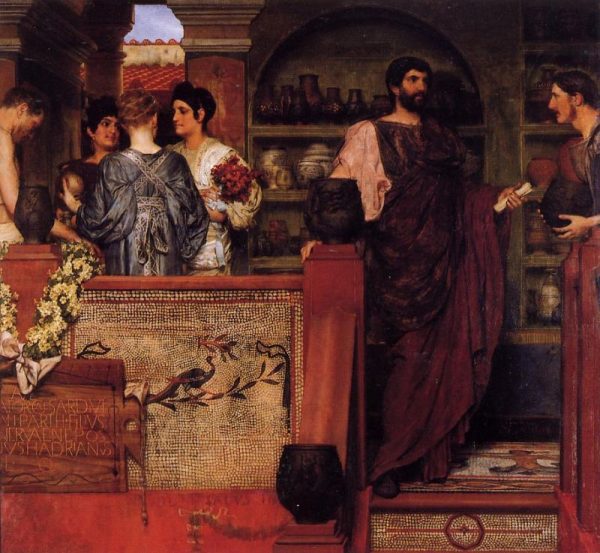
A hand-painted reproduction of Hadrian Visiting a Romano-British Pottery by Alma-Tadema, prized for its archaeological detail and the warm human exchange between emperor and craftsman.
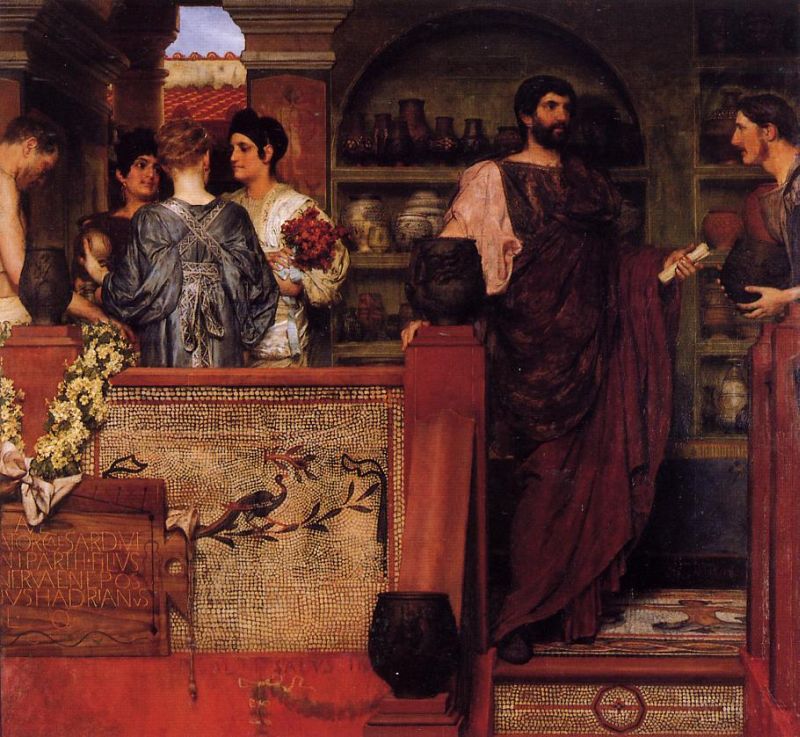
By the late 1870s Lawrence Alma-Tadema had built a considerable following for scenes that treated the ancient world as a place of daily habit rather than distant legend, and this canvas belongs to that mature phase of his career. It stages an imagined episode from the reign of Hadrian, the emperor who toured the far reaches of his territories and, in this telling, pauses to watch British potters at their wheels and kilns. The premise gives Alma-Tadema licence to bring together two subjects he loved equally: the machinery of empire and the quiet dignity of skilled hands at work.
The composition places Hadrian among the artisans without elevating him above their world; ceramic vessels, tools, and half-finished wares fill the middle ground, giving the picture the texture of a working studio rather than a stage set. Light falls unevenly across terracotta, bronze, and pale drapery, and Alma-Tadema uses that unevenness to model form and to suggest the warmth of a kiln fire somewhere near at hand. His research into Roman-British material culture, drawn from excavation reports and museum collections he studied closely, grounds every object on the canvas, yet the picture never feels like an illustration of research. The craftsmen look up, gesture, and continue their labour, and the emperor observes with what reads as genuine curiosity rather than condescension.
What makes the scene persuasive is the same quality that runs through his best archaeological subjects: a willingness to let ordinary human interest carry a historical set piece. The exchange between ruler and craftsman gives the picture a pulse that pure spectacle would lack, and it is this human note, as much as the marble and pottery, that has kept the composition appealing to viewers long after its first exhibition.
A ByMuseum hand-painted oil painting reproduction of Hadrian Visiting a Romano-British Pottery is built by a trained painter working directly in oil on artist-grade canvas, not printed or photographed from the original. The painter studies the palette closely, matching the warmth of the terracotta and the cooler tones of drapery and stone, and lays in the paint with the same attention to surface that the subject deserves, so that brushwork and impasto remain visible on close inspection. The result is a replica painting meant to be looked at as a physical object, with its own depth of colour and texture, rather than a flat facsimile.
Empty walls flatten a room. A classical artwork restores structure and visual hierarchy. One painting defines the space, anchors furniture, and establishes identity.
Worldwide shipping included. Each painting is produced to order and safely packed for international transport.
All payments are encrypted and processed through trusted payment providers.
Real brushwork, layered oil paint, and durable pigments on museum-quality canvas.
If the result does not meet expectations, return it for a full refund.


Your artwork is painted on premium cotton canvas, then shipped safely rolled in a rigid tube with extra blank canvas border — ready for stretching or framing locally.
Select a handcrafted frame and we’ll deliver your painting fully assembled, protected, and ready to hang.
For safe shipping, framing is available up to a maximum size. Larger sizes will automatically disable the frame option.


Choose “Stretched” to receive your canvas mounted on wooden stretcher bars — perfect if you’ll frame it later or display it as-is.
Gallery Wrap is a deeper, 1.5" style stretcher. The canvas wraps around the sides and is stapled on the back for a clean, modern, frameless look.
We ship with UPS, FedEx, or DHL straight to your door. You’ll receive a tracking number as soon as your order leaves our studio. Typical delivery is 5 to 7 days after dispatch; large, framed, or stretched pieces may take longer depending on the safest shipping route.


Unframed canvases are protected with a film, carefully rolled, and secured inside a rigid shipping tube.

Stretched, Gallery Wrapped, and Framed paintings are wrapped, cushioned with foam protection, and boxed for safe transit.
Academicism
Lawrence Alma-Tadema