Loading cart…
No products in the cart.

Original price was: $518.00.$259.00Current price is: $259.00.
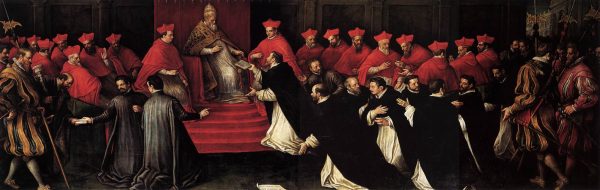
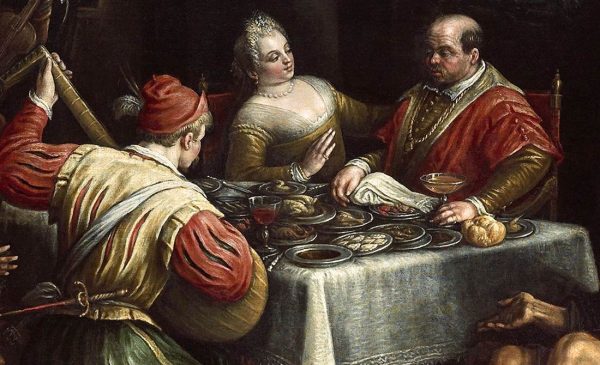
Crimson vestments meet pale gold cloth across this crowded papal scene by Leandro Bassano, a richly staged Venetian narrative worth returning to again and again.

Deep crimson vestments meet the pale gold of papal cloth, and against these two anchoring tones the canvas arranges a quieter register of grey stone and umber shadow, so that the eye is pulled first to the exchange of colour at the center before it settles into the surrounding architecture. Blues appear sparingly, in a sash or a fold of drapery, cool notes set deliberately against the warmth that otherwise governs the scene. Nothing fights for attention; the palette works instead as a kind of choreography, guiding the gaze through the gathered figures toward the moment of sanction at the heart of the composition.
The subject is the papal approval granted to the rule of Saint Dominic in 1216, a moment of institutional consequence rendered here as a formal, multi-figure tableau. Bassano organizes the crowd of clerics and attendants with the compositional discipline typical of large Venetian narrative painting, using architectural framing, an implied colonnade or chamber, to give the gathering its sense of ceremony and weight. Figures are grouped in loose triangular clusters, their gestures restrained, their expressions attentive rather than dramatic, which lends the scene a documentary calm appropriate to an act of ecclesiastical record.
What distinguishes the handling is the balance between descriptive precision and rhythmic movement across the surface. Costume detail, the fall of a chasuble, the sheen of a mitre, is rendered with care, yet the picture never feels static; a current of energy runs through the grouped bodies, carrying the eye from one cluster to the next. This balance of documentary detail and pictorial rhythm places the work within the mature phase of the Bassano workshop tradition, where large-scale religious narrative was treated with the same descriptive appetite as genre or portrait subjects.
Bringing this composition into a hand-painted oil painting reproduction means each of those tonal relationships, the crimson against the gold, the cool sash against the warm ground, is rebuilt by hand rather than reproduced by machine. A trained artist works in oil on artist-grade canvas, matching the original palette passage by passage and leaving the brushwork visible, so the surface carries the same texture and depth of colour that oil paint alone can produce. The result is a museum quality reproduction meant to be examined closely, not a flat facsimile viewed once and forgotten.
Live with it for a season and the picture keeps giving something back: a fold of drapery caught differently in evening light, a face at the edge of the crowd noticed only after the tenth viewing. That slow yield of detail is what a hand-painted canvas offers and a printed image cannot.
Empty walls flatten a room. A classical artwork restores structure and visual hierarchy. One painting defines the space, anchors furniture, and establishes identity.
Worldwide shipping included. Each painting is produced to order and safely packed for international transport.
All payments are encrypted and processed through trusted payment providers.
Real brushwork, layered oil paint, and durable pigments on museum-quality canvas.
If the result does not meet expectations, return it for a full refund.


Your artwork is painted on premium cotton canvas, then shipped safely rolled in a rigid tube with extra blank canvas border — ready for stretching or framing locally.
Select a handcrafted frame and we’ll deliver your painting fully assembled, protected, and ready to hang.
For safe shipping, framing is available up to a maximum size. Larger sizes will automatically disable the frame option.


Choose “Stretched” to receive your canvas mounted on wooden stretcher bars — perfect if you’ll frame it later or display it as-is.
Gallery Wrap is a deeper, 1.5" style stretcher. The canvas wraps around the sides and is stapled on the back for a clean, modern, frameless look.
We ship with UPS, FedEx, or DHL straight to your door. You’ll receive a tracking number as soon as your order leaves our studio. Typical delivery is 5 to 7 days after dispatch; large, framed, or stretched pieces may take longer depending on the safest shipping route.


Unframed canvases are protected with a film, carefully rolled, and secured inside a rigid shipping tube.

Stretched, Gallery Wrapped, and Framed paintings are wrapped, cushioned with foam protection, and boxed for safe transit.