Loading cart…
No products in the cart.

Original price was: $518.00.$259.00Current price is: $259.00.
A hand-painted reproduction of Italian Lake Scene by Albert Bierstadt, capturing the glowing light and mirrored water that have kept this landscape admired for generations.
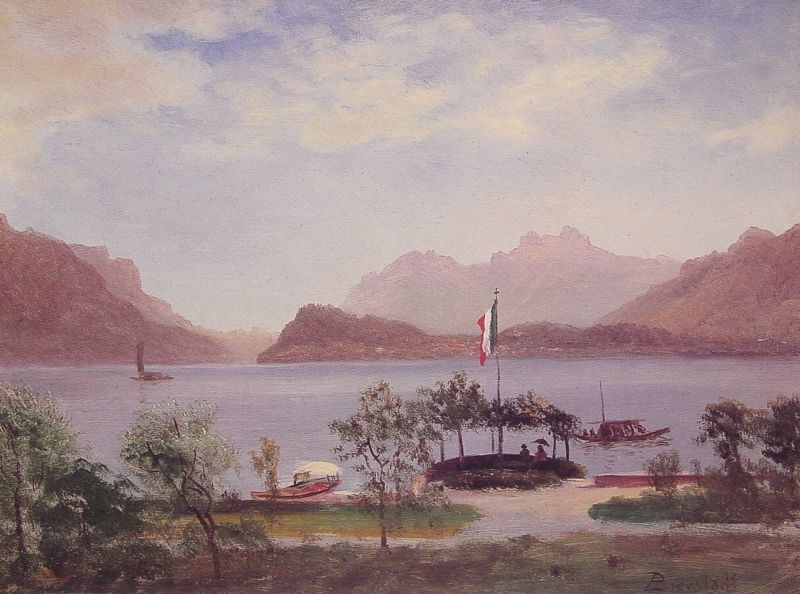
Collectors of nineteenth century American landscape painting have long treated Italian Lake Scene as evidence of how far Bierstadt could range beyond the Rockies, a quieter register of the same eye that made his western vistas famous. Historians of the Hudson River School point to it as proof that the grandeur associated with Bierstadt was never only about scale; it could settle into a single still lake and hold just as much attention.
What produces that response is visible on the canvas itself. The composition places calm water at the foreground, its surface returning a soft, near mirrored version of the hills and sky above, so that the eye moves between the real landscape and its reflection without quite settling on either. Bierstadt builds the scene through tonal transition rather than sharp contrast, letting golden, diffuse light spread across the middle distance and soften the edges of the hillsides as they recede toward a glowing horizon.
This kind of northern Italian light, warmer and more atmospheric than the clear air of the American west, gave Bierstadt a different set of problems to solve, and the painting reads as a study in that adjustment. Layered glazes of oil colour build the sky in gradual shifts rather than distinct bands, while the water is handled with a lighter, more fluid touch that lets the canvas texture show through where the reflection breaks. It belongs to a body of work in which Bierstadt, like many painters of his generation, travelled to Italy in search of the picturesque, carrying his American training into a European tradition of lakeside light.
ByMuseum recreates this painting as a hand-painted oil painting reproduction, worked in oil on canvas by a trained artist rather than produced as a print. The palette is matched layer by layer against the original, and the brushwork is left visible, so the same shimmer across the lake surface and the same gradated sky remain something you can see catch light differently as you move past it. A discerning eye will look for exactly that: raised texture where the paint has been built up, a woven canvas ground beneath the colour, and the small variations that mark a surface as painted rather than printed. Owning a version of a famous painting like this one means owning an object with that same physical presence, not a flat copy of it.
| artists |
|---|
Empty walls flatten a room. A classical artwork restores structure and visual hierarchy. One painting defines the space, anchors furniture, and establishes identity.
Worldwide shipping included. Each painting is produced to order and safely packed for international transport.
All payments are encrypted and processed through trusted payment providers.
Real brushwork, layered oil paint, and durable pigments on museum-quality canvas.
If the result does not meet expectations, return it for a full refund.


Your artwork is painted on premium cotton canvas, then shipped safely rolled in a rigid tube with extra blank canvas border — ready for stretching or framing locally.
Select a handcrafted frame and we’ll deliver your painting fully assembled, protected, and ready to hang.
For safe shipping, framing is available up to a maximum size. Larger sizes will automatically disable the frame option.


Choose “Stretched” to receive your canvas mounted on wooden stretcher bars — perfect if you’ll frame it later or display it as-is.
Gallery Wrap is a deeper, 1.5" style stretcher. The canvas wraps around the sides and is stapled on the back for a clean, modern, frameless look.
We ship with UPS, FedEx, or DHL straight to your door. You’ll receive a tracking number as soon as your order leaves our studio. Typical delivery is 4–5 business days after dispatch; large, framed, or stretched pieces may take longer depending on the safest shipping route.


Unframed canvases are protected with a film, carefully rolled, and secured inside a rigid shipping tube.

Stretched, Gallery Wrapped, and Framed paintings are wrapped, cushioned with foam protection, and boxed for safe transit.

A note from the studio
Our studio is working through an exceptional number of commissions, so we have paused new orders for a short time. We will start taking orders again on 1 October.
Every painting is made entirely by hand, and we would rather pause than rush one. Thank you for your patience and your trust.
Leave your details and we will reserve your place: we will write to you as soon as orders reopen.
Thank you
Your request is saved. We will write to you on 1 October, and a confirmation is on its way to your inbox.


