Loading cart…
No products in the cart.

Original price was: $599.00.$299.00Current price is: $299.00.
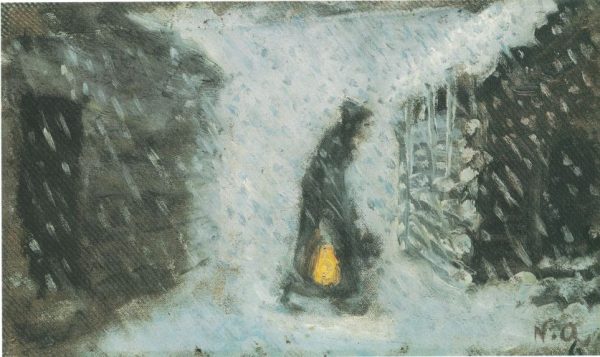
A hand-painted oil reproduction of Kjerringa med Lykta by Nikolai Astrup, capturing the lantern light and layered brushwork of this Post-Impressionist Norwegian scene.

Norwegian painting at the turn of the twentieth century broke away from the tonal naturalism that had dominated Scandinavian landscape work, and Nikolai Astrup stands among the painters who pushed it toward something more subjective and decorative. Kjerringa med Lykta belongs to this shift, a canvas built less on faithful description than on the emotional charge of a remembered place, rendered with the flattened forms and heightened colour that mark the Post-Impressionist sensibility as it reached the fjords and farmland of western Norway.
The picture centres on a solitary figure carrying a lantern through the dark, and Astrup organises the whole composition around that small point of light. Everything else, the surrounding forms and the deep tonal ground they sit against, is arranged to lead the eye toward the lamp and then let it settle there. The paint handling favours broad, decisive shapes over fine detail, with colour used to establish mood as much as to record what was seen. Warm light pushes against cool shadow in a way that gives the scene both intimacy and a slightly unsettled edge.
What holds the composition together is restraint. Astrup allows quieter passages of the canvas to remain calm and undeveloped, so the more active areas of brushwork carry greater weight by contrast. This balance between stillness and activity is characteristic of his mature work, painted during the period when he was returning repeatedly to the same motifs around his home at Jolster, refining them across multiple versions rather than treating any single canvas as final.
Each hand-painted oil painting reproduction from ByMuseum is built the same way the original was, in layered oil colour on canvas, applied by a trained painter who studies the palette, the brushwork, and the surface texture of the source image before starting work. Nothing here is printed or mechanically reproduced. The paint sits on the canvas with real body, the ridges and passages of impasto catching light exactly as they would on a traditionally worked panel, which matters to anyone who looks closely at condition and surface before deciding what belongs on a wall.
A century after it was painted, the lantern in this scene still draws the eye the way Astrup intended, and that staying power is part of what makes it a famous painting worth owning in painted form rather than as a flat print. For a collector who wants the object itself, not a facsimile of it, a reproduction painted stroke by stroke offers something closer to the original experience of standing in front of the work.
Empty walls flatten a room. A classical artwork restores structure and visual hierarchy. One painting defines the space, anchors furniture, and establishes identity.
Worldwide shipping included. Each painting is produced to order and safely packed for international transport.
All payments are encrypted and processed through trusted payment providers.
Real brushwork, layered oil paint, and durable pigments on museum-quality canvas.
If the result does not meet expectations, return it for a full refund.


Your artwork is painted on premium cotton canvas, then shipped safely rolled in a rigid tube with extra blank canvas border — ready for stretching or framing locally.
Select a handcrafted frame and we’ll deliver your painting fully assembled, protected, and ready to hang.
For safe shipping, framing is available up to a maximum size. Larger sizes will automatically disable the frame option.


Choose “Stretched” to receive your canvas mounted on wooden stretcher bars — perfect if you’ll frame it later or display it as-is.
Gallery Wrap is a deeper, 1.5" style stretcher. The canvas wraps around the sides and is stapled on the back for a clean, modern, frameless look.
We ship with UPS, FedEx, or DHL straight to your door. You’ll receive a tracking number as soon as your order leaves our studio. Typical delivery is 5 to 7 days after dispatch; large, framed, or stretched pieces may take longer depending on the safest shipping route.


Unframed canvases are protected with a film, carefully rolled, and secured inside a rigid shipping tube.

Stretched, Gallery Wrapped, and Framed paintings are wrapped, cushioned with foam protection, and boxed for safe transit.

Man Writing a Letter
Gabriel Metsu, c. 1664
The gallery list
Every painting is already 50% off. Join the list and we will send you an extra $15 code, plus first access to new collections.
No spam. Unsubscribe anytime. · Privacy Policy
Welcome
Your $15 code is on its way. Explore the gallery while you wait.