Loading cart…
No products in the cart.

Original price was: $599.00.$299.00Current price is: $299.00.
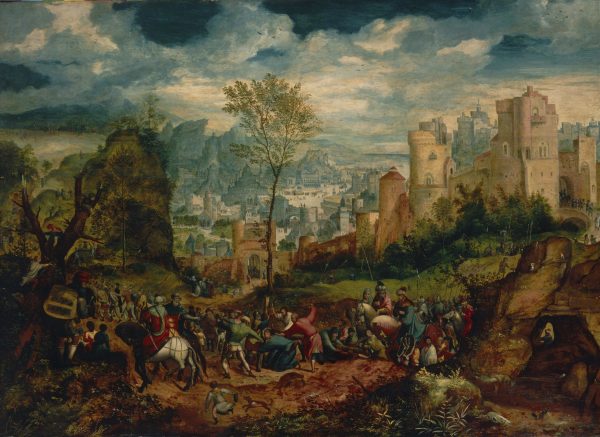
Henri Met de Bles sets the sorrowful banishment of Hagar within a sweeping Flemish landscape of cool greens and hazy blues, a composition worth owning as a hand-painted oil reproduction.
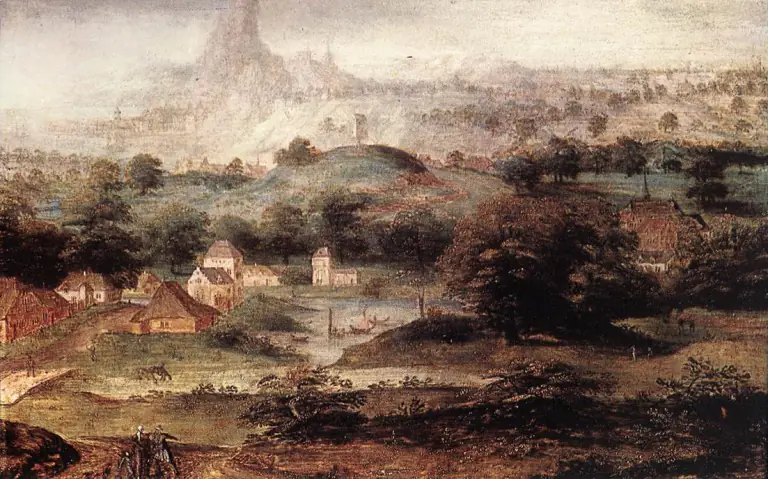
Look at how the greens sit against one another here, a cool sage in the foreground giving way to deeper olive, and then, further back, a blue so pale it almost dissolves into the sky. This is the palette that carries the whole composition: earthen browns and mossy greens close to the eye, softening through hazy blue-greys as the land recedes, until the horizon reads as little more than a whisper of colour. It is a scheme built on distance, and it does a great deal of quiet work before you even register the figures.
Set within this expanse, Hagar and her son appear almost incidental, a small human episode folded into a landscape that seems to stretch on regardless of their sorrow. This is the world-landscape tradition that Henri Met de Bles helped define within sixteenth-century Flemish painting, where towering rock formations, winding paths, and dense stands of trees are given as much weight as the biblical narrative they contain, sometimes more. The effect is not indifference so much as scale; the story matters, but so does everything around it.
Light moves through the scene in careful stages, catching the tops of trees and the ridges of rock while leaving valleys in shadow, a device that gives the terrain real depth and lets the eye travel from one passage of colour to the next. De Bles handled this transition with a controlled, layered technique typical of Flemish panel painting, building up thin glazes to achieve those graduated blues and greens without losing the crispness of individual leaves or stones. The banishment scene sits within this world as one moment among many, faithful to his broader practice of using landscape to frame, and sometimes dwarf, human events.
A hand-painted oil painting reproduction of this composition is built the same way, in oil on canvas rather than through print, with a trained painter working through the same colour transitions by hand and leaving the brushwork and surface texture visible under raking light. Nothing here is flattened onto a single plane; the layered blues and greens keep their depth, and the canvas itself takes on a slight tactile weave that a printed sheet cannot offer. It is as close as a fine art reproduction gets to standing in front of the original panel.
Four centuries on, the painting still holds attention because that colour logic still works, drawing you from a warm foreground into a cool, distant world in a single unbroken sweep. Owning a version of it painted by hand, rather than printed, means owning something made the way the original was made, brushstroke by brushstroke, and that continuity is worth having on your own wall.
Empty walls flatten a room. A classical artwork restores structure and visual hierarchy. One painting defines the space, anchors furniture, and establishes identity.
Worldwide shipping included. Each painting is produced to order and safely packed for international transport.
All payments are encrypted and processed through trusted payment providers.
Real brushwork, layered oil paint, and durable pigments on museum-quality canvas.
If the result does not meet expectations, return it for a full refund.


Your artwork is painted on premium cotton canvas, then shipped safely rolled in a rigid tube with extra blank canvas border — ready for stretching or framing locally.
Select a handcrafted frame and we’ll deliver your painting fully assembled, protected, and ready to hang.
For safe shipping, framing is available up to a maximum size. Larger sizes will automatically disable the frame option.


Choose “Stretched” to receive your canvas mounted on wooden stretcher bars — perfect if you’ll frame it later or display it as-is.
Gallery Wrap is a deeper, 1.5" style stretcher. The canvas wraps around the sides and is stapled on the back for a clean, modern, frameless look.
We ship with UPS, FedEx, or DHL straight to your door. You’ll receive a tracking number as soon as your order leaves our studio. Typical delivery is 5 to 7 days after dispatch; large, framed, or stretched pieces may take longer depending on the safest shipping route.


Unframed canvases are protected with a film, carefully rolled, and secured inside a rigid shipping tube.

Stretched, Gallery Wrapped, and Framed paintings are wrapped, cushioned with foam protection, and boxed for safe transit.

Man Writing a Letter
Gabriel Metsu, c. 1664
The gallery list
Every painting is already 50% off. Join the list and we will send you an extra $15 code, plus first access to new collections.
No spam. Unsubscribe anytime. · Privacy Policy
Welcome
Your $15 code is on its way. Explore the gallery while you wait.