Loading cart…
No products in the cart.

Original price was: $518.00.$259.00Current price is: $259.00.
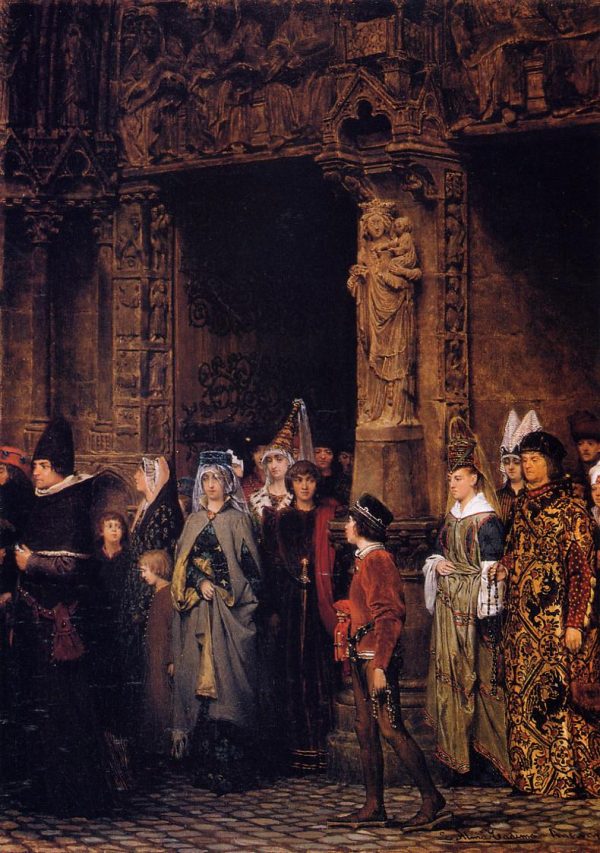
A muted procession of fifteenth century townspeople leaving a church, rendered by Alma-Tadema with the same observational rigor he gave to antiquity, now offered as a hand-painted oil reproduction.
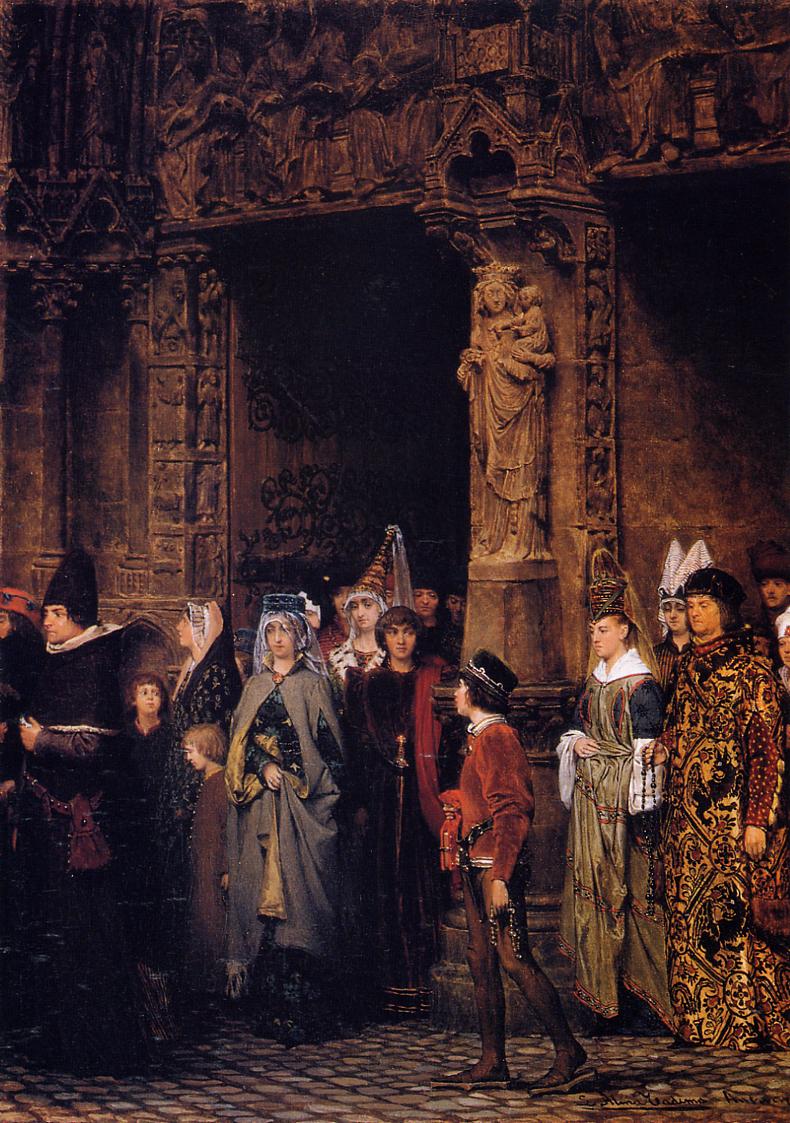
Grey stone, muted cloth, and a crowd caught mid-motion: the paint here is laid in close, restrained tones, with edges softened where figures overlap and sharpened where a collar or a hand catches the light. This handling of surface is what makes Leaving the Church in the Fifteenth Century recognisable at a glance, and it gives a room a piece with genuine visual density rather than mere decoration.
The composition follows a procession of townspeople as they file out of a church door, the architecture pressing in close on either side and the crowd spreading and thinning as it moves toward the viewer. Lawrence Alma-Tadema, better known for the marble and sunlight of his Roman and Greek scenes, turns here to a northern Gothic register: the light is flatter, the stonework rougher, the costumes heavier with wool and fur rather than draped linen. The shift in palette is deliberate. Where his classical paintings favour bright, saturated colour, this one works in ochres, dull reds, and greys, a register suited to a fifteenth century northern European interior and to the overcast quality of the moment being depicted.
What holds the scene together is the same rigor he brought to antiquity: a trained eye for how fabric folds, how stone weathers, and how a crowd organises itself in space without looking staged. Figures are individuated even within the density of the procession, each face and posture doing distinct work, and the layering of bodies front to back creates a believable depth to the churchyard. This period of his career shows him testing whether the observational method that made his Roman scenes convincing could carry equal weight in an unfamiliar historical setting, and the muted control of the paint suggests he thought it could.
Each ByMuseum reproduction of this composition is painted by hand in oil on canvas by a trained artist, working from the original to match its palette and preserve the texture of the brushwork rather than flattening it into a print. The result is a museum quality oil painting reproduction: a painted object with real surface and depth, not a printed facsimile of one.
It suits a study or a formal sitting room where the muted palette can hold its own without shouting, and it will reward anyone drawn to the quieter, more textured side of nineteenth century historical painting.
Empty walls flatten a room. A classical artwork restores structure and visual hierarchy. One painting defines the space, anchors furniture, and establishes identity.
Worldwide shipping included. Each painting is produced to order and safely packed for international transport.
All payments are encrypted and processed through trusted payment providers.
Real brushwork, layered oil paint, and durable pigments on museum-quality canvas.
If the result does not meet expectations, return it for a full refund.


Your artwork is painted on premium cotton canvas, then shipped safely rolled in a rigid tube with extra blank canvas border — ready for stretching or framing locally.
Select a handcrafted frame and we’ll deliver your painting fully assembled, protected, and ready to hang.
For safe shipping, framing is available up to a maximum size. Larger sizes will automatically disable the frame option.


Choose “Stretched” to receive your canvas mounted on wooden stretcher bars — perfect if you’ll frame it later or display it as-is.
Gallery Wrap is a deeper, 1.5" style stretcher. The canvas wraps around the sides and is stapled on the back for a clean, modern, frameless look.
We ship with UPS, FedEx, or DHL straight to your door. You’ll receive a tracking number as soon as your order leaves our studio. Typical delivery is 5 to 7 days after dispatch; large, framed, or stretched pieces may take longer depending on the safest shipping route.


Unframed canvases are protected with a film, carefully rolled, and secured inside a rigid shipping tube.

Stretched, Gallery Wrapped, and Framed paintings are wrapped, cushioned with foam protection, and boxed for safe transit.
Academicism
Lawrence Alma-Tadema