Loading cart…
No products in the cart.

Original price was: $599.00.$299.00Current price is: $299.00.
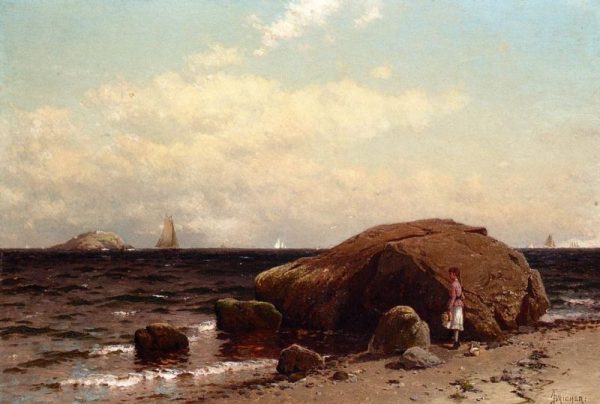
Looking out to Sea b by Alfred Thompson Bricher, hand-painted in oil on canvas with the layered light and quiet horizon that reward slow, repeated viewing.
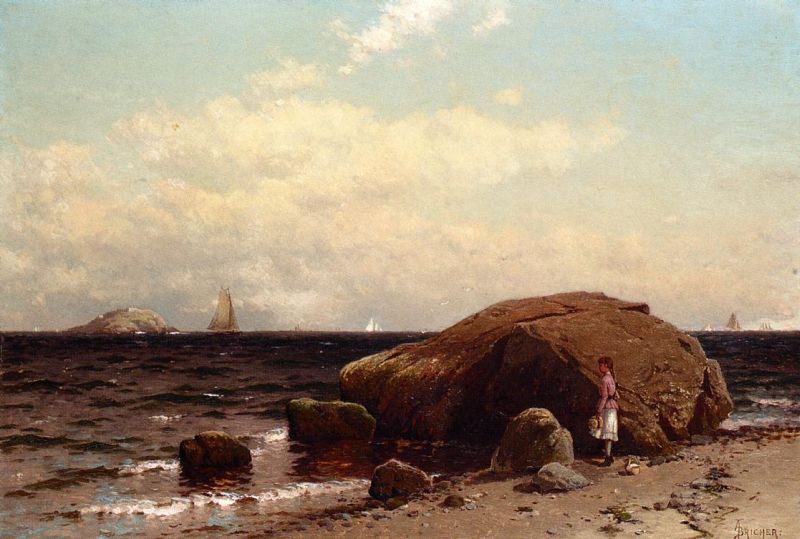
Collectors of American marine painting have long returned to Looking out to Sea b for the quiet authority of its horizon and the restraint with which Alfred Thompson Bricher handles light on water. It is a picture that rewards patience rather than a quick glance, which is part of why it has held a place in the affections of Hudson River School enthusiasts long after the movement itself passed out of fashion.
The painting turns on a simple, almost austere structure: a low horizon, a wide reach of sky, and a foreground built from a few carefully weighted shapes. Bricher, working in the tradition of Luminism that grew alongside the Hudson River School, was less interested in dramatic incident than in the slow accumulation of light across a surface. The sea here is rendered in thin, controlled layers, the sky given more atmosphere than event, so that the eye settles into the scene gradually instead of being pulled toward a single focal point.
That restraint is precisely what a discerning eye should look for when judging the quality of a reproduction. The transitions between water, sky, and shoreline in the original depend on subtle shifts of tone rather than bold contrast, and those shifts are the hardest passages for any copyist to get right. A trained painter working on an oil on canvas reproduction has to build the same layered glazes and let the brush slow down in the same places Bricher did, matching not just the palette but the pacing of the paint across the canvas. This is why ByMuseum treats the work as an oil painting reproduction in the fullest sense: painted by hand, stroke by stroke, on artist-grade canvas, rather than produced as a flat print that would flatten exactly the tonal nuance the composition depends on.
Live with a hand-painted version of Looking out to Sea b for a while and the picture keeps offering small revisions to first impressions. A passage of sky that read as uniform at a distance resolves, on closer inspection, into faint gradations of grey and pale gold; a shoreline shape that seemed incidental turns out to anchor the whole composition. Surface texture under changing daylight brings out ridges of impasto that a screen or a printed page cannot register, which is part of the pleasure of owning an actual painted object rather than a reproduction of one.
Empty walls flatten a room. A classical artwork restores structure and visual hierarchy. One painting defines the space, anchors furniture, and establishes identity.
Worldwide shipping included. Each painting is produced to order and safely packed for international transport.
All payments are encrypted and processed through trusted payment providers.
Real brushwork, layered oil paint, and durable pigments on museum-quality canvas.
If the result does not meet expectations, return it for a full refund.


Your artwork is painted on premium cotton canvas, then shipped safely rolled in a rigid tube with extra blank canvas border — ready for stretching or framing locally.
Select a handcrafted frame and we’ll deliver your painting fully assembled, protected, and ready to hang.
For safe shipping, framing is available up to a maximum size. Larger sizes will automatically disable the frame option.


Choose “Stretched” to receive your canvas mounted on wooden stretcher bars — perfect if you’ll frame it later or display it as-is.
Gallery Wrap is a deeper, 1.5" style stretcher. The canvas wraps around the sides and is stapled on the back for a clean, modern, frameless look.
We ship with UPS, FedEx, or DHL straight to your door. You’ll receive a tracking number as soon as your order leaves our studio. Typical delivery is 5 to 7 days after dispatch; large, framed, or stretched pieces may take longer depending on the safest shipping route.


Unframed canvases are protected with a film, carefully rolled, and secured inside a rigid shipping tube.

Stretched, Gallery Wrapped, and Framed paintings are wrapped, cushioned with foam protection, and boxed for safe transit.