Loading cart…
No products in the cart.

Original price was: $518.00.$259.00Current price is: $259.00.
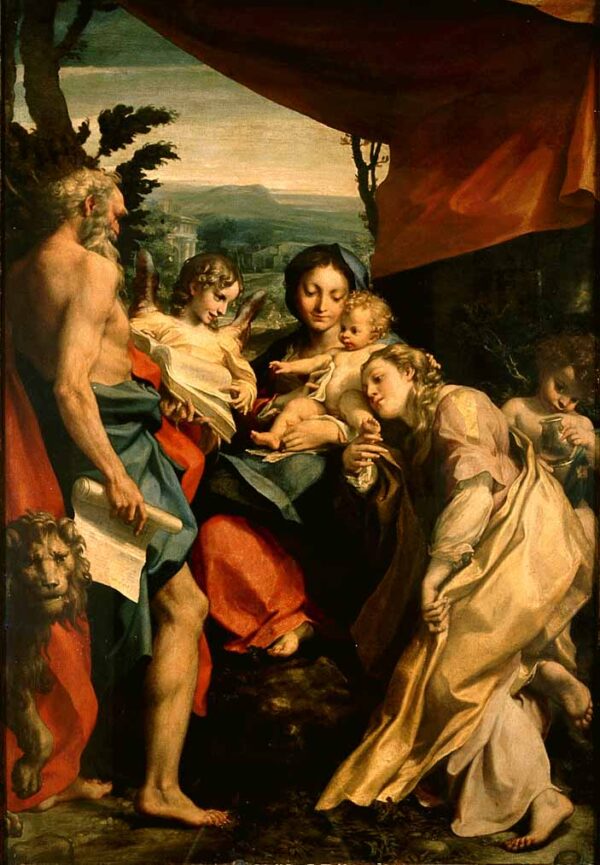
Bring the warmth of Madonna with St Jerome by Correggio home as a hand-painted oil reproduction, faithful to its soft light and famous palette.

Light gathers softly around the Virgin and Child at the center of this panel, while a kneeling figure, worn and penitent, leans toward the holy pair from one side. The eye moves from the tender gesture at the center outward to the surrounding figures, drawn by warm flesh tones that catch the light and by shadows that recede without ever going flat or dead. Nothing about the scene is rigid; the grouping feels close and human, more a quiet exchange between figures than a formal arrangement.
This painting belongs to the mature phase of the career of Correggio, a period when he was refining the soft transitions of light and shade that would become his signature. The Madonna, tilted gently toward St Jerome, anchors a composition built on diagonals and curved gestures rather than straight lines. Faces and hands are modeled with a delicacy that owes much to his study of sfumato, colour bleeding from warm to cool with almost no visible edge. The result is a mood of intimacy rather than solemn distance, unusual for religious painting of this era.
Colour carries much of the emotional weight here. Correggio favours warm ochres and rose tones in the flesh, set against deeper, cooler passages in the drapery and the surrounding dark. This balance of warmth and shadow gives the painting its gentle, almost breathing quality, and it places the work firmly among the famous paintings of the Italian Renaissance, admired for its handling of light long after it was made. A hand-painted oil painting reproduction of this work is built to hold that same balance: an artist trained in traditional technique lays down the underpainting, works the transitions between light and shadow by hand, and finishes with the same warm palette Correggio used, layer by layer in real oil on canvas rather than printed ink.
What matters most in a reproduction like this is fidelity: the exact gradation from lit flesh to shadowed drapery, the soft edges that never harden into outline, the particular warmth of the palette. A print flattens these qualities into a single even surface. A painted canvas keeps the texture of individual brushstrokes and the slight variation in paint thickness that gives Correggio his sense of atmosphere, so the version on your wall carries the same visual logic as the original, not just its outline.
Empty walls flatten a room. A classical artwork restores structure and visual hierarchy. One painting defines the space, anchors furniture, and establishes identity.
Worldwide shipping included. Each painting is produced to order and safely packed for international transport.
All payments are encrypted and processed through trusted payment providers.
Real brushwork, layered oil paint, and durable pigments on museum-quality canvas.
If the result does not meet expectations, return it for a full refund.


Your artwork is painted on premium cotton canvas, then shipped safely rolled in a rigid tube with extra blank canvas border — ready for stretching or framing locally.
Select a handcrafted frame and we’ll deliver your painting fully assembled, protected, and ready to hang.
For safe shipping, framing is available up to a maximum size. Larger sizes will automatically disable the frame option.


Choose “Stretched” to receive your canvas mounted on wooden stretcher bars — perfect if you’ll frame it later or display it as-is.
Gallery Wrap is a deeper, 1.5" style stretcher. The canvas wraps around the sides and is stapled on the back for a clean, modern, frameless look.
We ship with UPS, FedEx, or DHL straight to your door. You’ll receive a tracking number as soon as your order leaves our studio. Typical delivery is 5 to 7 days after dispatch; large, framed, or stretched pieces may take longer depending on the safest shipping route.


Unframed canvases are protected with a film, carefully rolled, and secured inside a rigid shipping tube.

Stretched, Gallery Wrapped, and Framed paintings are wrapped, cushioned with foam protection, and boxed for safe transit.