Loading cart…
No products in the cart.

Original price was: $518.00.$259.00Current price is: $259.00.
Mandan Scalping an Enemy by George Catlin, brought to life as a museum quality hand-painted oil reproduction with the texture and depth of a real painted canvas.
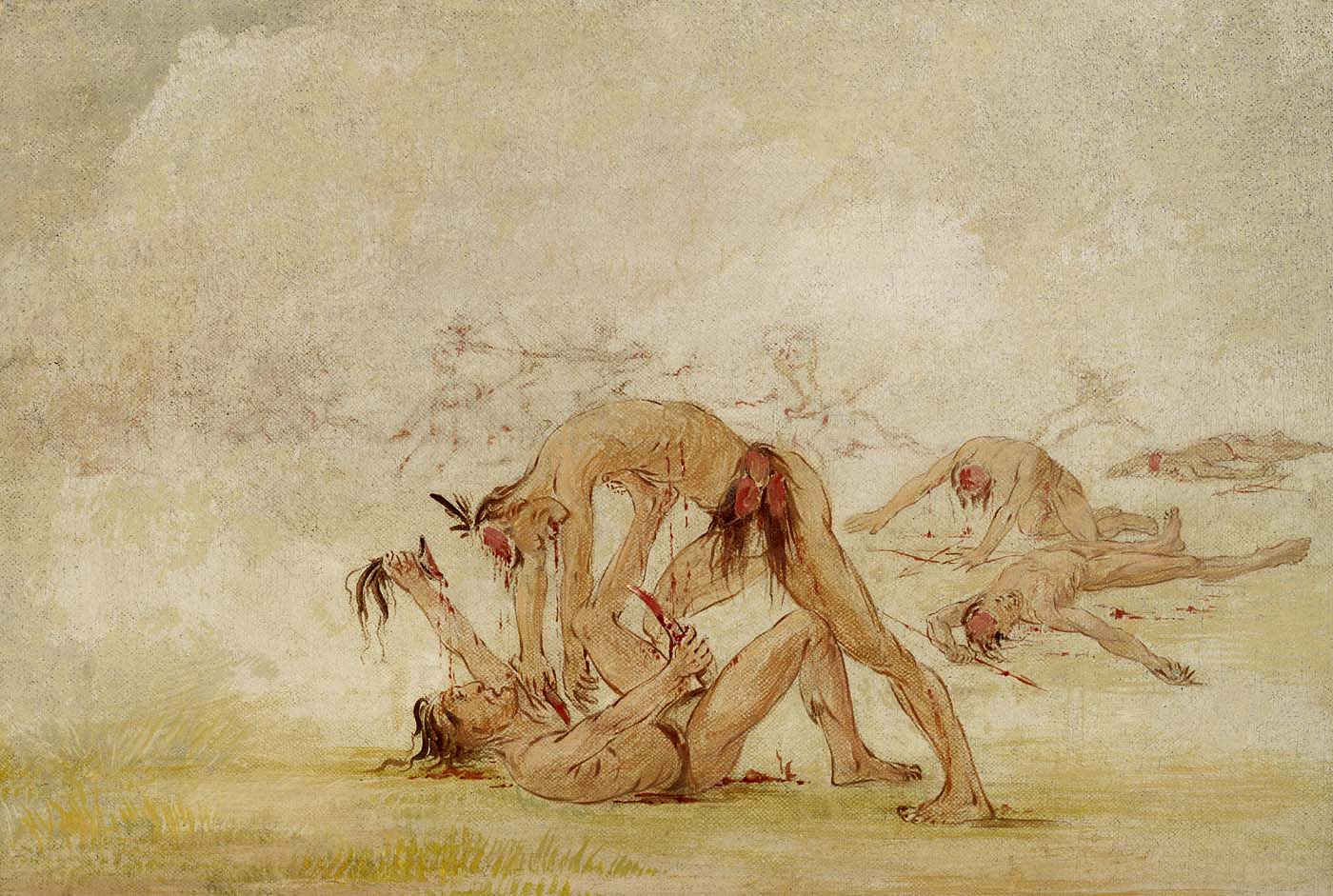
Stand close and this canvas asks you to work, not because it is large in the manner of a history painting, but because its proportions keep the eye moving between a tight, charged foreground and the loose atmosphere behind it. The scale is intimate rather than monumental, which means it rewards a spot where you can approach it, rather than a wall meant to be seen from across a room. That closeness matters, because the subject itself is built from small, decisive marks that only resolve at short range.
The scene depicts a moment of violent encounter on the plains, rendered with the ethnographic attentiveness that defined the years Catlin spent among the Mandan and other Missouri River peoples in the early 1830s. Rather than dramatizing the act for its own sake, the composition places the two figures within a loosely brushed setting that suggests open ground and shifting light, so the confrontation reads as documentary witness as much as narrative event. Catlin worked quickly in the field, and that urgency survives in the handling here: economical strokes describe muscle and motion, while the background is left comparatively soft, pushing the eye back to the central struggle.
Colour is kept deliberately narrow, built from earth tones and muted flesh tints that root the image in the specific light of the northern plains rather than in studio invention. This restraint was part of how Catlin worked throughout his years documenting Native American life, favouring accuracy of gesture and dress over painterly flourish, and the result has the immediacy of a sketch made on the spot even where the final surface has been carried further. A hand-painted oil painting reproduction of this work is built the same way, by a trained painter working in real pigment on canvas, matching the palette stroke by stroke rather than reproducing it mechanically, so the raised texture of the paint and the small variations in each brushstroke survive into the finished piece. The aim is a museum quality reproduction you could hang beside the original and mistake for a sibling rather than a copy.
Live with it for a while and it keeps giving something back: a passage of underpainting showing through at the edge of a figure, a change in the pressure of the brush where the ground meets the sky, details that a printed image would flatten into uniformity but that oil on canvas holds indefinitely. What you receive:
Empty walls flatten a room. A classical artwork restores structure and visual hierarchy. One painting defines the space, anchors furniture, and establishes identity.
Worldwide shipping included. Each painting is produced to order and safely packed for international transport.
All payments are encrypted and processed through trusted payment providers.
Real brushwork, layered oil paint, and durable pigments on museum-quality canvas.
If the result does not meet expectations, return it for a full refund.


Your artwork is painted on premium cotton canvas, then shipped safely rolled in a rigid tube with extra blank canvas border — ready for stretching or framing locally.
Select a handcrafted frame and we’ll deliver your painting fully assembled, protected, and ready to hang.
For safe shipping, framing is available up to a maximum size. Larger sizes will automatically disable the frame option.


Choose “Stretched” to receive your canvas mounted on wooden stretcher bars — perfect if you’ll frame it later or display it as-is.
Gallery Wrap is a deeper, 1.5" style stretcher. The canvas wraps around the sides and is stapled on the back for a clean, modern, frameless look.
We ship with UPS, FedEx, or DHL straight to your door. You’ll receive a tracking number as soon as your order leaves our studio. Typical delivery is 4–5 business days after dispatch; large, framed, or stretched pieces may take longer depending on the safest shipping route.


Unframed canvases are protected with a film, carefully rolled, and secured inside a rigid shipping tube.

Stretched, Gallery Wrapped, and Framed paintings are wrapped, cushioned with foam protection, and boxed for safe transit.