Loading cart…
No products in the cart.

Original price was: $599.00.$299.00Current price is: $299.00.
A composed allegory by Pompeo Batoni, Mercury Crowning Philosophy, Mother of the Arts pairs sculptural figures with a refined eighteenth-century palette, ideal for collectors who value surface and idea alike.

Mercury descends into the composition on a diagonal of pale light, his winged sandals catching a cool silver gleam as he lowers a laurel crown toward the seated figure of Philosophy. She occupies the visual centre with a calm, upright gravity, draped in rich fabric that falls in sculpted folds, while around her the personified arts gather in a loose arc, their attributes and gestures forming a kind of visual sentence that the eye reads from left to right. The light favours her face and raised hand, leaving the outer figures in softer half tones, so that the whole arrangement reads as a hierarchy of reason presiding over creative labour rather than a crowded tableau.
This clarity of staging was a hallmark of Pompeo Batoni, one of the most sought-after painters working in Rome during the middle decades of the eighteenth century. Though best remembered today for his portraits of Grand Tour travellers, he pursued grander allegorical subjects such as this one to demonstrate a command of multi-figure invention that portraiture alone could not showcase. Here Mercury, messenger of the gods, bestows honour on Philosophy as mother of the arts, a subject drawn from Greco-Roman iconography and arranged with the compositional logic that Enlightenment patrons prized in learned painting.
The colour handling rewards close looking: cool blues and silvery greys around Mercury give way to warmer ochres and deep reds in the drapery of Philosophy and her companions, a deliberate modulation that guides attention through the group without resorting to sharp contrast. Batoni models flesh and fabric with a sculptural fullness, building form through layered glazes rather than hard outline, and it is this modelling, more than any single figure, that gives the picture its sense of settled authority.
Reproducing this allegory as an oil painting reproduction means attending closely to that layered colour and to the sculptural weight of the figures, qualities that a flat print cannot register. A trained painter works in oil on artist-grade canvas, matching the cool and warm passages of the original palette and building the surface in the same deliberate layers Batoni used, so the raised texture of drapery and the soft transitions of flesh remain visible under raking light, the mark of a museum quality reproduction rather than a mechanical copy.
Empty walls flatten a room. A classical artwork restores structure and visual hierarchy. One painting defines the space, anchors furniture, and establishes identity.
Worldwide shipping included. Each painting is produced to order and safely packed for international transport.
All payments are encrypted and processed through trusted payment providers.
Real brushwork, layered oil paint, and durable pigments on museum-quality canvas.
If the result does not meet expectations, return it for a full refund.


Your artwork is painted on premium cotton canvas, then shipped safely rolled in a rigid tube with extra blank canvas border — ready for stretching or framing locally.
Select a handcrafted frame and we’ll deliver your painting fully assembled, protected, and ready to hang.
For safe shipping, framing is available up to a maximum size. Larger sizes will automatically disable the frame option.


Choose “Stretched” to receive your canvas mounted on wooden stretcher bars — perfect if you’ll frame it later or display it as-is.
Gallery Wrap is a deeper, 1.5" style stretcher. The canvas wraps around the sides and is stapled on the back for a clean, modern, frameless look.
We ship with UPS, FedEx, or DHL straight to your door. You’ll receive a tracking number as soon as your order leaves our studio. Typical delivery is 5 to 7 days after dispatch; large, framed, or stretched pieces may take longer depending on the safest shipping route.


Unframed canvases are protected with a film, carefully rolled, and secured inside a rigid shipping tube.

Stretched, Gallery Wrapped, and Framed paintings are wrapped, cushioned with foam protection, and boxed for safe transit.
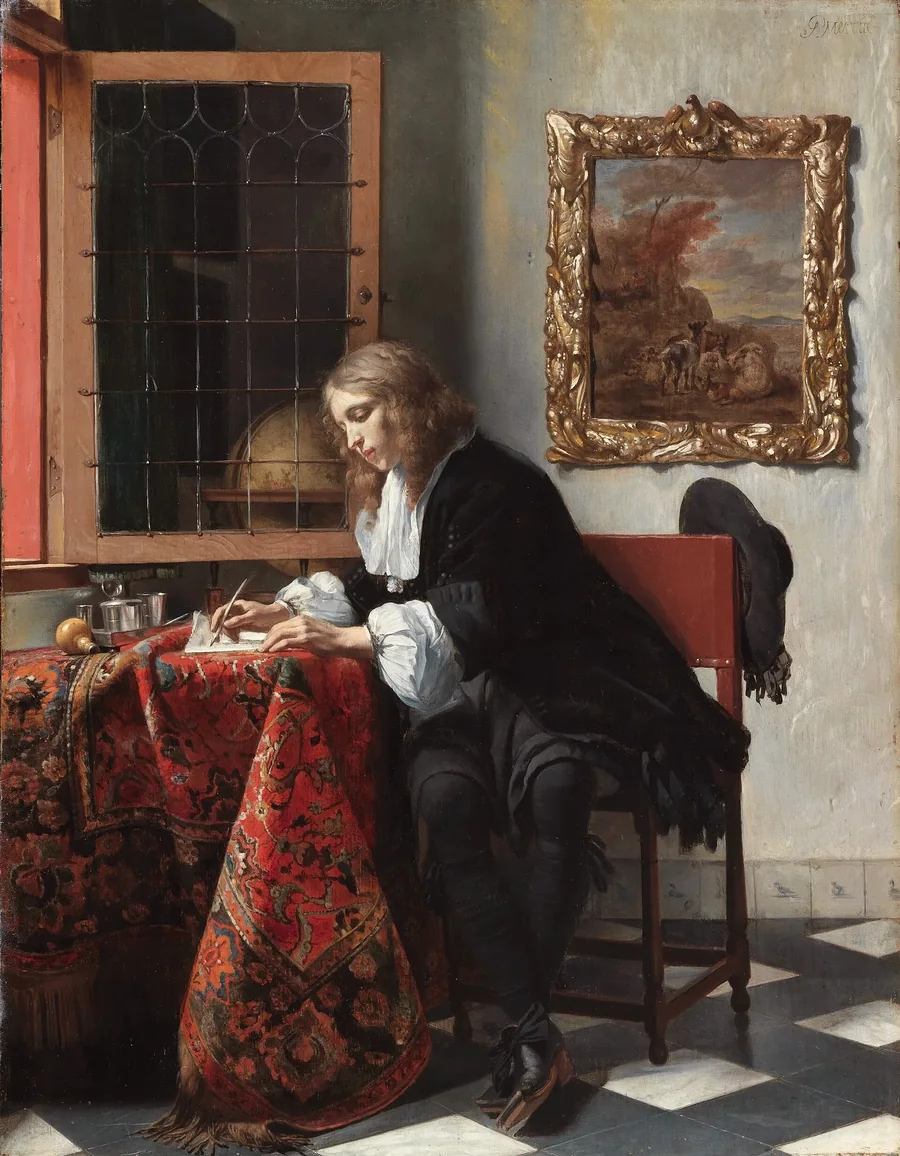
Man Writing a Letter
Gabriel Metsu, c. 1664
The gallery list
Every painting is already 50% off. Join the list and we will send you an extra $15 code, plus first access to new collections.
No spam. Unsubscribe anytime. · Privacy Policy
Welcome
Your $15 code is on its way. Explore the gallery while you wait.