Loading cart…
No products in the cart.

Original price was: $518.00.$259.00Current price is: $259.00.
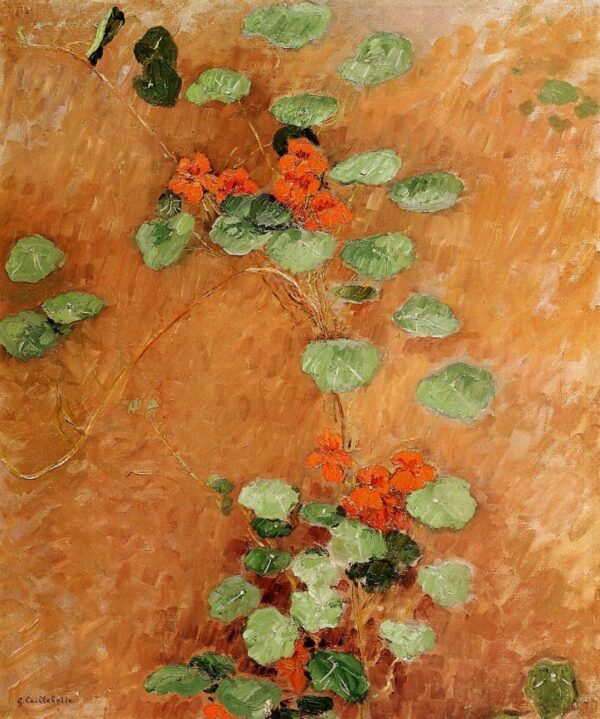
Nasturtiums by Gustave Caillebotte, reimagined as a hand-painted oil reproduction with the layered greens and dense brushwork of his later garden paintings.
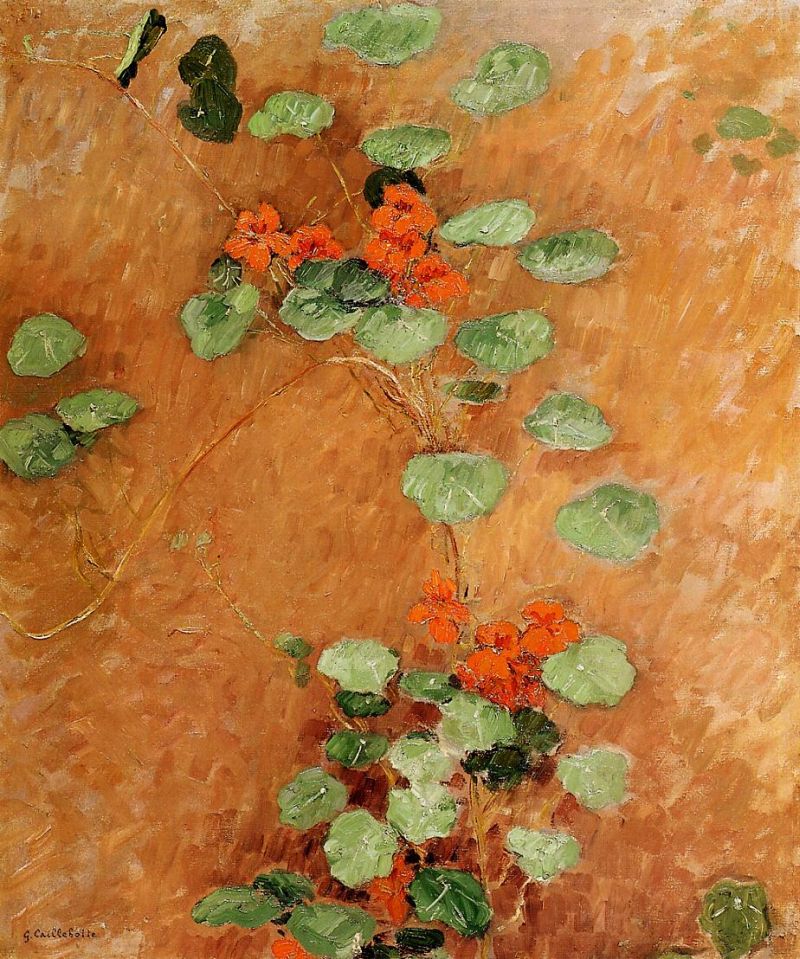
By the early 1890s Caillebotte had largely withdrawn from the Parisian exhibition circuit, devoting his attention instead to the garden he had cultivated at his property in Petit Gennevilliers along the Seine. Nasturtiums belongs to this later period, when the painter, already established through his early urban scenes, turned his eye toward the cultivated plots and greenhouse beds that had become his private preoccupation, working as both horticulturist and painter of what he grew.
The canvas holds close to its subject, letting the trailing vines and rounded leaves of the nasturtium fill the frame with a density that borders on abstraction. Rather than composing a tidy botanical study, Caillebotte lets the foliage sprawl and overlap, tracking how sunlight catches the upper leaves while the lower growth recedes into cooler shadow. The brushwork shifts register across the surface: broader, looser strokes describe the mass of greenery, while small flecks of orange and yellow mark the flowers themselves, giving the eye a place to rest amid the tangle.
What distinguishes the painting is its refusal of a conventional focal point. Caillebotte, trained in the rigours of academic drawing before he absorbed the loosened technique of his Impressionist circle, applies that structural discipline to an ostensibly casual subject, so the composition holds together even as it resists a single reading. Colour does the work of organising space here, with cool greens pushed back and warmer notes brought forward, a device that rewards a viewer willing to look past the first impression of a garden corner.
Each ByMuseum reproduction of this painting is worked by hand in oil on artist-grade canvas, with a trained painter matching the original palette stroke by stroke rather than reducing the image to a flat print. The result functions as a hand-painted oil painting reproduction in the fullest sense: raised ridges of pigment where the leaves catch light, the texture of the canvas weave still visible beneath thinner passages, and the kind of surface variation that only comes from a brush moving across cloth. Buyers who prefer a replica painting with genuine material presence, rather than a mechanically produced copy, will find that the layered greens and warm accents hold their depth under changing light, offering something new to notice in the tangle of foliage each time the eye returns to it.
Empty walls flatten a room. A classical artwork restores structure and visual hierarchy. One painting defines the space, anchors furniture, and establishes identity.
Worldwide shipping included. Each painting is produced to order and safely packed for international transport.
All payments are encrypted and processed through trusted payment providers.
Real brushwork, layered oil paint, and durable pigments on museum-quality canvas.
If the result does not meet expectations, return it for a full refund.


Your artwork is painted on premium cotton canvas, then shipped safely rolled in a rigid tube with extra blank canvas border — ready for stretching or framing locally.
Select a handcrafted frame and we’ll deliver your painting fully assembled, protected, and ready to hang.
For safe shipping, framing is available up to a maximum size. Larger sizes will automatically disable the frame option.


Choose “Stretched” to receive your canvas mounted on wooden stretcher bars — perfect if you’ll frame it later or display it as-is.
Gallery Wrap is a deeper, 1.5" style stretcher. The canvas wraps around the sides and is stapled on the back for a clean, modern, frameless look.
We ship with UPS, FedEx, or DHL straight to your door. You’ll receive a tracking number as soon as your order leaves our studio. Typical delivery is 4–5 business days after dispatch; large, framed, or stretched pieces may take longer depending on the safest shipping route.


Unframed canvases are protected with a film, carefully rolled, and secured inside a rigid shipping tube.

Stretched, Gallery Wrapped, and Framed paintings are wrapped, cushioned with foam protection, and boxed for safe transit.