Loading cart…
No products in the cart.

Original price was: $599.00.$299.00Current price is: $299.00.
A hand-painted oil reproduction of No way ke sug gah, He Who Strikes Two at Once, a Brave by George Catlin, painted with the visible brushwork and layered colour of the original.
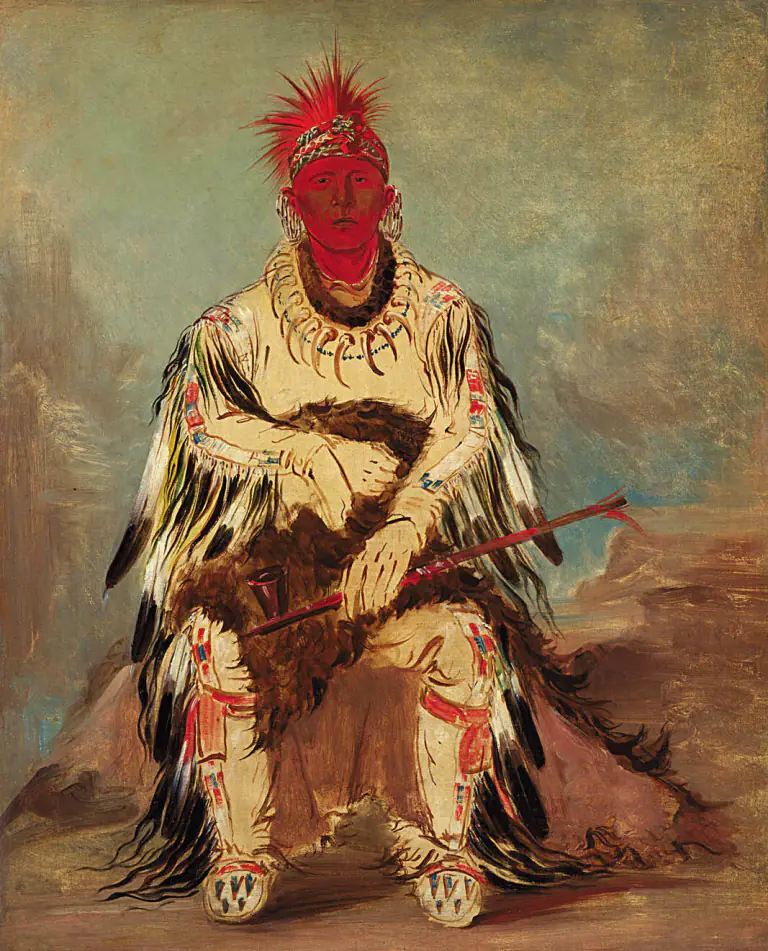
Stand close and this portrait asks for a certain kind of attention: a single figure set against a plain ground, the proportions calibrated so the eye settles on the face and the marks of status before it wanders anywhere else. The scale is intimate rather than heroic, closer to a study than a grand tableau, and that closeness is the point. It puts you within conversational distance of the sitter rather than at the far end of a hall.
The subject is a named Native American brave, painted by George Catlin during his extended documentation of Plains and Woodland peoples in the 1830s, a project that took him west with sketchbook and easel to record leaders and warriors he met in person. Here the arrangement is spare: the figure occupies most of the canvas, his bearing upright, his ornament and dress rendered with the descriptive care of a man who understood that these details were the record, not decoration added after the fact. Light falls evenly across the face and shoulders, favouring clarity over drama, and colour is handled in firm, readable passages rather than atmospheric blending.
What holds the composition together is Catlin working the same restraint through every part of it, letting repeated shapes and careful intervals of positive and negative space carry the picture rather than incident or gesture. The plain background is not empty so much as deliberate, a quiet field that lets the figure read as a document as much as a portrait, faithful to how Catlin saw his task: to set down likenesses that might otherwise have been lost.
ByMuseum recreates this as a hand-painted oil painting reproduction, worked by a trained artist directly onto canvas rather than printed or scanned. The palette is matched passage by passage, the brushwork left visible where Catlin built form with firm, economical strokes, and the surface carries the texture of oil laid on cloth rather than the flatness of ink. What arrives is a painted object with weight and grain, not a facsimile of one.
Nearly two centuries on, this remains a famous painting precisely because it refuses to fade into ethnography or curiosity; the directness of the gaze and the specificity of the ornament keep it present. Owning a painted version means keeping that presence on your own wall, made by hand rather than machine.
Empty walls flatten a room. A classical artwork restores structure and visual hierarchy. One painting defines the space, anchors furniture, and establishes identity.
Worldwide shipping included. Each painting is produced to order and safely packed for international transport.
All payments are encrypted and processed through trusted payment providers.
Real brushwork, layered oil paint, and durable pigments on museum-quality canvas.
If the result does not meet expectations, return it for a full refund.


Your artwork is painted on premium cotton canvas, then shipped safely rolled in a rigid tube with extra blank canvas border — ready for stretching or framing locally.
Select a handcrafted frame and we’ll deliver your painting fully assembled, protected, and ready to hang.
For safe shipping, framing is available up to a maximum size. Larger sizes will automatically disable the frame option.


Choose “Stretched” to receive your canvas mounted on wooden stretcher bars — perfect if you’ll frame it later or display it as-is.
Gallery Wrap is a deeper, 1.5" style stretcher. The canvas wraps around the sides and is stapled on the back for a clean, modern, frameless look.
We ship with UPS, FedEx, or DHL straight to your door. You’ll receive a tracking number as soon as your order leaves our studio. Typical delivery is 5 to 7 days after dispatch; large, framed, or stretched pieces may take longer depending on the safest shipping route.


Unframed canvases are protected with a film, carefully rolled, and secured inside a rigid shipping tube.

Stretched, Gallery Wrapped, and Framed paintings are wrapped, cushioned with foam protection, and boxed for safe transit.

Man Writing a Letter
Gabriel Metsu, c. 1664
The gallery list
Every painting is already 50% off. Join the list and we will send you an extra $15 code, plus first access to new collections.
No spam. Unsubscribe anytime. · Privacy Policy
Welcome
Your $15 code is on its way. Explore the gallery while you wait.