Loading cart…
No products in the cart.

Original price was: $599.00.$299.00Current price is: $299.00.
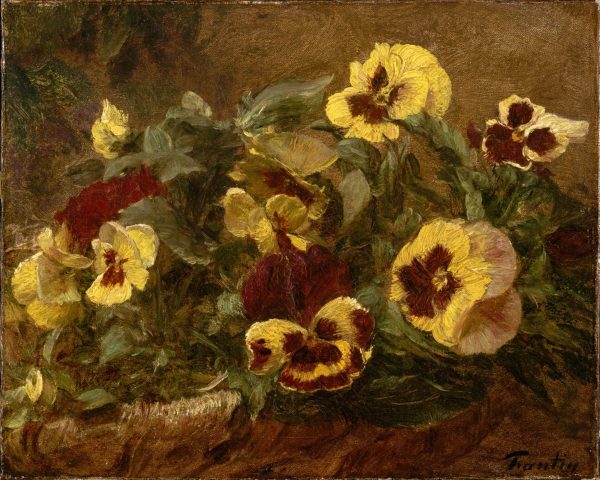
Pansies by Henri Fantin-Latour. Pansies with dark centers fill a dense patch of leaves. Hand-painted in oil on canvas.
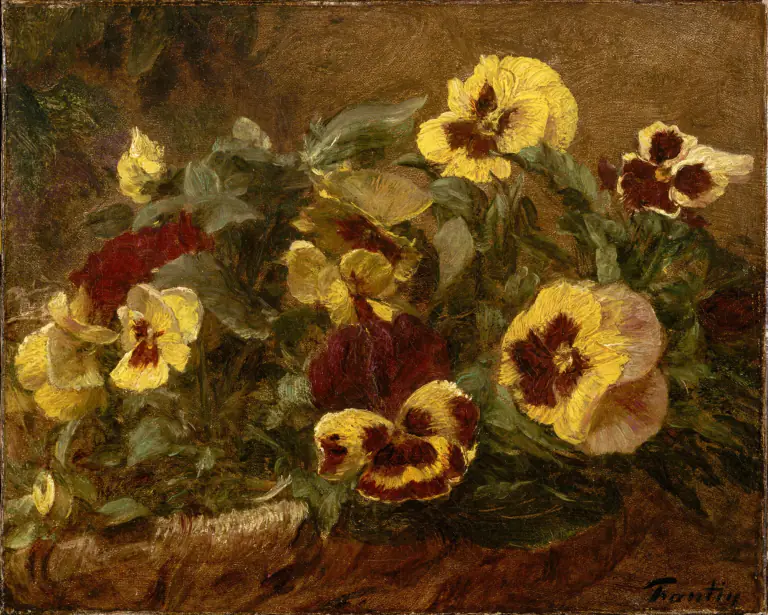
Several pansies grow in a dense patch, their rounded petals marked with dark centers and yellow, purple, and white areas. Leaves and stems fill the ground beneath the blooms. The close composition crops out most of the setting, focusing attention on the faces of the flowers and overlapping forms.
Light catches the upper petals, while shadow gathers beneath the leaves. The flowers vary in size and angle, creating a natural cluster rather than an even row. Soil and greenery form a dark base. The palette is rich but subdued, with small bright marks on the petals.
The repeated flower heads create a rhythm across the patch. Their dark centers guide attention, while contrasting colors keep each bloom distinct. Dense leaves fill the gaps and provide texture. The close view turns a simple garden subject into a study of pattern, color, and soft natural light. Petal edges overlap in layers, with yellow centers and deep violet markings drawing attention inward. Leaves curl around the flower heads, and dark soil shows through gaps. The shallow view makes the pansies feel close enough to inspect individually. Yellow and purple centers distinguish the separate blossoms. The flowers overlap closely, with lighter petals catching sun above the darker leafy ground. Dark centers mark the overlapping pansy petals, while glossy leaves fill the gaps between blossoms. Dark centers mark the overlapping pansy petals, while glossy leaves fill the gaps between blossoms.
ByMuseum offers Pansies by Henri Fantin-Latour as a hand-painted oil reproduction on canvas. A square or close placement suits the flower study.
Empty walls flatten a room. A classical artwork restores structure and visual hierarchy. One painting defines the space, anchors furniture, and establishes identity.
Worldwide shipping included. Each painting is produced to order and safely packed for international transport.
All payments are encrypted and processed through trusted payment providers.
Real brushwork, layered oil paint, and durable pigments on museum-quality canvas.
If the result does not meet expectations, return it for a full refund.


Your artwork is painted on premium cotton canvas, then shipped safely rolled in a rigid tube with extra blank canvas border — ready for stretching or framing locally.
Select a handcrafted frame and we’ll deliver your painting fully assembled, protected, and ready to hang.
For safe shipping, framing is available up to a maximum size. Larger sizes will automatically disable the frame option.


Choose “Stretched” to receive your canvas mounted on wooden stretcher bars — perfect if you’ll frame it later or display it as-is.
Gallery Wrap is a deeper, 1.5" style stretcher. The canvas wraps around the sides and is stapled on the back for a clean, modern, frameless look.
We ship with UPS, FedEx, or DHL straight to your door. You’ll receive a tracking number as soon as your order leaves our studio. Typical delivery is 5 to 7 days after dispatch; large, framed, or stretched pieces may take longer depending on the safest shipping route.


Unframed canvases are protected with a film, carefully rolled, and secured inside a rigid shipping tube.

Stretched, Gallery Wrapped, and Framed paintings are wrapped, cushioned with foam protection, and boxed for safe transit.

Man Writing a Letter
Gabriel Metsu, c. 1664
The gallery list
Every painting is already 50% off. Join the list and we will send you an extra $15 code, plus first access to new collections.
No spam. Unsubscribe anytime. · Privacy Policy
Welcome
Your $15 code is on its way. Explore the gallery while you wait.