Loading cart…
No products in the cart.

Original price was: $599.00.$299.00Current price is: $299.00.
Restrained browns and grays hold the quiet authority of this Bassano portrait, a famous painting rendered here as a hand-painted oil on canvas true to its original stillness.

Brown, umber, and a deep, almost black-green settle against the pale gray of the friar habit, and it is this quiet friction of tones that gives the picture its gravity. The dark wool of the robe absorbs the light rather than returning it, while the collar and the visible skin of the face catch what little brightness the composition allows, so the eye is pulled steadily inward from a shadowed field toward a single point of human presence.
The painting depicts a robed religious figure whose habit and demeanor announce his vocation before any detail of the face is read. Bassano frames the sitter tightly, allowing the background to fall away into near darkness so that nothing competes with the stillness of the expression. Light moves across the forehead and cheekbones in narrow, controlled passages, modeling the structure of the face with a precision that owes as much to observation as to devotion. The habit itself, for all its plainness, is worked with real attentiveness: folds are built through layered shadow rather than outline, and the muted cloth carries a range of warm and cool grays that keep the surface from ever going flat.
This restraint places the work at an interesting point in the career of the artist, a moment when the elaborate narrative machinery of his larger religious and pastoral canvases gives way to something plainer and more searching. Among the smaller portraits attributed to this period, the friar picture has earned recognition as a famous painting precisely because it shows a different register of the same hand, one willing to trade colour and incident for concentration on a single, quietly held gaze.
Recreating this balance by hand is the task each ByMuseum oil painting reproduction is set. A trained painter works in oil on canvas, mixing the same family of umbers, browns, and cool grays and building them up in the same layered manner, so that the habit reads with the correct weight and the face keeps its restrained modeling rather than flattening into a copy of tone alone. What is carried across is not simply the image but the relationship between the darks and the lights, the pacing of the brush through the folds of cloth, and the particular stillness that depends on getting that relationship right. Surface texture and visible brushwork remain part of the object, because a reproduction of this subject only succeeds if it is felt as a painting rather than read as a picture.
Empty walls flatten a room. A classical artwork restores structure and visual hierarchy. One painting defines the space, anchors furniture, and establishes identity.
Worldwide shipping included. Each painting is produced to order and safely packed for international transport.
All payments are encrypted and processed through trusted payment providers.
Real brushwork, layered oil paint, and durable pigments on museum-quality canvas.
If the result does not meet expectations, return it for a full refund.


Your artwork is painted on premium cotton canvas, then shipped safely rolled in a rigid tube with extra blank canvas border — ready for stretching or framing locally.
Select a handcrafted frame and we’ll deliver your painting fully assembled, protected, and ready to hang.
For safe shipping, framing is available up to a maximum size. Larger sizes will automatically disable the frame option.


Choose “Stretched” to receive your canvas mounted on wooden stretcher bars — perfect if you’ll frame it later or display it as-is.
Gallery Wrap is a deeper, 1.5" style stretcher. The canvas wraps around the sides and is stapled on the back for a clean, modern, frameless look.
We ship with UPS, FedEx, or DHL straight to your door. You’ll receive a tracking number as soon as your order leaves our studio. Typical delivery is 5 to 7 days after dispatch; large, framed, or stretched pieces may take longer depending on the safest shipping route.


Unframed canvases are protected with a film, carefully rolled, and secured inside a rigid shipping tube.

Stretched, Gallery Wrapped, and Framed paintings are wrapped, cushioned with foam protection, and boxed for safe transit.
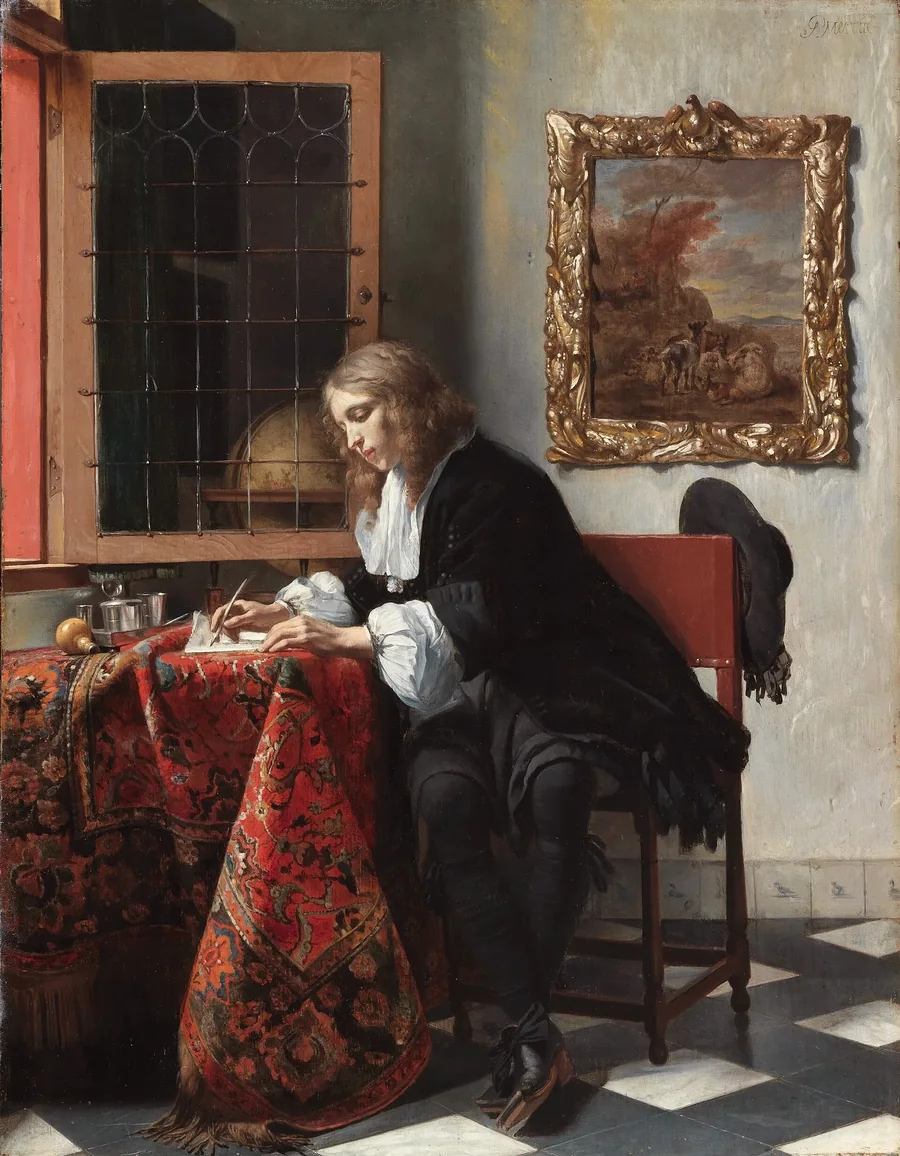
Man Writing a Letter
Gabriel Metsu, c. 1664
The gallery list
Every painting is already 50% off. Join the list and we will send you an extra $15 code, plus first access to new collections.
No spam. Unsubscribe anytime. · Privacy Policy
Welcome
Your $15 code is on its way. Explore the gallery while you wait.